Oscillation - NEET Physics Questions
← All Chapters

Oscillation

Question 1: easy

If the maximum velocity and acceleration of a particle executing SHM are equal in magnitude, the time period will be

1. 1.57 sec.
2. 3.14 sec.
3. 6.28 sec.
4. 12.56 sec.
View Answer

In simple harmonic motion (SHM), the maximum velocity \( v_{\text{max}} \) and maximum acceleration \( a_{\text{max}} \) are given by:

\[
v_{\text{max}} = \omega A \quad \text{and} \quad a_{\text{max}} = \omega^2 A
\]

where:
- \( \omega \) is the angular frequency,
- \( A \) is the amplitude.

 Solution:

1. Given that \( v_{\text{max}} = a_{\text{max}} \), we have:
\[
\omega A = \omega^2 A
\]

2. Dividing both sides by \( A \) (assuming \( A \neq 0 \)):
\[
\omega = \omega^2
\]

3. Solving for \( \omega \):
\[
\omega = 1 \, \text{rad/s}
\]

4. Time Period \( T \):
\[
T = \frac{2\pi}{\omega} = \frac{2\pi}{1} = 2\pi \approx 6.28 \, \text{s}
\]

Answer:
The time period of the particle is **6.28 seconds**.
Question 2: easy

The equation of SHM of a particle is given as 2d²x/dt² + 32x = 0, where x is the displacement from the mean position. then time period of its oscillation (in seconds) is

1. 4
2. π/2
3. π/2√2
4.
View Answer

Given the SHM equation:

\[
2 \frac{d^2x}{dt^2} + 32x = 0
\]

We can rewrite it as:

\[
\frac{d^2x}{dt^2} + 16x = 0
\]

This equation is of the form:

\[
\frac{d^2x}{dt^2} + \omega^2 x = 0
\]

where \( \omega^2 = 16 \).

Solution:

1. Angular Frequency \( \omega \):
\[
\omega = \sqrt{16} = 4 \, \text{rad/s}
\]

2. Time Period \( T \):
\[
T = \frac{2\pi}{\omega} = \frac{2\pi}{4} = \frac{\pi}{2} \, \text{s}
\]

 Answer:
The time period of the oscillation is \( \frac{\pi}{2} \) seconds.

Question 3: easy

Two simple harmonic motions of angular frequency 10rad/sec and 100 rad s–¹ have the same displacement amplitude. The ratio of their maximum acceleration is

1. 1 : 10³
2. \[ 1:10^{4}\]
3. 1 : 10
4. 1 : 10²
View Answer

Solution:

1. Maximum Acceleration in SHM is given by:
\[
a_{\text{max}} = \omega^2 A
\]

2. Ratio of Maximum Accelerations:
\[
\frac{a_{\text{max}_2}}{a_{\text{max}_1}} = \frac{\omega_2^2 A}{\omega_1^2 A} = \frac{\omega_2^2}{\omega_1^2} = \frac{(100)^2}{(10)^2} = \frac{10000}{100} = 100
\]

Answer:
The ratio of their maximum accelerations is \( 1 : 100 \) or \( 1 : 10^2 \).

Question 4: easy

A particle executing SHM has amplitude 0.01 m and frequency 60 Hz. The maximum acceleration of the particle is

1. 60π² m/s²
2. 88π² m/s²
3. 150π² m/s²
4. 144π² m/s²
View Answer

Given:
- Amplitude, \( A = 0.01 \, \text{m} \)
- Frequency, \( f = 60 \, \text{Hz} \)

Solution:

1. Angular Frequency \( \omega \):
\[
\omega = 2 \pi f = 2 \pi \times 60 = 120 \pi \, \text{rad/s}
\]

2. Maximum Acceleration \( a_{\text{max}} \):
Maximum acceleration in SHM is given by:
\[
a_{\text{max}} = \omega^2 A
\]

Substitute values of \( \omega \) and \( A \):
\[
a_{\text{max}} = (120 \pi)^2 \times 0.01 = 14400 \pi^2 \times 0.01 = 144 \pi^2 \, \text{m/s}^2
\]

Answer:
The maximum acceleration of the particle is \( 144 \pi^2 \, \text{m/s}^2 \).

Question 5: easy

Average velocity of a particle performing SHM in one time period is:

1. Zero
2. Aω/2
3. Aω/2π
4. 2Aω/π
View Answer

As displacement in one time interval is zero. Average velocity is zero.

Question 6: easy

The equation of SHM of a particle is a + 4π²x = 0 where a is instantaneous linear acceleration at displacement x. The frequency of motion is :

1. 1 Hz
2. 4π Hz
3. 1/4 Hz
4. 4 Hz
View Answer
Question 7: easy

The equation of motion of a particle of mass 1 gm is d²x/dt² + π²x = 0 where x is displacement (in m) from mean position. The frequency of oscillation is (in Hz) :

1. 1/2
2. 2
3. 5√10
4. 1/5√10
View Answer

a =- ω²x

comparing 

ω² = π² ⇒ ω =π ⇒ 2πυ= π ⇒ υ = 1/2 Hz

Question 8: easy

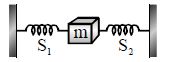
In figure S1 and S2 are identical springs. The oscillation frequency of the mass m is f. If one spring is removed, the frequency will become :

1. f
2. 2f
3. f√2
4. f/√2
View Answer

Given that \( S_1 \) and \( S_2 \) are identical springs, they each have the same spring constant \( k \). When both springs are attached, they are in parallel, so the effective spring constant \( k_{\text{eq}} \) is:

\[
k_{\text{eq}} = k + k = 2k
\]

The frequency \( f \) of oscillation for mass \( m \) with effective spring constant \( k_{\text{eq}} = 2k \) is:

\[
f = \frac{1}{2\pi} \sqrt{\frac{2k}{m}}
\]

If One Spring is Removed

If one spring is removed, only one spring with constant \( k \) is left. The new frequency \( f' \) becomes:

\[
f' = \frac{1}{2\pi} \sqrt{\frac{k}{m}}
\]

Ratio of New Frequency to Original Frequency

\[
\frac{f'}{f} = \frac{\frac{1}{2\pi} \sqrt{\frac{k}{m}}}{\frac{1}{2\pi} \sqrt{\frac{2k}{m}}} = \frac{\sqrt{\frac{k}{m}}}{\sqrt{\frac{2k}{m}}} = \frac{1}{\sqrt{2}}
\]

Thus:

\[
f' = \frac{f}{\sqrt{2}}
\]

Answer: \( f' = \frac{f}{\sqrt{2}} \)

Question 9: easy

What should be the displacement of a simple pendulum whose amplitude is A, at which potential energy is 1/4 th of the total energy ?

1. A/√2
2. A/2
3. A/4
4. A/2√2
View Answer

\[ \frac{1}{2} k x^{2}=\frac{1}{4}\left( \frac{1}{2}kA^{2} \right) \]

\[ \frac{1}{2}k x^{2}=\frac{1}{4}\left(kA^{2} \right)  x= \frac{A}{2} \]