The velocities of a body executing SHM are v 1 and v 2 when the displacements are x1 and x2 respectively. The period is :
\[ v= \omega \sqrt{A^{2}-x^{2}} \]
The velocities of a body executing SHM are v 1 and v 2 when the displacements are x1 and x2 respectively. The period is :
\[ v= \omega \sqrt{A^{2}-x^{2}} \]
The x-t graph of a particle undergoing simple harmonic motion is shown below. The acceleration of the particle at t = 4/3 s is :

\[ x= A sin\left( \omega t \right) \]
x= (1cm) sin (2π/8t)= (1 cm ) sin ( π/4t)
v=dx/dt= π/4 cos( π/4t)
a= dv/dt = -(π/4)²sin (π/4t)
a= -(π/4)²sin (π/4×4/3)= -√3/32π² cm/s²
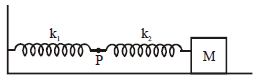
The mass M shown in the figure oscillates in simple harmonic motion with amplitude A. The amplitude of the point P is :

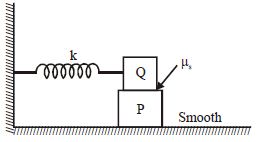
A block P of mass m is placed on a frictionless horizontal surface. Another block Q of same mass is kept on P and connected to the wall with the help of a spring of spring constant k as shown in the figure. μs is the coefficient of friction between P and Q. The blocks move together performing simple harmonic motion with amplitude A. The
maximum value of the friction force between P and Q is :

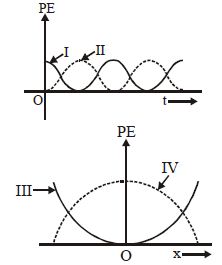
For a particle executing simple harmonic motion, the displacement x is given by x = A cosωt. Identify the graph which represents the variation of potential energy (PE) as function of time t and displacement x

\[ P.E = \frac{1}{2}Kx^{2} = \frac{1}{2}KA^{2}cos^{2}\left( \omega t \right) \]
Graph I represents graph of cos²ωt.
\[ P.E = \frac{1}{2}Kx^{2} \]
Graph III represents a parabolic function
Two simple pendulums of length 1 m and 16m respectively are both given small displacement in the same direction at the same instant. They will be again in phase after the shorter pendulum has completed n oscillations. The value of n is :
\[ T = 2\pi\sqrt{\frac{l}{g}} \]
\[ T_{1}= 2\pi\sqrt{\frac{1}{g}}= 2 sec \]
\[ T_{2}= 2\pi\sqrt{\frac{16}{g}}= 8 sec \]
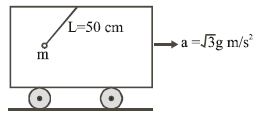
A simple pendulum 50 cm long is suspended from the roof of a cart accelerating in the horizontal direction with constant acceleration √3g m / s² .The period of small oscillations of the pendulum about its equilibrium position is (g = π² m/s²):

\[ T = 2\pi\sqrt{\frac{l}{\sqrt{a^{2}+g^{2}}}} \]
\[ T = 2\pi\sqrt{\frac{0.5}{\sqrt{\left( \sqrt{3}g \right)^{2}+g^{2}}}} \]
\[ T = 2\pi\sqrt{\frac{0.5}{2g}} \]
\[ T = 2\pi\frac{1}{2\sqrt{g}} = 2\pi\frac{1}{2\pi}= 1 sec \]
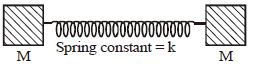
What is the angular frequency of the system shown in the figure?

The system shown consists of two masses \( M \) connected by a spring with a spring constant \( k \). Since the masses are identical, the angular frequency \( \omega \) of the system for oscillations is given by:
\[
\omega = \sqrt{\frac{k}{\text{reduced mass}}}
\]
In this case, the reduced mass \( \mu \) of the system is given by:
\[
\mu = \frac{M \cdot M}{M + M} = \frac{M}{2}
\]
Thus, the angular frequency \( \omega \) is:
\[
\omega = \sqrt{\frac{k}{M/2}} = \sqrt{\frac{2k}{M}}
\]
Answer:
\[
\omega = \sqrt{\frac{2k}{M}}
\]