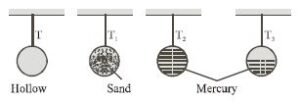
The period of a simple pendulum, whose bob is a hollow metallic sphere, is T. The period is T1 when the bob is filled with sand, T2 when it is filled with mercury and T3 when it is half filled with mercury. Which of the following is true:
1. T = T1 = T2 > T3
2. T = T1 = T3 > T
3. T > T3 > T1 = T2
4. T = T1 = T2 < T3
View Answer
In Hollow Sphere (T) , Solid Spheres ( T1 and T2) Center of mass lie at center. Where as in Half filled sphere center of mass lie below center(T3).
As length of pendulum will increase in T3. Time period is highest for it.
Two simple pendulums of length 1 m and 16m respectively are both given small displacement in the same direction at the same instant. They will be again in phase after the shorter pendulum has completed n oscillations. The value of n is :
1. 1/3
2. 2/3
3. 1
4. 4/3
View Answer
\[ T = 2\pi\sqrt{\frac{l}{g}} \]
\[ T_{1}= 2\pi\sqrt{\frac{1}{g}}= 2 sec \]
\[ T_{2}= 2\pi\sqrt{\frac{16}{g}}= 8 sec \]
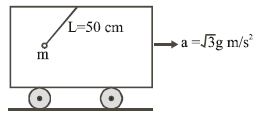
A simple pendulum 50 cm long is suspended from the roof of a cart accelerating in the horizontal direction with constant acceleration √3g m / s² .The period of small oscillations of the pendulum about its equilibrium position is (g = π² m/s²):
1. 1.0 sec
2. 1.25 sec
3. 1.53 sec
4. 1.68 sec
View Answer
\[ T = 2\pi\sqrt{\frac{l}{\sqrt{a^{2}+g^{2}}}} \]
\[ T = 2\pi\sqrt{\frac{0.5}{\sqrt{\left( \sqrt{3}g \right)^{2}+g^{2}}}} \]
\[ T = 2\pi\sqrt{\frac{0.5}{2g}} \]
\[ T = 2\pi\frac{1}{2\sqrt{g}} = 2\pi\frac{1}{2\pi}= 1 sec \]
Two pendulums have time periods T and \(\frac{5T}{4}\). They start SHM at the same time from the mean position. What will be the phase difference between them, when the smaller pendulum has completed one oscillation?
1. \(60^\circ\)
2. \(72^\circ\)
3. \(90^\circ\)
4. \(120^\circ\)
View Answer
For the smaller pendulum, time elapsed for one oscillation is \(t = T\), so its phase is \(2\pi\). The phase of the second pendulum is \(\phi_2 = \frac{2\pi}{5T/4}T = \frac{8\pi}{5}\). The phase difference is \(2\pi - \frac{8\pi}{5} = \frac{2\pi}{5} = 72^\circ\).
Assertion (A): For large angle in simple pendulum \(T > 2\pi \sqrt{\frac{l}{g}}\)
Reason (R): \(sin \theta < \theta\), if the restoring force. \(mg sin \theta\) is replaced by \(mg \theta\), this amounts to effective reduction in g for large angle, hence an increase in T.
1. Both (A) & (R) are true and the (R) is the correct explanation of the (A)
2. Both (A) & (R) are true but the (R) is not the correct explanation of the (A)
3. (A) is true but (R) is false
4. Both (A) and (R) are false
View Answer
Assertion (A) is true: The period of a simple pendulum increases for large amplitudes compared to the small angle approximation. Reason (R) is true: For large angles, \(sin \theta < \theta\). This makes the actual restoring force smaller than the linear approximation, effectively reducing the 'g' and thereby increasing the period \(T\). (R) correctly explains (A).
Assertion (A): For a physical pendulum period of oscillation is maximum about an axis passes through centre of mass.
Reason (R): A physical pendulum is in neutral equilibrium about centre of mass.
1. Both (A) & (R) are true and the (R) is the correct explanation of the (A)
2. Both (A) & (R) are true but the (R) is not the correct explanation of the (A)
3. (A) is true but (R) is false
4. Both (A) and (R) are false
View Answer
Assertion (A) is false. If a physical pendulum is pivoted at its center of mass, it will be in neutral equilibrium and will not oscillate, so there is no period. Reason (R) is true. A body pivoted at its center of mass is indeed in neutral equilibrium. Thus, (A) is false and (R) is true.
Assertion (A): Two particles are in SHM with same time period, same amplitude, same position and same speed are in the same phase.
Reason (R): Phase of particle depends on position and speed of particle.
1. Both (A) & (R) are true and the (R) is the correct explanation of the (A)
2. Both (A) & (R) are true but the (R) is not the correct explanation of the (A)
3. (A) is true but (R) is false
4. Both (A) and (R) are false
View Answer
The position of a particle in SHM is given by \(x = A cos(omega t + phi)\) and velocity by \(v = -Aomega sin(omega t + phi)\). Given same amplitude \(A\), time period \(T\) (thus \(omega\)), position \(x\), and speed \(v\), the phase \(phi\) must be the same. Thus, A and R are true and R is the correct explanation of A.
Assertion (A): Time period of partially immersed spring block system is less than full immersed spring block system.
Reason (R): Time period of spring system is independent of changing values of g.
1. Both (A) & (R) are true and the (R) is the correct explanation of the (A)
2. Both (A) & (R) are true but the (R) is not the correct explanation of the (A)
3. (A) is true but (R) is false
4. Both (A) and (R) are false
View Answer
For a partially immersed block, the effective spring constant is \(k_{eff} = k + \rho_l A g\), leading to \(T_p = 2\pi \sqrt{m/(k + \rho_l A g)}\). For a fully immersed block, \(k_{eff} = k\), so \(T_f = 2\pi \sqrt{m/k}\). Since \(k + \rho_l A g > k\), \(T_p < T_f\). So A is true. The time period of a simple spring-mass system \(T = 2\pi \sqrt{m/k}\) is independent of \(g\). So R is true. However, R does not explain A because the change in period is due to effective spring constant, not general independence from \(g\).
Assertion (A): In forced oscillations, the steady state motion of the particle (after natural oscillations die out) is SHM whose frequency is the frequency of the driving frequency \(\omega_d\), not the natural frequency \(\omega\) of the particle.
Reason (R): In forced oscillation \(\omega_d\) should be greater than natural frequency \(\omega\) of the particle.
1. Both (A) & (R) are true and the (R) is the correct explanation of the (A)
2. Both (A) & (R) are true but the (R) is not the correct explanation of the (A)
3. (A) is true but (R) is false
4. Both (A) and (R) are false
View Answer
In forced oscillations, the system eventually settles into oscillating at the frequency of the driving force, \(\omega_d\). So Assertion (A) is true. The driving frequency \(\omega_d\) can be any value (less than, equal to, or greater than) compared to the natural frequency \(\omega\). So Reason (R) is false.
Assertion (A): For a physical pendulum if distance of point of suspension from centre of mass increases time period first decreases then increases.
Reason (R): For a physical pendulum there is some distance from centre of mass at which frequency of oscillation is maximum.
1. Both (A) & (R) are true and the (R) is the correct explanation of the (A)
2. Both (A) & (R) are true but the (R) is not the correct explanation of the (A)
3. (A) is true but (R) is false
4. Both (A) and (R) are false
View Answer
The time period of a physical pendulum is \(T = 2pi sqrt{(I_{CM} + mL^2)/(mgL)}\). Analyzing this function, \(T\) has a minimum value at \(L = sqrt{I_{CM}/m}\). This minimum time period corresponds to a maximum frequency. Thus, as \(L\) increases, \(T\) first decreases to a minimum and then increases. Both Assertion (A) and Reason (R) are true, and R correctly explains A.