Photoelectric Effects and deBroglie Equation - NEET Physics Questions
← Back to Modern Physics

Photoelectric Effects and deBroglie Equation

Question 21: moderate

If the momentum of an electron is changed by P, then de-Broglie wavelength associated with it
changes by 0.2%. The initial momentum of electron will be about :
1. P/200
2. 100 P
3. 500 P
4. 400 P
View Answer
Question 22: moderate

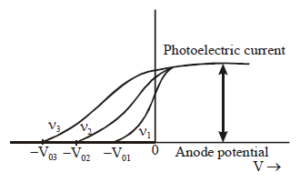
In photoelectric effect, the curve between photoelectric current and anode potential V (for
different frequencies) is shown in figure, then :

1. \[\nu_{1}>\nu_{2}>\nu_{3}\]
2. \[\nu_{1}<\nu_{2}<\nu_{3}\]
3. \[\nu_{1}=\nu_{2}=\nu_{3}\]
4. \[\nu_{1}>\nu_{2}<\nu_{3}\]
View Answer
Question 23: easy

When the energy of the incident radiation is increased by 20%, the kinetic energy of the
photoelectrons emitted from a metal surface increased from 0.5eV to 0.8eV. The work
function of the metal is :

1. 0.65 eV
2. 1.0 eV
3. 1.3 eV
4. 1.5 eV
View Answer
Question 24: easy

The de Broglie wavelength of an electron moving with a velocity

\[1.5\times 10^{8}m/s\] is equal to that of a photon. The ratio of the kinetic energy of the electron to the energy of the photon is :

1. 1/4
2. 1/2
3. 2
4. 4/1
View Answer
Question 25: easy

A 200 W sodium street lamp emits yellow light of wavelength 0.6Ξm. Assuming it to be 25%
efficent converting electrical energy to light, the number of photons of yellow light it emits per
second is :

1. \62\times 10^{20}\]
2. \3\times 10^{19}\]
3. \1.5\times 10^{20}\]
4. \6\times 10^{18}\]
View Answer
Question 26: easy

The ratio of wavelength of deutron and proton accelerated through the same potential difference will be :

1. 1/√2
2. \[\sqrt{\frac{2}{1}}\]
3. 1/2
4. 2/1
View Answer
Question 27: moderate

If the kinetic energy of the particle is increased to 16 times its previous value, the percentage
change in the de-Broglie wavelength of the particle is :

1. 25
2. 75
3. 60
4. 50
View Answer
Question 28: easy

The maximum kinetic energy of the emitted photoelectrons in photoelectric effects is independent of:

1. Frequency of incident radiation
2. Wavelength of incident radiation
3. Work function of material
4. Intensity of incident radiation
View Answer

According to Einstein's photoelectric equation, \(K_{\text{max}} = h\nu - \phi\). The maximum kinetic energy depends on the frequency/wavelength of the incident light and the work function, but is independent of the intensity of the light.

Question 29: easy

The de Broglie wavelength associated with an electron, accelerated by a potential difference of 81 V is given by:

1. 1.36 nm
2. 0.136 nm
3. 13.6 nm
4. 136 nm
View Answer

The de Broglie wavelength for an electron accelerated through a potential \(V\) is given by \(\lambda = \frac{1.227}{\sqrt{V}}\text{ nm}\). Substituting \(V = 81\text{ V}\), we get \(\lambda = \frac{1.227}{9}\text{ nm} \approx 0.136\text{ nm}\).

Question 30: easy

The number of photons per second on an average emitted by the source of monochromatic light of wavelength \(600\text{ nm}\), when it delivers the power of \(3.3 \times 10^{-3}\text{ watt}\) will be (\(h = 6.6 \times 10^{-34}\text{ J s}\))

1. \(10^{15}\)
2. \(10^{18}\)
3. \(10^{17}\)
4. \(10^{16}\)
View Answer

Power \(P = n \frac{hc}{\lambda}\), where \(n\) is the number of photons emitted per second. Substituting the given values, we get \(n = \frac{3.3 \times 10^{-3} \times 600 \times 10^{-9}}{6.6 \times 10^{-34} \times 3 \times 10^8} = 10^{16}\text{ s}^{-1}\).