Modern Physics - NEET Physics Questions
← All Chapters

Modern Physics

Question 1: difficult

All electron ejected from a surface by incident of wavelength 200 nm can be stopped before
travelling 1 meter in the direction of a uniform electric field of 4 NC–¹ the work function of the
surface is :
1. 4eV
2. 5.2eV
3. 2eV
4. 2.2eV
View Answer
Question 2: difficult

A 200 W sodium street lamp emits yellow light of wavelength 0.6 μm. Assuming it to be 25% efficient in converting electrical energy to light, the number of photons of yellow light it emits per second is :

1. \[3\times 10^{19}\]
2. \[1.5\times 10^{20}\]
3. \[6\times 10^{18}\]
4. \[62\times 10^{20}\]
View Answer
Question 3: difficult

When photons of energy hv fall on an aluminium plate (of work function E0), photoelectrons of maximum kinetic energy K are ejected. If the frequency of the radiation is doubled, the maximum kinetic energy of the ejected photoelectrons will be :

1. K + E0
2. 2K
3. K
4. K + hv
View Answer
Question 4: difficult

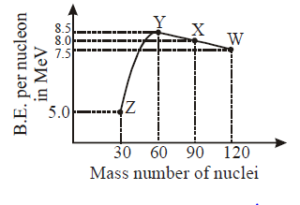
Binding energy per nucleon verses mass number curve for nuclei is shown in the figure. W, X, Y and Z are four nuclei indicated on the curve. The process that would release energy is :

1. Y → 2Z
2. W → X + Z
3. W → 2Y
4. X → Y + Z
View Answer
Question 5: difficult

Energy from the sun is received on the earth at the rate of 2 cal per cm² per min. If average wavelength of solar light be taken at 5500 Å, then how many photons are received on the earth per cm² per min ?

\[\left( h=6.6\times 10^{-34}J-s,cal = 4.2 J \right)\]

1. \[1.5\times 10^{13}\]
2. \[2.9\times 10^{13}\]
3. \[2.3\times 10^{19}\]
4. \[1.75\times 10^{19}\]
View Answer
Question 6: difficult

A photon and an electron have equal energy E. \[\lambda_{photon}/\lambda_{electron}\] is proportional to

1. √E
2. 1/√E
3. 1/E
4. Does not depend upon E
View Answer
Question 7: difficult

Ultraviolet light of wavelength 300 nm and intensity 1.0 watt/m² falls on the surface of a photosensitive material. If 1% of the incident photons produce photoelectrons, then the number of photoelectrons emitted from an area of 1.0 cm² of the surface is nearly

1. \[9.61\times 10^{14}per sec\]
2. \[4.12\times 10^{13}per sec\]
3. \[1.51\times 10^{12}per sec\]
4. \[2.13\times 10^{11}per sec\]
View Answer
Question 8: difficult

Photoelectric emission is observed from a metallic surface for frequencies ν1 and ν2 of the incident light rays (ν1 > ν2). If the maximum value of kinetic energy of the photoelectrons emitted in the two cases are in the ratio of 1 : k, then the threshold frequency of the metallic surface is :

1. \[\frac{\nu_{1}-\nu_{2}}{k-1}\]
2. \[\frac{k\nu_{1}-\nu_{2}}{k-1}\]
3. \[\frac{k\nu_{2}-\nu_{1}}{k-1}\]
4. \[\frac{\nu_{2}-\nu_{1}}{k}\]
View Answer
Question 9: difficult

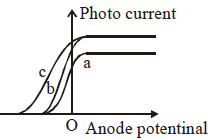
The figure shows the variation of photo current with anode potential for a photo-sensitive surface for three different radiations. Let Ia, Ib, and Ic be the intensities and fa, fb and fc be the frequencies for the curves a, b and c respectively :

1. \[f_{a}=f_{b} and I_{a}\neq I_{b}\]
2. \[f_{a}=f_{c} and I_{a}= I_{c}\]
3. \[f_{a}=f_{b} and I_{a}= I_{b}\]
4. \[f_{b}=f_{c} and I_{b}= I_{c}\]
View Answer
Question 10: difficult

Half life of a radio-active substance is 20 minutes. The time between 20% and 80% decay will be :

1. 20 minutes
2. 40 minutes
3. 30 minutes
4. 25 minutes
View Answer