Magnetic Effects of Current - NEET Physics Questions
← All Chapters

Magnetic Effects of Current

Question 41: moderate

Consider six wires coming into or out of the page, all with the same current. Rank the line integral of the magnetic field (from most positive to most negative) taken counter-clockwise around each
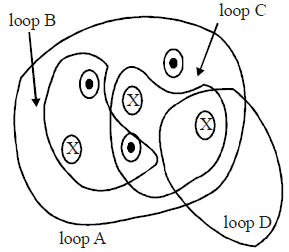
loop shown.

1. B > C > D > A
2. B > C = D > A
3. B > A > C = D  
4. C > B = D > A
View Answer

Current enclosed in A = 3i -3i =0

Current enclosed in B = 2i-i=i

Current enclosed in C = - 2i + i= - i

Current enclosed in D= -i

so Correct order of integral of B.dl is B > A > C = D
Question 42: moderate

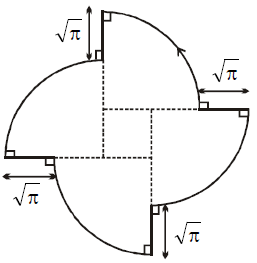
As shown in the figure, the radius of each of quarter circular arc is 2m. Find the magnetic moment of the given loop for the current in the loop :

1. 5πi
2. 4πi
3. 2πi
4. 3πi
View Answer
Question 43: easy

A loop in the shape of an equilateral triangle of side l is suspended between the pole pieces of a
permanent magnet such that \[\overrightarrow{B}\] is in plane of the loop. If due to a current i in the triangle a torque τ acts on it, the side l of the triangle is :

1. \[\frac{2}{\sqrt{3}}.\left( \frac{\tau}{Bi} \right)\]
2. \[\frac{1}{\sqrt{3}}.\frac{\tau}{Bi}\]
3. \[2\left( \frac{\tau}{\sqrt{3}Bi} \right)^{1/2}\]
4. \[\frac{2}{\sqrt{3}}.\left( \frac{\tau}{Bi} \right)^{1/2}\]
View Answer
Question 44: easy

When a charged particle moving with velocity \(\overrightarrow{v}\)is subjected to a magnetic field of induction                 \(\overrightarrow{B}\) , the force on it is non-zero. This implies the :

1. angle between \[\overrightarrow{v}\] and \[\overrightarrow{B}\] is necessary 90º
2. angle between \[\overrightarrow{v}\] and \[\overrightarrow{B}\] can have at value other than 90º
3. angle between \[\overrightarrow{v}\] and \[\overrightarrow{B}\] can have at value other than zero and 180º
4. angle between \[\overrightarrow{v}\] and \[\overrightarrow{B}\] is either zero or 180º
View Answer
Question 45: moderate

A charge q coulomb moves in a circle with n revolutions per second and the radius of the circle is r metre. The magnetic field at the centre of the circle is :

1. \[\frac{2\pi q}{nr}\times10^{-7}NA^{-1}m^{-1}\]
2. \[\frac{2\pi q}{r}\times10^{-7}NA^{-1}m^{-1}\]
3. \[\frac{2\pi nq}{r}\times10^{-7}NA^{-1}m^{-1}\]
4. \[\frac{2\pi q}{r}\times NA^{-1}m^{-1}\]
View Answer
Question 46: moderate

A charged particle moves along a circle under the action of possible constant electric and magnetic fields. Which of the following are possible ?

1. E = 0, B = 0
2. E = 0, B ≠ 0
3. E ≠ 0, B = 0
4. E ≠ 0, B ≠ 0
View Answer
Question 47: moderate

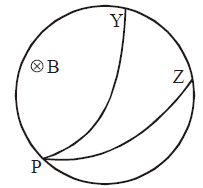
Two particles Y and Z emitted by a radioactive source at P made tracks in a chamber as illustrated in the figure. A magnetic field acts downward into the paper. Careful measurements showed that both tracks were circular, the radius of Y track being half that of the Z track. Which one of the following statements is certainly true ?

1. Both particles Y and Z carried a positive charge
2. The mass of particle Z was one half that of particle Y
3. The mass of particle Z was twice that of particle Y
4. The charge of particle Z was twice that of particle Y
View Answer
Question 48: moderate

A charged particle enters a uniform magnetic field with velocity vector at an angle of 45° with the magnetic field. The pitch of the helical path followed by the particle is p. The radius of circle of the helix will be :

1. p/√2π
2. √2p
3. p/2π
4. √2p/π
View Answer
Question 49: difficult

Two identical wires A and B have the same length l and carry the same current I. Wire A is bent into a circle of radius R and wire B is bent to form a square of side a. If B1 and B2 are the values of magnetic induction at the centre of the circle and the centre of the square, respectively. then the ratio B1/B2 is :

1. (π² / 8)
2. (π² / 8√2)
3. (π² / 16)
4. (π² / 16√2)
View Answer
Question 50: moderate

A long straight, hollow, conductor (tube) carrying a current has two sections A and C of unequal cross sections joined by a conical section B. 1, 2 and 3 are points on a line parallel to the axis of the conductor. The magnetic fields at 1, 2 and 3 have magnitudes B1, B2 and B3. Then :

1. B1 = B2 = B3
2. B1 = B2 ≠ B3
3. B1 < B2 < B3
4. B2 cannot be found unless the dimensions of the section B are known
View Answer