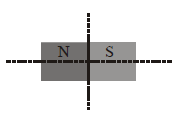
Two bar magnets with magnetic moments 2M and M are fastened together at right angles to each other at their centres to form a crossed system, which can rotate freely about a vertical axis through the centre. The crossed system sets in earth’s magnetic field with magnet having magnetic moment 2M making and angle θ with the magnetic meridian such that :
1. \[\theta=tan^{-1}\left( \frac{1}{\sqrt{3}} \right)\]
2. \[\theta=tan^{-1}\left( \sqrt{3} \right)\]
3. \[\theta=tan^{-1}\left( \frac{1}{{2}} \right)\]
4. \[\theta=tan^{-1}\left( \frac{3}{{4}} \right)\]
View Answer
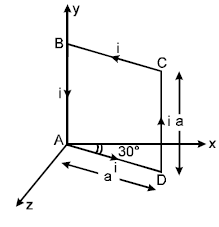
A square coil of side ‘a’ carrying current ‘ i ’ and is having one of its side AB parallel to
y-axis and its plane is at angle θ = 30° with x-axis. If a uniform magnetic field B exist in
the region along \[\hat{k}\] direction, then torque due to magnetic force on the coil is:
1. \[\frac{ia^{2}B}{2}\hat{j}\]
2. \[-\frac{ia^{2}B}{\sqrt{2}}\left(-\hat{k}+ \hat{j} \right)\]
3. \[-\frac{ia^{2}B}{2}\hat{j}\]
4. \[\frac{ia^{2}B}{2}\hat{i}\]
View Answer
A bar magnet has length \(3\text{ cm}\), cross-sectional area \(2\text{ cm}^2\) and magnetic moment \(3\text{ A m}^2\). The intensity of magnetisation of bar magnet is
1. \(2 \times 10^5\text{ A/m}\)
2. \(3 \times 10^5\text{ A/m}\)
3. \(4 \times 10^5\text{ A/m}\)
4. \(5 \times 10^5\text{ A/m}\)
View Answer
Intensity of magnetisation \(I = \frac{M}{V}\). Here, volume \(V = A \times L = (2 \times 10^{-4}\text{ m}^2) \times (3 \times 10^{-2}\text{ m}) = 6 \times 10^{-6}\text{ m}^3\). Thus, \(I = \frac{3}{6 \times 10^{-6}} = 5 \times 10^5\text{ A/m}\).
Assertion (A): Pole pieces of the magnet used in a moving coil galvanometer are given a concave shape to achieve a radial magnetic field.
Reason (R): A radial magnetic field ensures a better current sensitivity and also makes possible to use a linear scale for current measurement.
1. (1) Both (A) & (R) are true and the (R) is the correct explanation of the (A)
2. (2) Both (A) & (R) are true but the (R) is not the correct explanation of the (A)
3. (3) (A) is true but (R) is false
4. (4) Both (A) and (R) are false
View Answer
Concave pole pieces ensure a radial magnetic field in a moving coil galvanometer, keeping \(\vec{B}\) always perpendicular to the coil's area vector. This ensures maximum torque \(\tau = NIAB\) and a linear scale (deflection \(\phi \propto I\)), leading to better current sensitivity. Both (A) and (R) are true, and (R) explains (A).
Assertion (A): When a straight wire carrying current is placed along the axis of a current carrying ring, it starts rotating about the wire.
Reason (R): Charged ring will experience a torque when current carrying cable will pass through its axis.
1. Both (A) & (R) are true and the (R) is the correct explanation of the (A)
2. Both (A) & (R) are true but the (R) is not the correct explanation of the (A)
3. (A) is true but (R) is false
4. Both (A) and (R) are false
View Answer
Assertion (A) is false. A straight wire carrying current along the axis of a ring produces a magnetic field that is perpendicular to the current elements of the ring. Consequently, the magnetic force \(I(\vec{dl} \times \vec{B}))\ on each element is zero, resulting in no net force or torque on the ring.
Reason (R) is also false because no torque is experienced under these conditions. Both assertion and reason are false.
Assertion (A): A planar circular coil of area \(A\) and current \(I\) is equivalent to magnetic dipole of dipole moment \(M = IA\).
Reason (R): At large distances, magnetic field of circular loop and magnetic dipole is same.
1. Both (A) & (R) are true and the (R) is the correct explanation of the (A)
2. Both (A) & (R) are true but the (R) is not the correct explanation of the (A)
3. (A) is true but (R) is false
4. Both (A) and (R) are false
View Answer
Assertion (A) is true. The magnetic dipole moment \(M\) of a current loop with area \(A\) and current \(I\) is indeed given by \(IA\). Reason (R) is also true. At large distances, the magnetic field produced by a circular current loop is identical to the field of an ideal magnetic dipole with moment \(IA\). Reason (R) provides the correct explanation for Assertion (A) as this equivalence is the basis for the definition of the magnetic dipole moment.
Assertion (A): The surface integral of magnetic field over any closed surface is always zero.
Reason (R): Magnetic poles are always exists in pairs.
1. Both (A) & (R) are true and the (R) is the correct explanation of the (A)
2. Both (A) & (R) are true but the (R) is not the correct explanation of the (A)
3. (A) is true but (R) is false
4. Both (A) and (R) are false
View Answer
Assertion (A) is Gauss's Law for Magnetism \(\oint \vec{B} \cdot d\vec{A} = 0\), which is true.
Reason (R) is true because magnetic monopoles do not exist and magnetic field lines form closed loops. (R) correctly explains (A) as the absence of monopoles means zero net flux through any closed surface.