Kinematics - NEET Physics Questions
Question 71: moderate

A man wishes to swim across a river 0.5 km wide. If he can swim at the rate of 2 km/h in still water and the river flows at the rate of 1 km/h. The angle made by the directon (w.r.t. the flow of the river) along which he should swim so as to reach a point exactly opposite his starting point, should be :

1. 60°
2. 120°
3. 145°
4. 90°
View Answer

To swim across the river and reach a point directly opposite his starting point, the man must swim at an angle against the flow of the river to counteract the river's current.

### Given:
- Speed of the man in still water = 2 km/h
- Speed of the river flow = 1 km/h

Let \(\theta\) be the angle between the man's swimming direction and the river flow. To counteract the river's flow, the horizontal component of the man's velocity must equal the river's velocity.

\[
\text{Horizontal component} = 2 \sin \theta = 1
\]

Solving for \(\theta\):

\[
\sin \theta = \frac{1}{2}
\]
\[
\theta = \sin^{-1} \left( \frac{1}{2} \right) = 30^\circ
\]

Thus, the man should swim at an angle of:

\[
{120^\circ} \text{ upstream from the river flow.}
\]
Question 72: difficult

A boat-man can row a boat to make it move with a speed of 10 km/h in still water. River flows steadily at the rate of 5 km/h. and the width of the river is 2 km. If the boat man cross the river along the minimum distance of approach then time elapsed in rowing the boat will be :

1. \[\frac{2\sqrt{3}}{5}h\]
2. \[\frac{2}{5\sqrt{3}}h\]
3. \[\frac{3\sqrt{2}}{5}h\]
4. \[\frac{5\sqrt{2}}{5}h\]
View Answer

To cross the river along the minimum distance (i.e., directly perpendicular to the riverbank), the boatman must row with a velocity component equal and opposite to the river flow to cancel the drift.

Given:
- Speed of the boat in still water = 10 km/h
- Speed of the river flow = 5 km/h
- Width of the river = 2 km

The boat's velocity perpendicular to the riverbank is:

\[
v_{\text{perpendicular}} = \sqrt{(10^2 - 5^2)} = \sqrt{100 - 25} = \sqrt{75} = 5\sqrt{3} \, \text{km/h}
\]

Time to cross the river:

\[
\text{Time} = \frac{\text{Distance}}{\text{Speed perpendicular}} = \frac{2}{5\sqrt{3}} \, \text{hours}
\]

Simplifying:

\[{\frac{2}{5\sqrt{3}} \, \text{hours}}
\]

Question 73: moderate

A bird is flying towards south with a velocity 40km/h and a train is moving with a velocity 40 km/h towards east. What is the velocity of the bird w.r.t. an observer in the train ?

1. 40 √2 km/h. N-E
2. 40 √2 km/h. S-E
3. 40 √2 km/h. S-W
4. 40 √2 km/h. N-W
View Answer

The relative velocity of the bird with respect to the observer in the train is found by combining the bird's velocity (south) and the train's velocity (east) using the Pythagorean theorem.

\[
v_{\text{relative}} = \sqrt{(40^2 + 40^2)} = \sqrt{3200} = 40\sqrt{2} \, \text{km/h}
\]

The direction is \( 45^\circ \) south of west.

Thus, the relative velocity is:

\[ {40\sqrt{2} \, \text{km/h} \text{ at } 45^\circ \text{ south of west}}
\]

Question 74: easy

A train moves in north direction with a speed of 54 km/h A monkey is running on the roof of the train, against its motion with a velocity of 18 km/h. with respect to train. The velocity of monkey as observed by a man standing on the ground is :

1. 5 ms–¹ due south
2. 25 ms–¹ due south
3. 10 ms–¹ due south
4. 10 ms–¹ due north
View Answer

To find the velocity of the monkey as observed by a man standing on the ground, we need to add the velocity of the monkey relative to the train to the velocity of the train.

 Given:
- Velocity of the train (north direction) = 54 km/h
- Velocity of the monkey relative to the train (opposite to train's motion) = 18 km/h

Monkey's velocity relative to the ground:
Since the monkey is running against the train’s motion, the monkey's velocity relative to the ground will be:

\[
\vec{v}_{\text{monkey}} = \vec{v}_{\text{train}} - \vec{v}_{\text{monkey relative to train}}
\]

\[
v_{\text{monkey}} = 54 \, \text{km/h} - 18 \, \text{km/h} = 36 \, \text{km/h}
\]

Thus, the velocity of the monkey as observed by a man on the ground is:

\[
{36 \, \text{km/h} \text{ north} or 10 m/s \text{ north}}
\]

Question 75: difficult

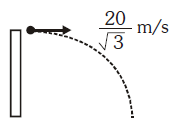
A particle is projected horizontally with a speed of 20/√3 m/s, from some height at t = 0. At what time will its velocity make 60° angle with the initial velocity

1. 1 sec
2. 2 sec
3. 1.5 sec
4. 2.5 sec
View Answer

\[ tan \alpha = \frac{-gt}{u} \]

\[ tan (-60^{\circ })= \frac{-10t}{20/\sqrt{3}} \]

Solving t =2 sec

Question 76: moderate

A boy is running on a levelled road with velocity (v) with a long hollow tube in his hand. Water is falling vertically downwards with velocity (u). At what angle to the vertical, should he incline the tube so that the water drops enters without touching its side :

1. \[tan^{-1}\left( \frac{v}{u} \right)\]
2. \[sin^{-1}\left( \frac{v}{u} \right)\]
3. \[tan^{-1}\left( \frac{u}{v} \right)\]
4. \[cos^{-1}\left( \frac{v}{u} \right)\]
View Answer

The tube should be inclined at an angle \(\theta\) such that the water's relative velocity to the boy is along the axis of the tube.

The horizontal velocity of the boy is \(v\), and the vertical velocity of the falling water is \(u\). The angle \(\theta\) between the tube and the vertical satisfies:

\[
\tan \theta = \frac{v}{u}
\]

Thus, the required angle is:

\[
\theta = \tan^{-1} \left( \frac{v}{u} \right)
\]

Question 77: easy

A boat is sailing with a velocity \[\left( 3\hat{i}+4\hat{j} \right)\] with respect to ground and water in river is flowing with a velocity

\[\left( -3\hat{i}-4\hat{j} \right)\] . Relative velocity of the boat with respect to water is :

1. \[8\hat{j}\]
2. 5√2
3. \[6\hat{i}+8\hat{j}\]
4. \[-6\hat{i}-8\hat{j}\]
View Answer

The relative velocity of the boat with respect to the water is given by subtracting the velocity of the water from the velocity of the boat.

\[
\vec{v}_{\text{bw}} = \vec{v}_{\text{boat}} - \vec{v}_{\text{water}}
\]

Given:
\[
\vec{v}_{\text{boat}} = 3\hat{i} + 4\hat{j}, \quad \vec{v}_{\text{water}} = -3\hat{i} - 4\hat{j}
\]

Now, subtract:

\[
\vec{v}_{\text{bw}} = (3\hat{i} + 4\hat{j}) - (-3\hat{i} - 4\hat{j})
\]
\[
\vec{v}_{\text{bw}} = 3\hat{i} + 4\hat{j} + 3\hat{i} + 4\hat{j}
\]
\[
\vec{v}_{\text{bw}} = 6\hat{i} + 8\hat{j}
\]

Thus, the relative velocity of the boat with respect to the water is:

\[ {6\hat{i} + 8\hat{j}} \]

Question 78: difficult

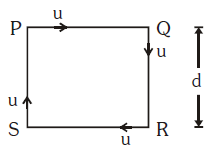
Four persons P, Q, R and S of same mass travel with same speed u along a square of side ‘d’ such that each one always faces the other. After what time will they meet each other ?

1. \[\frac{d}{u}\]
2. \[\frac{2d}{3u}\]
3. \[\frac{2d}{u}\]
4. d√3u
View Answer

To determine when the four persons \( P, Q, R, \) and \( S \) will meet, consider the following:

Relative Velocity:
- Each person moves with speed \( u \) towards the center of the square.

Configuration:
- As they face each other and move towards the center, their paths converge.

Effective Speed Towards Each Other:
- The effective speed of each person towards the center is \( u \cos 45^\circ = \frac{u}{\sqrt{2}} \) because they move diagonally.

Distance to Center:
- The distance from each person to the center of the square is \( \frac{d}{\sqrt{2}} \).

Time to Meet:
\[
t = \frac{\text{Distance}}{\text{Effective Speed}} = \frac{\frac{d}{\sqrt{2}}}{\frac{u}{\sqrt{2}}} = \frac{d}{u}
\]

Thus, the time after which they will all meet is \( \frac{d}{u} \).

Question 79: moderate

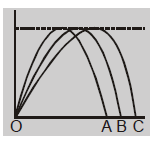
Three projectiles A, B and C are thrown from the same point in the same plane. Their trajectories are shown in the figure. Which of the following statement is true ?

1. The time of flight is the same for all the three
2. The launch speed is largest for particle C
3. The horizontal velocity component is largest for particle C
4. All of the above
View Answer

As maximum height is same is all three they will have same vertical speed.

Range of C is maximum so its horizontal speed is maximum.

Question 80: difficult

At what angle to the horizontal should a ball be thrown so that its range R is related to the time of flight T as R = 5T² ? Take g = 10 ms–² :

1. 30°
2. 45°
3. 60°
4. 90°
View Answer


Given the relationship \( R = 5T^2 \), and using the formulas for range \( R \) and time of flight \( T \):

1. **Range formula:**
R = u cos(θ) · T

2. **Time of flight formula:**
T = (2u sin(θ)) / g

Substituting T into the range equation:

R = u cos(θ) · (2u sin(θ) / g)

This gives:

R = (2u² sin(θ) cos(θ)) / g

Setting this equal to \( 5T^2 \):

(2u² sin(θ) cos(θ)) / g = 5((2u sin(θ)) / g)²

Simplifying:

(2u² sin(θ) cos(θ)) / g = (20u² sin²(θ)) / g²

Cancelling \( u² / g \):

2 cos(θ) = 20 sin(θ) / g

Given g = 10 m/s²:

2 cos(θ) = 2 sin(θ)

Thus:

cos(θ) = sin(θ)

This implies:

tan(θ) = 1 → θ = 45°

The angle to the horizontal should be  45°