Kinematics - NEET Physics Questions
Question 91: moderate

A body is dropped from a tower. It covers 64% distance of its total height in last second. Find out the height of tower [g = 10 ms–²]

1. 31.25 m
2. 25.31 m
3. 40 m
4. 125 m
View Answer

\[ 0.36 H= \frac{1}{2}g(t-1)^{2} \]

\[ H= \frac{1}{2}g(t)^{2} \]

Dividing we get

\[ 0.36 = \frac{(t-1)^{2}}{t^{2}} \]

\[ 0.6 = \frac{(t-1)}{t} \]

0.4t =1

t= 2.5 sec

S= (1/2) ×10 ×(2.5)²= 31.25 m
Question 92: difficult

A body dropped from the top of a tower clears 7/16th of the total height of the tower in its last second of flight. The time taken by the body to reach the ground is :

1. 2 s
2. 3 s
3. 4 s
4. 5 s
View Answer

According to Galileo's Ratio of Odd Number distances travelled is consecution interval of 1 sec is in the ratio of 1:3:5:7 so in 4th second distance travelled is 7/16th of total journey.

so, total time = 4 sec.

Question 93: moderate

A particle is fired with velocity u making an angle θ with the horizontal. What is the change in velocity when it is at the highest point :

1. u cosθ
2. u
3. u sinθ
4. (u cosθ-u)
View Answer

At the highest point of its trajectory, the vertical component of the velocity becomes zero, while the horizontal component remains unchanged.

- Initial velocity: \( u \)
- Horizontal component: \( u_x = u \cos \theta \)
- Vertical component: \( u_y = u \sin \theta \)

At the highest point:
- Vertical velocity: \( u_y = 0 \)
- Horizontal velocity: \( u_x = u \cos \theta \)

The change in velocity is only in the vertical direction, from \( u \sin \theta \) to 0.

So, the change in velocity is:

\[
\Delta v = u \sin \theta
\]

Thus, the change in velocity is \( u \sin \theta \).

Question 94: easy

Two cars are moving along a straight line in opposite direction with the same speed 10 m/s. The relative velocity of two cars w.r.t. each other is:

1. 20 m/s
2. 30 m/s
3. zero
4. none of these
View Answer

When objects move in opposite directions relative velocity= v1+ v2= 20 m/s

Question 95: easy

Two objects A and B are moving with speeds 10 m/s  and 20 m/s respectively in the same direction. The relative velocity of A w.r.t. B is

1. 30 m/s
2. 10 m/s
3. - 10 m/s
4. 50 m/s
View Answer

When moving in same direction relative velocity = V 1 -V 2= 10-20 = -10 m/s

Question 96: easy

Two objects A and B are moving with speeds 10 m/s and 20 m/s respectively in the same direction. The relative velocity of B w.r.t. A is

1. 30 m/s
2. 10 m/s
3. - 10 m/s
4. 50 m/s
View Answer

Velocity of A w.r.t B = V A - V B
Velocity of B w.r.t A = V B - V A

Question 97: easy

The relative velocity of two objects A and B is 10 m/s. If the velocity of object A is 40 m/s then the velocity with which B is moving is (assume both objects are moving in same direction)

1. 10 m/s
2. 20 m/s
3. 30 m/s
4. 40 m/s
View Answer

Relative Velocity = V A - V B
10= 40 - V B
V B = 30 m/s

* Is 50 m/s a possible answer ?

Question 98: easy

Two trains A and B are moving in a straight line in the same direction with speeds of 54 km/h and 15 m/s respectively. The relative velocity of one train w.r.t. other is

1. 69 km/hr
2. 69 m/s
3. 39 m/s
4. Zero
View Answer

As, 54 km/hr = 15 m/s both have same velocity in same direction their relative speed/velocity is zero

Question 99: easy

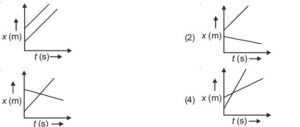
Two objects A and B are moving in same direction with same speed of 20 m/s each then, which of the following position-time graphs correctly represents two moving objects A and B

neet question in 1-d motion

1. 1
2. 2
3. 3
4. 4
View Answer

As both A and B have same velocity their relative speed is zero. so both have same slope in position time graph.

Question 100: moderate

A boat takes two hours to travel 4 km down and 4 km up the river when the water is still. How much time will the boat take to make the same trip when the river starts flowing at 2 kmph?

1. 2 hour
2. 2 hour 40 minute
3. 3 hour
4. 3 hour 40 minute
View Answer

Let the boat's speed in still water be x kmph. Given

8x=2\frac{8}{x} = 2

, we get x = 4 kmph.

With a 2 kmph current:

  • Downstream speed = 6 kmph, time =
    46=23\frac{4}{6} = \frac{2}{3}
     

    hours

  • Upstream speed = 2 kmph, time =
    42=2\frac{4}{2} = 2
     

    hours

Total time =

2232 \frac{2}{3}

hours or 2 hours 40 minutes.