Gravitation - NEET Physics Questions
← All Chapters

Gravitation

Question 31: moderate

Two types of balances, the beam balance and the spring balance are commonly used for measuring weight at shops. If we are at the moon, we can continue to use :

1. Only the beam type balance without any change
2. Only the spring balance without any change
3. both the balances without any change
4. Neither of the two balances without making any change
View Answer

On the Moon, the acceleration due to gravity is weaker (about \( \frac{1}{6} \) of that on Earth), affecting how a spring balance measures weight.

A spring balance relies on the gravitational force to measure weight based on the stretch of the spring, so it would give a lower reading on the Moon.

In contrast, a beam balance compares masses based on equilibrium, unaffected by gravity. Thus, it can be used without any change to measure weight accurately on the Moon.
Question 32: moderate

The depth at which the effective value of acceleration due to gravity is g/4 is (R is radius of the earth) :

1. R
2. 3R/4
3. R/2
4. R/4
View Answer

To find the depth \( d \) at which the effective acceleration due to gravity is \( \frac{g}{4} \), we use the formula for gravity at depth:

\[
g_d = g \left(1 - \frac{d}{R}\right).
\]

Setting \( g_d = \frac{g}{4} \):

\[
\frac{g}{4} = g \left(1 - \frac{d}{R}\right).
\]

Dividing both sides by \( g \):

\[
\frac{1}{4} = 1 - \frac{d}{R}.
\]

Rearranging gives:

\[
\frac{d}{R} = 1 - \frac{1}{4} = \frac{3}{4}.
\]

Thus:

\[
d = \frac{3R}{4}.
\]

So, the depth at which the effective value of acceleration due to gravity is \( \frac{g}{4} \) is \( \frac{3R}{4} \).

Question 33: moderate

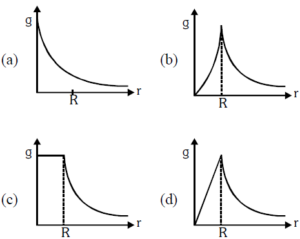
The dependence of acceleration due to gravity ‘g’ on the distance ‘r’ from the centre of the earth, assumed to be a sphere of radius R of uniform density, is as shown in figure below:-

The correct figure is :

1. (a)
2. (b)
3. (c)
4. (d)
View Answer

\[ g= \frac{GMr}{R^{3}}  \] for internal point

\[ g= \frac{GM}{r^{2}}  \] for external point


Question 34: moderate

A particle of mass M is situated at the centre of a spherical shell of same mass and radius a. The gravitational potential at a point situated at a/2 distance from the centre, will be :

1. \[ \frac{-4GM}{a} \]
2. \[ \frac{-3GM}{a} \]
3. \[ \frac{-2GM}{a} \]
4. \[ \frac{-GM}{a} \]
View Answer

Total gravitational potential at a point \( r = \frac{a}{2} \):

1. Potential due to the mass at the center:
The gravitational potential at a distance \( r \) from a point mass \( M \) is given by:
\[
V_{\text{center}} = -\frac{GM}{r}
\]
At \( r = \frac{a}{2} \), this becomes:
\[
V_{\text{center}} = -\frac{GM}{\frac{a}{2}} = -\frac{2GM}{a}
\]

2. **Potential due to the spherical shell**:
Inside a spherical shell, the gravitational potential is constant and equal to the potential at the surface, which is:
\[
V_{\text{shell}} = -\frac{GM}{a}
\]

### Total potential at \( r = \frac{a}{2} \):

The total gravitational potential is the sum of the potentials due to the mass at the center and the shell:
\[
V_{\text{total}} = V_{\text{center}} + V_{\text{shell}} = -\frac{2GM}{a} - \frac{GM}{a} = -\frac{3GM}{a}
\]

So, the gravitational potential at a distance \( \frac{a}{2} \) from the center is:
\[
V = -\frac{3GM}{a}
\]