Gravitation - NEET Physics Questions
← All Chapters

Gravitation

Question 21: moderate

A body attains a height equal to the radius of the earth when projected from earth’ surface. The velocity of the body with which it was projected is :

1. \[\sqrt{\frac{GM}{R}}\]
2. \[\sqrt{\frac{2GM}{R}}\]
3. \[\sqrt{\frac{5GM}{4R}}\]
4. \[\sqrt{\frac{3GM}{R}}\]
View Answer

The velocity required to reach a height equal to the Earth's radius \( R \) is the escape velocity for a total distance of \( 2R \) from the Earth's center.

Escape velocity formula:

\[
v = \sqrt{\frac{GM}{R}}
\]

At height \( h = R \), the velocity needed is:

\[
v = \sqrt{\frac{GM}{2R}} = \frac{V_e}{\sqrt{2}}
\]

Thus, the velocity is:

\[
v = \frac{V_e}{\sqrt{2}} = \frac{\sqrt{2GM/R}}{\sqrt{2}} = \sqrt{\frac{GM}{R}} = V_e/\sqrt{2}= \sqrt{\frac{GM}{R}}
\]

Question 22: moderate

Two bodies of masses m and 4m are placed at a distance r. The gravitational potential at a point on the line joining them where the gravitational field is zero is :

1. \[ \frac{- Gm}{r} \]
2. \[ \frac{-9 Gm}{r} \]
3. zero
4. \[ \frac{-4 Gm}{r} \]
View Answer

The point where the gravitational field is zero lies closer to the smaller mass \( m \). Let the distance of this point from \( m \) be \( x \), and from \( 4m \) be \( r - x \).

At this point:

\[
\frac{Gm}{x^2} = \frac{G \cdot 4m}{(r - x)^2}
\]

Taking the square root:

\[
\frac{1}{x} = \frac{2}{r - x}
\]

Solving:

\[
r - x = 2x \quad \Rightarrow \quad x = \frac{r}{3}
\]

The gravitational potential \( V \) at this point is the sum of the potentials due to both masses:

\[
V = -\frac{Gm}{\frac{r}{3}} - \frac{G \cdot 4m}{\frac{2r}{3}} = -\frac{3Gm}{r} - \frac{6Gm}{r} = -\frac{9Gm}{r}
\]

Thus, the potential at the point is:

\[
V = -\frac{9Gm}{r}
\]

Question 23: moderate

Kepler’s third law states that square of period of revolution (T) of a planet around the sun, is proportional to third power of average distance r between sun and planet
i.e. T² = Kr³
here K is constant.
If the masses of sun and planet are M and m respectively then as per Newton’s law of gravitation force of attraction between them is
F = GMm/r², here G is gravitational constant.
The relation between G and K is described as :

1. GMK=4π²
2. K = G
3. K = 1/G
4. GK=4π²
View Answer

To find the relation between \( G \) and \( K \), we can use both Kepler’s third law and Newton’s law of gravitation.

1. **Gravitational Force**:
From Newton's law of gravitation, the gravitational force between the Sun and a planet is:
\[
F = \frac{GMm}{r^2}
\]

2. **Centripetal Force**:
For a planet moving in a circular orbit, the gravitational force provides the necessary centripetal force. The centripetal force for a planet with mass \( m \) and orbital speed \( v \) is:
\[
F = \frac{mv^2}{r}
\]

Equating the two expressions for force:
\[
\frac{GMm}{r^2} = \frac{mv^2}{r}
\]
Simplifying, we get:
\[
v^2 = \frac{GM}{r}
\]

3. **Orbital Period**:
The orbital speed \( v \) is related to the period \( T \) by:
\[
v = \frac{2 \pi r}{T}
\]
Substituting into \( v^2 = \frac{GM}{r} \), we get:
\[
\left( \frac{2 \pi r}{T} \right)^2 = \frac{GM}{r}
\]
Simplifying:
\[
\frac{4 \pi^2 r^2}{T^2} = \frac{GM}{r}
\]
\[
T^2 = \frac{4 \pi^2 r^3}{GM}
\]

4. **Kepler’s Third Law**:
From Kepler's third law, we know:
\[
T^2 = Kr^3
\]

Comparing both expressions for \( T^2 \):
\[
K = \frac{4 \pi^2}{GM}
\]

### Conclusion:
The relation between \( G \) and \( K \) is:
\[
K = \frac{4 \pi^2}{GM}
\]

Question 24: moderate

A remote – sensing satellite of earth revolves in a circular orbit at a height of \(0.25 × 10^{6} m\) above the surface of earth. If earth’s radius is \( 6.38 × 10^{6} m \)  and g=9.8 ms–², then the orbital speed of the satellite is :

1. 6.67 km s–¹
2. 7.76 km s–¹
3. 8.56 km s–¹
4. 9.13 km s–¹
View Answer

The orbital speed \( v \) of a satellite is given by:

\[
v = \sqrt{\frac{GM}{R}}
\]

where \( R \) is the distance from the center of the Earth to the satellite and \( g \) is the acceleration due to gravity at the Earth's surface. Using the relation \( g = \frac{GM}{R_e^2} \), where \( R_e \) is the Earth's radius, we can rewrite the formula as:

\[
v = \sqrt{g \cdot \frac{R_e^2}{R}}
\]

Here, \( R = R_e + h \), where \( h = 0.25 \times 10^6 \) m is the height above the surface of the Earth.

Now, substituting values:

\[
R = 6.38 \times 10^6 + 0.25 \times 10^6 = 6.63 \times 10^6 \, \text{m}
\]

\[
v = \sqrt{9.8 \times \frac{(6.38 \times 10^6)^2}{6.63 \times 10^6}}
\]

Solving:

\[
v \approx 7.76 \, \text{km/s}
\]

So, the orbital speed of the satellite is approximately \( 7.76 \, \text{km/s} \).

Question 25: moderate

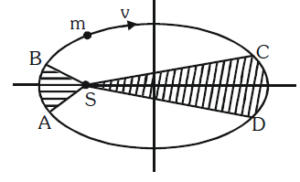
The figure shows elliptical orbit of a planet m about the sun S. The shaded area SCD is twice the shaded area SAB. If t1 is the time for the planet to move from C to D and t2 is the time to move from A to B then :

1. \[ t_{1}=t_{2}\]
2. \[ t_{1}< t_{2}\]
3. \[ t_{1}=4t_{2}\]
4. \[ t_{1}=2t_{2}\]
View Answer

According to **Kepler's second law** (law of areas), a planet sweeps out equal areas in equal times. This means the area swept out is proportional to the time taken.

In the problem, the area \( SCD \) is given to be twice the area \( SAB \). Therefore, the time taken to sweep these areas will also follow the same ratio.

Thus, the relation between the times is:

\[
t_1 = 2 t_2
\]

So, the time taken to move from \( C \) to \( D \) is twice the time taken to move from \( A \) to \( B \).

Question 26: moderate

A spherical planet has a mass Mp and diameter Dp. A particle of mass m falling freely near the surface of this planet will experience an acceleration due to gravity, equal to :

1. GMp/Dp²
2. 4GMpm/Dp²
3. 4GMp/Dp²
4. GMpm/ Dp²
View Answer

The acceleration due to gravity \( g \) on the surface of a spherical planet can be calculated using the formula:

\[
g = \frac{GM_p}{R_p^2},
\]

where:
- \( G \) is the gravitational constant,
- \( M_p \) is the mass of the planet,
- \( R_p \) is the radius of the planet.

Given that the diameter \( D_p = 2R_p \), we can express the radius as \( R_p = \frac{D_p}{2} \).

Substituting this into the formula gives:

\[
g = \frac{GM_p}{\left(\frac{D_p}{2}\right)^2} = \frac{GM_p}{\frac{D_p^2}{4}} = \frac{4GM_p}{D_p^2}.
\]

Thus, the acceleration due to gravity experienced by the particle near the surface of the planet is:

\[
g = \frac{4GM_p}{D_p^2}.
\]

Question 27: moderate

A particle is thrown with escape velocity Ve from the surface of earth. Calculate its velocity at height 3 R :

1. ≅ 9.25 km/s
2. ≅ 7.9 km/s
3. ≅ 11.2 km/s
4. ≅ 4.3 km/s
View Answer

The escape velocity \( V_e \) is the speed needed to escape Earth's gravitational pull. The energy conservation principle applies, where the total mechanical energy at the surface and at height \( h = 3R \) (where \( R \) is the Earth's radius) should be equal.

The total energy at the surface:
\[
E_1 = \frac{1}{2} m V_e^2 - \frac{G M m}{R}
\]

At height \( 3R \), the total energy is:
\[
E_2 = \frac{1}{2} m v^2 - \frac{G M m}{4R}
\]

Since \( E_1 = E_2 \), we equate the two:
\[
\frac{1}{2} m V_e^2 - \frac{G M m}{R} = \frac{1}{2} m v^2 - \frac{G M m}{4R}
\]

We know that the escape velocity is given by:
\[
V_e^2 = \frac{2 G M}{R}
\]

Substitute this into the equation:
\[
\frac{1}{2} m \frac{2 G M}{R} - \frac{G M m}{R} = \frac{1}{2} m v^2 - \frac{G M m}{4R}
\]

Simplifying:
\[
\frac{G M m}{R} - \frac{G M m}{R} = \frac{1}{2} m v^2 - \frac{G M m}{4R}
\]

This simplifies to:
\[
0 = \frac{1}{2} m v^2 - \frac{G M m}{4R}
\]

Solving for \( v^2 \):
\[
\frac{1}{2} m v^2 = \frac{G M m}{4R}
\]

\[
v^2 = \frac{2 G M}{4R} = \frac{G M}{2R}
\]

Thus, the velocity at height \( 3R \) is:
\[
v = \sqrt{\frac{G M}{2R}} = \frac{V_e}{\sqrt{2}}= 7.92 km/sec
\]

So, the velocity at height \( 3R \) is \( \frac{V_e}{\sqrt{2}} \).= 7.92 km/sec

Question 28: moderate

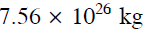
Weight of 1 kg becomes 1/6th on moon. If the radius of moon is \( 1.768 × 10^{6} m \), then the mass of moon will be :

1.
2.
3.
4.
View Answer

The weight of an object on the Moon is given by:

\[
W_{\text{moon}} = \frac{1}{6} W_{\text{earth}}
\]

Weight is related to the gravitational acceleration \( g \) by:

\[
W = mg
\]

Thus,

\[
g_{\text{moon}} = \frac{1}{6} g_{\text{earth}}
\]

The formula for gravitational acceleration is:

\[
g = \frac{GM}{R^2}
\]

Where:
- \( G \) is the gravitational constant,
- \( M \) is the mass of the Moon,
- \( R \) is the radius of the Moon.

Given:
- \( g_{\text{earth}} = 9.8 \, \text{m/s}^2 \),
- \( g_{\text{moon}} = \frac{1}{6} \times 9.8 = 1.633 \, \text{m/s}^2 \),
- \( R_{\text{moon}} = 1.768 \times 10^6 \, \text{m} \).

Now, solve for \( M_{\text{moon}} \) using:

\[
g_{\text{moon}} = \frac{G M_{\text{moon}}}{R_{\text{moon}}^2}
\]

Rearranging for \( M_{\text{moon}} \):

\[
M_{\text{moon}} = \frac{g_{\text{moon}} R_{\text{moon}}^2}{G}
\]

Substitute values:

\[
M_{\text{moon}} = \frac{1.633 \times (1.768 \times 10^6)^2}{6.674 \times 10^{-11}}
\]

Calculating this gives:

\[
M_{\text{moon}} \approx 7.35 \times 10^{22} \, \text{kg}
\]

Thus, the mass of the Moon is approximately \( 7.35 \times 10^{22} \, \text{kg} \).

Question 29: moderate

The diameter of two planets are in the ratio 4:1 and their mean densities in the ratio 1:2 the amocceleration due to gravity on the planets will be in ratio :

1. 1 : 2
2. 2 : 3
3. 2 : 1
4. 4 : 1
View Answer

The formula for acceleration due to gravity \( g \) on a planet is:

\[
g = \frac{GM}{R^2}
\]

Where:
- \( G \) is the gravitational constant,
- \( M \) is the mass of the planet,
- \( R \) is the radius of the planet.

Mass \( M \) is related to density \( \rho \) and volume \( V \):

\[
M = \rho V = \rho \frac{4}{3} \pi R^3
\]

Substituting into the equation for \( g \):

\[
g = \frac{G \rho \frac{4}{3} \pi R^3}{R^2} = \frac{4}{3} \pi G \rho R
\]

Thus, \( g \propto \rho R \).

Given:
- Diameter ratio \( R_1 : R_2 = 4:1 \), so \( R_1 : R_2 = 4:1 \),
- Density ratio \( \rho_1 : \rho_2 = 1:2 \).

Now,

\[
g_1 : g_2 = (\rho_1 R_1) : (\rho_2 R_2) = (1 \times 4) : (2 \times 1) = 4:2 = 2:1
\]

Thus, the ratio of acceleration due to gravity on the planets is \( 2:1 \).

Question 30: moderate

The change in the value of g at a height h above the surface of the earth is the same as at a depth d below the earth when both d and h are much smaller than the radius of the earth, which one of the following is correct ?

1. d = h/2
2. d = 3h/2
3. d = 2h
4. d = h
View Answer

The change in the value of \( g \) at height \( h \) above the surface of the Earth and at depth \( d \) below the surface can be expressed using the following formulas:

1. **At height \( h \)**:
\[
g_h = g \left(1 - \frac{2h}{R}\right) \quad \text{(for small } h\text{)}
\]

The change in \( g \) is:
\[
\Delta g_h = g - g_h = g \frac{2h}{R} = \frac{2gh}{R}.
\]

2. **At depth \( d \)**:
\[
g_d = g \left(1 - \frac{d}{R}\right) \quad \text{(for small } d\text{)}
\]

The change in \( g \) is:
\[
\Delta g_d = g - g_d = g \frac{d}{R}.
\]

Setting the changes equal gives:

\[
\frac{2gh}{R} = \frac{g d}{R}.
\]

Cancelling \( g \) and \( R \) (assuming they are non-zero):

\[
2h = d.
\]

Thus, the relation between depth \( d \) and height \( h \) is:

\[
d = 2h.
\]