Gravitation - NEET Physics Questions
← All Chapters

Gravitation

Question 1: moderate

The acceleration due to gravity on the planet A is 9 times the acceleration due to gravity on planet B. A man jumps to a height of 2m on the surface of A. What is the height of jump by the same person on the planet B ?

1. 18 m
2. 6 m
3. 2/3 m
4. 2/9 m
View Answer

From Equations of motion

The height of a jump is inversely proportional to the acceleration due to gravity. Let \( h_A \) be the height of the jump on planet A, and \( h_B \) be the height of the jump on planet B. Also, let \( g_A \) and \( g_B \) represent the acceleration due to gravity on planets A and B, respectively.

Given:
- \( g_A = 9g_B \)
- \( h_A = 2 \, \text{m} \)

The ratio of heights is:

\[
\frac{h_B}{h_A} = \frac{g_A}{g_B} = 9
\]

Thus, the height on planet B is:

\[
h_B = 9 \times h_A = 9 \times 2 = 18 \, \text{m}
\]

So, the height of the jump on planet B is \( 18 \, \text{m} \).
 

Question 2: difficult

If 100 kg mass is split into two parts and then seperated by certain distance. then what ratio of masses so that gravitational force between them is maximum :

1. 2/3
2. 1/2
3. 1
4. 1/3
View Answer

The gravitational force between two masses \( m_1 \) and \( m_2 \) is:

\[
F = G \frac{m_1 \cdot m_2}{r^2}
\]

To maximize \( F \), we set \( m_1 = x \) and \( m_2 = 100 - x \), then maximize the product \( m_1 \cdot m_2 = x(100 - x) \).

This product is maximized when \( x = 50 \). So, the masses should be split equally.

The ratio of masses is:

\[
\frac{m_1}{m_2} = \frac{50}{50} = 1
\]

Question 3: moderate

The diameter of two planets are in the ratio 4:1 and their mean densities in the ratio 1:2 the acceleration due to gravity on the planets will be in ratio :

1. 1 : 2
2. 2 : 3
3. 2 : 1
4. 4 : 1
View Answer

\[ g=\frac{GM}{R^{2}}= \frac{G\times \rho\frac{4}{3}\pi R^{3}}{R^{2}}=\frac{4G\rho\pi R}{3} \]

\[ \frac{g_{1}}{g_{2}}= \frac{R_{1}.\rho_{1}}{R_{2}.\rho_{2}}= \frac{4\times 1}{1\times 2}= \frac{2}{1} \]


Question 4: easy

The depth at which the value of acceleration due to gravity becomes 1/n times the value at the surface is (R be the radius of the earth) :

1. R/n
2. R/n²
3. R(n-1)/n
4. Rn/n-1
View Answer

The depth at which the acceleration due to gravity becomes \( \frac{1}{n} \) times the surface value is:

\[
d = \left( 1 - \frac{1}{n} \right) R
\]

where \( R \) is the radius of the Earth.

Question 5: moderate

The earth is assumed to be a sphere of radius R. A platform is arranged at a height R from the surface of the earth. The escape velocity of a body from this platform is FVe, where Ve is its escape velocity from the earth surface. The value of F is :

1. √2
2. 1/√2
3. 1/3
4. 1/2
View Answer

The escape velocity \( V_e \) from the Earth's surface is given by:

\[
V_e = \sqrt{\frac{2GM}{R}}
\]

At a height \( h = R \) (i.e., the platform is at a distance \( 2R \) from the Earth's center), the escape velocity \( V \) becomes:

\[
V = \sqrt{\frac{2GM}{2R}} = \frac{V_e}{\sqrt{2}}
\]

So, the factor \( F \) is:

\[
F = \frac{V}{V_e} = \frac{1}{\sqrt{2}}
\]

Question 6: moderate

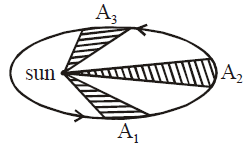
A planet moving around sun sweeps area A1 in 2 days, A2 in 3 days and A3 in 6 days. Then the relation between A1, A2 and A3 is :

1. 3A1 = 2A2 = A3
2. 2A1 = 3A2 = 6A3
3. 3A1 = 2A2 = 6A3
4. 6A1 = 3A2 = 2A3
View Answer

According to **Kepler's Second Law** (the Law of Equal Areas), a line segment joining a planet and the Sun sweeps out equal areas in equal times. Therefore, the area swept out in a given time is proportional to the time interval.

### Given:
- Area \( A_1 \) is swept in 2 days.
- Area \( A_2 \) is swept in 3 days.
- Area \( A_3 \) is swept in 6 days.

### Area Swept Proportions:
Since the area swept is proportional to the time taken:
\[
\frac{A_1}{A_2} = \frac{2 \text{ days}}{3 \text{ days}} \quad \Rightarrow \quad A_1 = \frac{2}{3} A_2
\]

\[
\frac{A_2}{A_3} = \frac{3 \text{ days}}{6 \text{ days}} \quad \Rightarrow \quad A_2 = \frac{1}{2} A_3
\]

### Relating Areas:
Substituting the relationship of \( A_2 \) in \( A_1 \):
\[
A_1 = \frac{2}{3} \left(\frac{1}{2} A_3\right) = \frac{1}{3} A_3
\]

### Final Relationships:
Now, we can express the areas in terms of \( A_3 \):
- \( A_1 = \frac{1}{3} A_3 \)
- \( A_2 = \frac{1}{2} A_3 \)

### Conclusion:
The relationship between the areas \( A_1 \), \( A_2 \), and \( A_3 \) can be summarized as:
\[
A_1 : A_2 : A_3 = 1 : \frac{3}{2} : 3
\]
This can also be expressed as:
\[
A_1 : A_2 : A_3 = 2: 3 : 6
\]

Question 7: moderate

A satellite of mass m orbiting closely around the earth in a circular orbit with a velocity v. What will be its energy ?

1. 3/4mv²
2. 1/2mv²
3. mv²
4. -1/2mv²
View Answer

The total mechanical energy \( E \) of a satellite in a circular orbit is the sum of its kinetic energy \( K \) and potential energy \( U \).

1. **Kinetic Energy (K):**

\[
K = \frac{1}{2} m v^2
\]

2. **Potential Energy (U):**

\[
U = -\frac{GMm}{r}
\]

For a satellite orbiting closely around the Earth, its velocity \( v \) is related to the Earth's gravitational constant by:

\[
v = \sqrt{\frac{GM}{r}}
\]

Substitute \( v^2 = \frac{GM}{r} \) into the kinetic energy expression:

\[
K = \frac{1}{2} m \left( \frac{GM}{r} \right) = \frac{GMm}{2r}
\]

Now, the **total energy** is:

\[
E = K + U = \frac{GMm}{2r} - \frac{GMm}{r} = -\frac{GMm}{2r}
\]

Thus, the total energy of the satellite is:

\[
E = -\frac{GMm}{2r}= -\frac{1}{2}mv^{2}
\]

Question 8: moderate

Earth exerts a gravitational force on the Moon, keeping it in its orbit. The reaction to this force, in the sense of Newton’s third law, is:

1. the centripetal force on the Moon
2. the nearly circular orbit of the Moon
3. the gravitational force on Earth by the Moon
4. the tides due to the Moon
View Answer

According to Newton’s third law, for every action, there is an equal and opposite reaction.

The Earth exerts a gravitational force on the Moon, and the Moon exerts an equal and opposite gravitational force on the Earth. This reaction force is the gravitational force on Earth by the Moon.

Question 9: moderate

Two bodies having same mass m each are placed at a distance r, gravitation force between them is F.  If 25 % mass of the body is transfer to the second body and separation become half then gravitational force between them is :

1. 15/4F
2. F
3. 4F/15
4. 15F/16
View Answer

The initial gravitational force between two bodies is:

\[
F = G \frac{m \cdot m}{r^2}
\]

After transferring 25% of mass from one body to the other, the new masses become \( 0.75m \) and \( 1.25m \), and the separation becomes \( \frac{r}{2} \). The new gravitational force is:

\[
F' = G \frac{(0.75m)(1.25m)}{\left(\frac{r}{2}\right)^2}
\]

Simplifying:

\[
F' = G \frac{0.9375 m^2}{\frac{r^2}{4}} = 4 \times 0.9375 \times \frac{G m^2}{r^2} = 15F/4
\]

So, the new gravitational force is:

\[
F' = 3.75F= 15F/4
\]

Question 10: moderate

If the universal constant of gravitation were decreasing uniformly with time, then a satellite in orbit would still maintain its :

1. Radius
2. Tangential speed
3. Angular momentum
4. Period of revolution
View Answer

If the universal constant of gravitation \( G \) were decreasing uniformly with time, the gravitational force between the satellite and the Earth would weaken. However, the satellite's angular momentum would remain conserved because angular momentum depends on the mass, velocity, and radius of orbit, and not directly on \( G \).

According to the law of conservation of angular momentum:

\[
L = m v r
\]

where \( L \) is angular momentum, \( m \) is the satellite's mass, \( v \) is its velocity, and \( r \) is the orbital radius. Since no external torque acts on the system, angular momentum is conserved even if \( G \) changes.

However, the satellite’s orbital parameters like its velocity and orbital radius might change over time due to the weakening gravitational force, but the total angular momentum will remain constant.