Gravitation - NEET Physics Questions
← All Chapters

Gravitation

Question 1: difficult

If 100 kg mass is split into two parts and then seperated by certain distance. then what ratio of masses so that gravitational force between them is maximum :

1. 2/3
2. 1/2
3. 1
4. 1/3
View Answer

The gravitational force between two masses \( m_1 \) and \( m_2 \) is:

\[
F = G \frac{m_1 \cdot m_2}{r^2}
\]

To maximize \( F \), we set \( m_1 = x \) and \( m_2 = 100 - x \), then maximize the product \( m_1 \cdot m_2 = x(100 - x) \).

This product is maximized when \( x = 50 \). So, the masses should be split equally.

The ratio of masses is:

\[
\frac{m_1}{m_2} = \frac{50}{50} = 1
\]
Question 2: difficult

At what height from the surface of earth the gravitation potential and the value of g are –5.4 × 10⁷ J/kg² and 6.0 m/s² respectively ? Take the radius of earth as 6400 km :

1. 2600 km
2. 1600 km
3. 1400 km
4. 2000 km
View Answer

The gravitational potential \( V \) at height \( h \) from the Earth's surface is given by:

\[
V = -\frac{GM}{R + h}
\]

The acceleration due to gravity \( g \) at height \( h \) is:

\[
g = \frac{GM}{(R + h)^2}
\]

Given:
- \( V = -5.4 \times 10^7 \, \text{J/kg} \)
- \( g = 6.0 \, \text{m/s}^2 \)
- \( R = 6400 \, \text{km} = 6.4 \times 10^6 \, \text{m} \)

From the first equation:

\[
-5.4 \times 10^7 = -\frac{GM}{R + h}
\]

From the second equation:

\[
6.0 = \frac{GM}{(R + h)^2}
\]

Dividing the two equations to eliminate \( GM \):

\[
\frac{V}{g} = \frac{-(R + h)}{(R + h)^2}
\]

Simplifying:

\[
\frac{-5.4 \times 10^7}{6.0} = -(R + h)
\]

Solving for \( h \):

\[
R + h = 9 \times 10^6 \, \text{m}
\]

\[
h = 9 \times 10^6 - 6.4 \times 10^6 = 2.6 \times 10^6 \, \text{m} = 2600 \, \text{km}
\]

Thus, the height is \( 2600 \, \text{km} \).

Question 3: difficult

A thin rod of length L is bent to form a semicircle. The mass of rod is M. What will be the gravitational potential at the centre of the circle

1. \[ \frac{-GM}{L}\]
2. \[ \frac{-GM}{2\pi L} \]
3. \[ \frac{- \pi GM}{2L}\]
4. \[ \frac{- \pi GM}{L} \]
View Answer

The gravitational potential at the center due to a semicircular rod is given by:

\[
V = - \frac{GM}{R}
\]

Where \( R \) is the radius of the semicircle, which is related to the length of the rod:

\[
L = \pi R \quad \Rightarrow \quad R = \frac{L}{\pi}
\]

Substituting \( R \) into the potential formula:

\[
V = - \frac{GM}{\frac{L}{\pi}} = - \frac{\pi GM}{L}
\]

Thus, the gravitational potential at the center is:

\[
V = - \frac{\pi GM}{L}
\]

Question 4: difficult

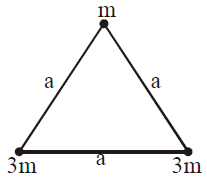
3 point masses are placed at the vertices of equilateral triangle . If a mass m is placed at the, centroid of the triangle. Find force on the mass placed at centroid.
(given : a is side of equilateral triangle)

1. 12Gm²/a²
2. 8Gm²/a²
3. 6Gm²/a²
4. 3Gm²/a²
View Answer

To find the net gravitational force on the mass \( m \) at the centroid, we follow these steps:

1. Forces due to extra masses \( 2m \):
- Each of the two lower vertices has an extra mass \( 2m \).
- The gravitational force due to one \( 2m \) mass at a distance \( \frac{a}{\sqrt{3}} \) from the centroid is:
\[
F = \frac{G (2m) m}{\left( \frac{a}{\sqrt{3}} \right)^2} = \frac{6 G m^2}{a^2}
\]

2. Net force between the two extra masses:
- The angle between the two forces is \( 120^\circ \).
- The resultant force is given by the vector addition formula:
\[
F_{\text{resultant}} = \sqrt{F^2 + F^2 + 2 F F \cos 120^\circ}
\]
Since \( \cos 120^\circ = -\frac{1}{2} \):
\[
F_{\text{resultant}} = \sqrt{F^2 + F^2 - F^2} = F = \frac{6 G m^2}{a^2}
\]

3. Conclusion:
The net gravitational force on the mass \( m \) at the centroid is:
\[
F_{\text{resultant}} = \frac{6 G m^2}{a^2}
\]
This force is directed vertically downward.

Question 5: difficult

If 100 kg mass is split into two parts and then separated by certain distance. then what ratio of masses so that gravitational force between them is maximum :

1. 2/3
2. 1/2
3. 1
4. 1/3
View Answer

The gravitational force between two masses \( m_1 \) and \( m_2 \) is given by Newton's law of gravitation:

\[
F = \frac{G m_1 m_2}{r^2}
\]

Let the total mass be \( M = 100 \, \text{kg} \), and split it into two parts: \( m_1 = x \) and \( m_2 = 100 - x \).

The gravitational force becomes:

\[
F = \frac{G x (100 - x)}{r^2}
\]

To maximize \( F \), we need to maximize \( x(100 - x) \), which is a quadratic function. The product \( x(100 - x) \) is maximized when \( x = 50 \).

Thus, the ratio of the two masses is:

\[
m_1 : m_2 = 50 : 50 = 1:1
\]

Therefore, the masses should be in a 1:1 ratio for the gravitational force to be maximum.

Question 6: difficult

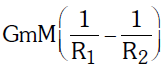
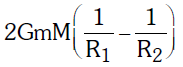
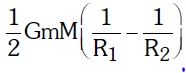
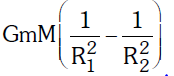
The additional kinetic energy to be provided to a satellite of mass m revolving around a planet of mass M, to transfer it from a circular orbit of radius R1 to another of radius R2(R2 > R1) is :

1.
2.
3.
4.
View Answer

The additional kinetic energy required to transfer a satellite from a circular orbit of radius \( R_1 \) to \( R_2 \) is the difference in kinetic energy between the two orbits.

Kinetic energy in a circular orbit is:

\[
K = \frac{GMm}{2R}
\]

The kinetic energy difference is:

\[
\Delta K = \frac{GMm}{2R_1} - \frac{GMm}{2R_2}
\]

Simplifying:

\[
\Delta K = \frac{GMm}{2} \left( \frac{1}{R_1} - \frac{1}{R_2} \right)
\]

So, the additional kinetic energy is:

\[
\Delta K = \frac{GMm}{2} \left( \frac{1}{R_1} - \frac{1}{R_2} \right)
\]