Gravitation - NEET Physics Questions
← All Chapters

Gravitation

Question 11: moderate

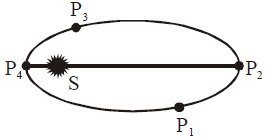
Figure shows a planet in an elliptical orbit around the sun S. Where is the kinetic energy of the planet maximum ?

1. P1
2. P2
3. P3
4. P4
View Answer

Explanation:

1. **Kepler's Second Law**:
- Kepler's Second Law states that a line segment joining a planet to the Sun sweeps out equal areas during equal intervals of time. This means that the planet moves faster when it is closer to the Sun and slower when it is farther away.

2. **Orbital Mechanics**:
- When the planet is at perigee, it is closer to the Sun, resulting in a stronger gravitational pull, which increases its orbital speed.
- Conversely, when the planet is at apogee, it is farther from the Sun, leading to a weaker gravitational pull and a decrease in its speed.

Summary:
- Maximum Speed: At perigee (closest point).
- Minimum Speed: At apogee (farthest point).

If you have any specific context or example related to this concept, please let me know!

Question 12: moderate

Taking that the earth revolves round the sun in a circular orbit of radius \( 15 × 10^{10}\)m with a time period of 1 year, the time taken by another planet, which is at a distance of \( 540 × 10^{10} \)m, to revolve round the sun in a circular orbit once, will be :

1. 216 years
2. 144 years
3. 72 years
4. 36 years
View Answer

To find the time taken by a planet at a distance of \( 540 \times 10^{10} \) m to revolve around the Sun, we can use Kepler's Third Law:

\[
\frac{T_1^2}{T_2^2} = \frac{r_1^3}{r_2^3}
\]

 Given:
- Earth:
- \( T_1 = 1 \) year
- \( r_1 = 15 \times 10^{10} \) m
- Planet:
- \( r_2 = 540 \times 10^{10} \) m

 Calculation:
1. Set up the ratio:
\[
\frac{1^2}{T_2^2} = \left( \frac{15}{540} \right)^3
\]
\[
\frac{15}{540} = \frac{1}{36} \quad \Rightarrow \quad \left( \frac{1}{36} \right)^3 = \frac{1}{46656}
\]

2. Solve for \( T_2^2 \):
\[
T_2^2 = 46656 \quad \Rightarrow \quad T_2 = \sqrt{46656} = 216 \text{ years}
\]

The time taken by the planet to revolve around the Sun once is approximately 216 years.

Question 13: moderate

Kepler’s second law is based on :

1. Newton's first law
2. Newton's second law
3. Special theory of relativity
4. Conservation of angular momentum
View Answer

Kepler's Second Law, also known as the **Law of Equal Areas**, states that a line segment joining a planet and the Sun sweeps out equal areas during equal intervals of time. This law implies that a planet moves faster when it is closer to the Sun and slower when it is farther away, resulting in an elliptical orbit.

### Connection to Angular Momentum Conservation:

1. **Angular Momentum Definition**:
Angular momentum (\( L \)) of a body moving around a point is given by:
\[
L = mvr
\]
where:
- \( m \) = mass of the body,
- \( v \) = tangential velocity,
- \( r \) = distance from the center of rotation (the Sun, in this case).

2. **Conservation of Angular Momentum**:
- In a system where no external torques act (like a planet orbiting the Sun), the angular momentum is conserved.
- This means that:
\[
L = mvr = \text{constant}
\]

3. **Implications for Planetary Motion**:
- As a planet moves in its elliptical orbit, its distance \( r \) from the Sun changes.
- To conserve angular momentum (\( L \)), if the planet is closer to the Sun (\( r \) decreases), its velocity \( v \) must increase. Conversely, when it is farther from the Sun (\( r \) increases), its velocity \( v \) must decrease.

4. **Area Swept Out**:
- The area swept out by the line segment joining the planet to the Sun in a time interval \( dt \) can be expressed in terms of angular momentum. The area (\( dA \)) swept out in time \( dt \) is:
\[
dA = \frac{1}{2} r^2 d\theta
\]
where \( d\theta \) is the angle subtended at the Sun during that time interval.

5. **Equal Areas in Equal Times**:
- Since angular momentum is conserved, the planet's motion adjusts in such a way that it sweeps out equal areas in equal times, which is the essence of Kepler's Second Law.

### Conclusion:
Kepler's Second Law reflects the conservation of angular momentum in planetary orbits. The relationship between distance from the Sun, velocity, and the areas swept out in equal time intervals illustrates that as a planet moves in its elliptical orbit, it adjusts its speed to conserve angular momentum, leading to the sweeping of equal areas in equal times.
Question 14: moderate

Two satellites are in the parking orbits around the earth. Mass of one is 10 times that of the other. The ratio of their periods of revolution is :

1. 1
2. √10
3. 10
4. 100
View Answer

The orbital period of a satellite depends only on the radius of its orbit and the mass of the Earth, not on the mass of the satellite itself. The period \( T \) is given by:

\[
T = 2\pi \sqrt{\frac{r^3}{GM}}
\]

Since the masses of the satellites do not appear in this formula, the periods of the two satellites will be the same if they are in the same orbit, regardless of their masses.

Therefore, the ratio of their periods of revolution is:

\[
\frac{T_1}{T_2} = 1
\]

So, the ratio is 1:1.

Question 15: moderate

A satellite is orbiting around the earth with a period T. If the earth suddenly shrinks to half its radius without change in mass the period of revolution of the satellite will be :

1. T/√2
2. T/2
3. T
4. 2T
View Answer

If the Earth's radius shrinks to half, but its mass remains the same, the orbital period of the satellite will not change.

The orbital period \( T \) of a satellite depends on the mass of the Earth \( M \) and the radius of the orbit \( r \), not the radius of the Earth itself. The formula for the period of a satellite in orbit is:

\[
T = 2\pi \sqrt{\frac{r^3}{GM}}
\]

Since the mass \( M \) of the Earth and the radius \( r \) of the satellite’s orbit (which is unaffected by the Earth shrinking) remain the same, the period \( T \) remains unchanged.

Thus, the new period of revolution will still be \( T \).

Question 16: moderate

Energy required to shift a satellite of mass m from orbit of radius r to another orbit of radius 3r/2 is ? (mass of earth = M )

1. GMm/3r
2. GMm/6r
3. 2GMm/3r
4. None of these
View Answer

The energy required to move a satellite from one orbit to another can be found using the difference in total mechanical energy between the two orbits.

The total energy \( E \) of a satellite in orbit of radius \( r \) is:

\[
E = -\frac{GMm}{2r}
\]

For the initial orbit of radius \( r \), the energy is:

\[
E_1 = -\frac{GMm}{2r}
\]

For the final orbit of radius \( \frac{3r}{2} \), the energy is:

\[
E_2 = -\frac{GMm}{2 \times \frac{3r}{2}} = -\frac{GMm}{3r}
\]

The energy required to shift the satellite is the difference between the two energies:

\[
\Delta E = E_2 - E_1 = \left(-\frac{GMm}{3r}\right) - \left(-\frac{GMm}{2r}\right)
\]

\[
\Delta E = \frac{GMm}{2r} - \frac{GMm}{3r} = \frac{GMm}{6r}
\]

So, the energy required is:

\[
\Delta E = \frac{GMm}{6r}
\]

Question 17: moderate

The mean distance of mars from sun is 1.5 times that of earth from sun. What is approximately the number of years required by mars to make one revolution about sun ?

1. 2.35 years
2. 1.85 years
3. 3.65 years
4. 2.75 years
View Answer

To find the number of years Mars takes to make one revolution around the Sun, we can use Kepler's Third Law, which states:

\[
T^2 \propto r^3
\]

where \( T \) is the orbital period and \( r \) is the average distance from the Sun.

Given:
- Let the average distance of Earth from the Sun be \( r_E \).
- The average distance of Mars from the Sun is \( r_M = 1.5 r_E \).

Using Kepler's Third Law:
1. For Earth:
\[
T_E^2 \propto r_E^3
\]

2. For Mars:
\[
T_M^2 \propto r_M^3 ; T_M^2 \propto (1.5 r_E)^3 = 1.5^3 r_E^3
\]

3. We know \( T_E \) (the period of Earth) is approximately **1 year**:
\[
T_M^2 = 1.5^3 T_E^2
\]
\[
T_M^2 = 1.5^3 \times 1^2 = 3.375
\]

4. Therefore,
\[
T_M = \sqrt{3.375} \approx 1.84 \, \text{years}
\]

Conclusion:
Mars takes approximately 1.84 years to make one revolution around the Sun.

Question 18: easy

Near the earth’s surface time period of a satellite is 1.4 hrs. Find its time period if it is at the distance ‘4R’ from the centre of earth :

1. 32 hrs.
2. (1/8√2) hrs.
3. 8√2 hrs.
4. 16 hrs.
View Answer

To find the time period of a satellite at a distance \( 4R \) from the center of the Earth, we can use Kepler's third law of planetary motion, which states:

\[
T^2 \propto r^3
\]

1. Given:
- Time period at Earth's surface (\( T_0 \)): \( 1.4 \) hours (or \( T_0 = 1.4 \times 3600 \) seconds).
- Radius of the Earth: \( R \).

2. At Distance \( 4R \):
- The new radius \( r = 4R \).

3. Using the relationship:
\[
\frac{T^2}{T_0^2} = \frac{r^3}{R^3}
\]

Substituting \( r = 4R \):
\[
\frac{T^2}{T_0^2} = \frac{(4R)^3}{R^3} = \frac{64R^3}{R^3} = 64
\]

4. Solving for \( T \):
\[
T^2 = 64 T_0^2 ; T = 8 T_0
\]

5. Substituting \( T_0 \):
\[
T = 8\sqrt{2}, \text{hours} \]

Question 19: moderate

The orbital velocity of an artificial satellite in a circular orbit just above the earth’s surface is v0. The orbital velocity of satellite orbiting at an altitude of half of the radius is :

1.
2.
3.
4.
View Answer

The orbital velocity \( v \) at a height \( h \) above the Earth's surface is given by:

\[
v = \sqrt{\frac{GM}{R + h}}
\]

For the satellite orbiting just above the Earth's surface (i.e., \( h = 0 \)), the velocity is:

\[
v_0 = \sqrt{\frac{GM}{R}}
\]

For a satellite at an altitude of \( h = \frac{R}{2} \), the velocity \( v_h \) becomes:

\[
v_h = \sqrt{\frac{GM}{R + \frac{R}{2}}} = \sqrt{\frac{GM}{\frac{3R}{2}}} = \sqrt{\frac{2}{3}} v_0
\]

Thus, the orbital velocity at an altitude of \( \frac{R}{2} \) is:

\[
v_h = \sqrt{\frac{2}{3}} v_0
\]

Question 20: moderate

Two satellites A and B go around a planet P in circular orbits having radius 4R and R respectively. If the speed of satellite A is 3 v, then the speed of satellite B will be :

1. 5 v
2. 9 v
3. 6 v
4. none of these
View Answer

The orbital speed \( v \) of a satellite is given by:

\[
v = \sqrt{\frac{GM}{r}}
\]

where \( r \) is the radius of the orbit.

Let the speeds of satellites A and B be \( v_A \) and \( v_B \), and their orbital radii be \( 4R \) and \( R \), respectively. Using the relation:

\[
v_A = \sqrt{\frac{GM}{4R}}, \quad v_B = \sqrt{\frac{GM}{R}}
\]

Given \( v_A = 3v \), we can write:

\[
3v = \sqrt{\frac{GM}{4R}}
\]

Now, the speed of satellite B is:

\[
v_B = \sqrt{\frac{GM}{R}} = 2 \times \sqrt{\frac{GM}{4R}} = 2 \times 3v = 6v
\]

So, the speed of satellite B is \( 6v \).