Gravitation - NEET Physics Questions
Question 1: easy

The depth at which the value of acceleration due to gravity becomes 1/n times the value at the surface is (R be the radius of the earth) :

1. R/n
2. R/nΒ²
3. R(n-1)/n
4. Rn/n-1
View Answer

The depth at which the acceleration due to gravity becomes \( \frac{1}{n} \) times the surface value is:

\[
d = \left( 1 - \frac{1}{n} \right) R
\]

where \( R \) is the radius of the Earth.
Question 2: easy

Near the earth’s surface time period of a satellite is 1.4 hrs. Find its time period if it is at the distance ‘4R’ from the centre of earth :

1. 32 hrs.
2. (1/8√2) hrs.
3. 8√2 hrs.
4. 16 hrs.
View Answer

To find the time period of a satellite at a distance \( 4R \) from the center of the Earth, we can use Kepler's third law of planetary motion, which states:

\[
T^2 \propto r^3
\]

1. Given:
- Time period at Earth's surface (\( T_0 \)): \( 1.4 \) hours (or \( T_0 = 1.4 \times 3600 \) seconds).
- Radius of the Earth: \( R \).

2. At Distance \( 4R \):
- The new radius \( r = 4R \).

3. Using the relationship:
\[
\frac{T^2}{T_0^2} = \frac{r^3}{R^3}
\]

Substituting \( r = 4R \):
\[
\frac{T^2}{T_0^2} = \frac{(4R)^3}{R^3} = \frac{64R^3}{R^3} = 64
\]

4. Solving for \( T \):
\[
T^2 = 64 T_0^2 ; T = 8 T_0
\]

5. Substituting \( T_0 \):
\[
T = 8\sqrt{2}, \text{hours} \]

Question 3: easy

The height at which the weight of a body becomes 1/16th, its weight on the surface of earth (radius R), is :

1. 3R
2. 4R
3. 5R
4. 15R
View Answer

The weight of a body at height \( h \) is given by:

\[
W_h = W_0 \left( \frac{R}{R + h} \right)^2.
\]

To find \( h \) when \( W_h = \frac{1}{16} W_0 \):

\[
\frac{1}{16} = \left( \frac{R}{R + h} \right)^2.
\]

Taking the square root:

\[
\frac{1}{4} = \frac{R}{R + h}.
\]

Cross-multiplying gives:

\[
R + h = 4R ; h = 3R.
\]

Thus, the height is \( 3R \).

Question 4: easy

The height at which the acceleration due to gravity decreases by 36% of its value on the surface of the earth is: (Assume radius of the earth is R) :

1. R/4
2. R/2
3. R/6
4. 4R
View Answer

The height \( h \) at which gravity decreases by 36% (to 64% of its surface value) is found using:

\[
g_h = \frac{gR^2}{(R + h)^2}.
\]

Setting \( g_h = 0.64g \):

\[
0.64 = \frac{R^2}{(R + h)^2}.
\]

Taking the square root:

\[
0.8 = \frac{R}{R + h}.
\]

Cross-multiplying gives:

\[
0.8(R + h) = R \implies 0.8h = 0.2R \implies h = 0.25R=R/4
\]

Thus, the height is R/4.

Question 5: easy

A particle of mass M is situated at the centre of a spherical shell of same mass and radius a. The gravitational potential at a point situated at a/2 distance from the centre, will be :

1. -4GM/a
2. -3GM/a
3. -2GM/a
4. -GM/a
View Answer

The gravitational potential inside a spherical shell (including at the center) due to the shell is constant. The potential at a distance \( a/2 \) from the center is the sum of the potentials due to the mass at the center and the shell.

\[
V = -\frac{GM}{a/2} - \frac{GM}{a}
\]

Simplifying:

\[
V = -\frac{2GM}{a} - \frac{GM}{a} = -\frac{3GM}{a}
\]

So, the potential at \( a/2 \) is:

\[
V = -\frac{3GM}{a}
\]

Question 6: easy

A satellite S is moving in an elliptical orbit around the earth. The mass of the satellite is very small compared to the mass of the earth. Then,

1. the acceleration of S is always directed towards the centre of the earth.
2. the angular momentum of S about the centre of the earth changes in direction, but its magnitude remains constant.
3. the total mechanical energy of S varies periodically with time.
4. the linear momentum of S remains constant in magnitude.
View Answer

Yes, the acceleration of the satellite \( S \) is always directed towards the center of the Earth. This is because the gravitational force, which provides the acceleration, always points towards the Earth's center, regardless of the satellite's position in its elliptical orbit. This centripetal acceleration is responsible for keeping the satellite in orbit.

Question 7: easy

A planet is moving in a elliptical orbit. If T, U, E and L are its kinetic energy, potential energy, total energy and magnitude of angular momentum respectively. Then which is true

1. T is conserved
2. U is always positive
3. E is always negative
4. L is conserved but direction of vector L will continously change
View Answer

For a planet in an elliptical orbit:

- Total energy (E) is the sum of kinetic energy (T) and potential energy (U).
- In a bound orbit like an ellipse, E is always negative. This indicates that the planet is gravitationally bound to the star and cannot escape.
- Kinetic energy (T) is always positive.
- Potential energy (U)Β is negative due to the attractive gravitational force, and its magnitude is greater than T.
- Angular momentum (L)Β is constant for elliptical orbits.

Thus, E is always negativeΒ for elliptical orbits.

Question 8: easy

The height at which the weight of a body becomes 1/16th, its height from the surface of earth (radius R), is :

1. 3R
2. 4R
3. 5R
4. 15R
View Answer

To find the height \( h \) at which the weight of a body becomes \( \frac{1}{16} \) of its weight on the surface of the Earth, use the formula:

\[
W_h = W_0 \left( \frac{R}{R + h} \right)^2.
\]

Setting \( W_h = \frac{1}{16} W_0 \):

\[
\frac{1}{16} = \left( \frac{R}{R + h} \right)^2.
\]

Taking the square root:

\[
\frac{1}{4} = \frac{R}{R + h}.
\]

Cross-multiplying gives:

\[
R + h = 4R ; h = 4R - R = 3R.
\]

Thus, the height is \( 3R \).

Question 9: easy

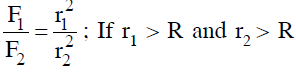
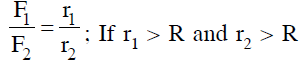
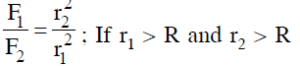
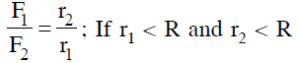
The magnitude of the gravitational force at distance r1 and r2 from the centre of a uniform sphere of radius R and mass M are F1 and F2 respectively then :

1.
2.
3.
4.
View Answer

When both \( r_1 \) and \( r_2 \) are greater than \( R \) (i.e., both are outside the sphere), the gravitational force at a distance \( r \) from the center of a uniform sphere is given by:

\[
F = \frac{G M}{r^2}
\]

So, the forces \( F_1 \) and \( F_2 \) at distances \( r_1 \) and \( r_2 \) from the center are:

\[
F_1 = \frac{G M}{r_1^2}
\]
\[
F_2 = \frac{G M}{r_2^2}
\]

Now, taking the ratio \( \frac{F_1}{F_2} \):

\[
\frac{F_1}{F_2} = \frac{\frac{G M}{r_1^2}}{\frac{G M}{r_2^2}} = \frac{r_2^2}{r_1^2}
\]

Thus, the ratio of the gravitational forces is:

\[
\frac{F_1}{F_2} = \left( \frac{r_2}{r_1} \right)^2
\]

Question 10: easy

If the rotational motion of earth is suddenly stopped then which one is correct :

1. Value of g decreases on all places of earth
2. Value of g increases on all places of earth except pole
3. Value of g increases on all places of earth
4. Value of g decreases on all places of earth except equator
View Answer

If the Earth's rotational motion were suddenly stopped, the value of \( g \) would effectively increase everywhere except at the poles due to the following reasons:

1. Centrifugal Force: The Earth's rotation creates a centrifugal force that slightly counteracts the force of gravity. At the equator, this effect is the greatest, reducing the apparent weight and thus the effective value of \( g \). When rotation stops, this centrifugal force disappears.

2. At the Poles: At the poles, there is no centrifugal force due to rotation since they are the axis of rotation. Therefore, the value of \( g \) would remain unchanged at the poles.

Consequently, \( g \) would increase at all places on Earth except at the poles, where it would stay the same.