LR, RC and LCR Circuits - NEET Physics Questions
← Back to Alternating Current

LR, RC and LCR Circuits

Question 1: difficult

The graph shows variation of I with f for a series R-L-C network. Keeping L and C constant. If R
decreases :
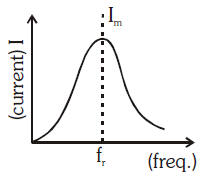
(a) Maximum current (Im) increases
(b) Sharpness of the graph increases
(c) Quality factor increases
(d) Band width increases

1. a, b, c
2. b, c, d
3. c, d, a
4. All
View Answer
Question 2: difficult

A series LCR circuit containing \(5.0\text{ H}\) inductor, \(80 \mu\text{F}\) capacitor and \(40 \Omega\) resistor is connected to \(230\text{ V}\) variable frequency ac source. The angular frequencies of the source at which power transferred to the circuit is half the power at the resonant angular frequency are likely to be

1. 42 rad/s and 58 rad/s
2. 25 rad/s and 75 rad/s
3. 50 rad/s and 25 rad/s
4. 46 rad/s and 54 rad/s
View Answer

The resonant angular frequency is \(\omega_0 = \frac{1}{\sqrt{LC}} = \frac{1}{\sqrt{5 \times 80 \times 10^{-6}}} = 50\text{ rad/s}\) and the bandwidth is \(Delta \omega = \frac{R}{L} = \frac{40}{5} = 8\text{ rad/s}\). The half-power frequencies are \(omega_0 \pm \frac{\Delta \omega}{2} = 50 \pm 4\text{ rad/s}\), which gives \(46\text{ rad/s}\) and \(54\text{ rad/s}\).