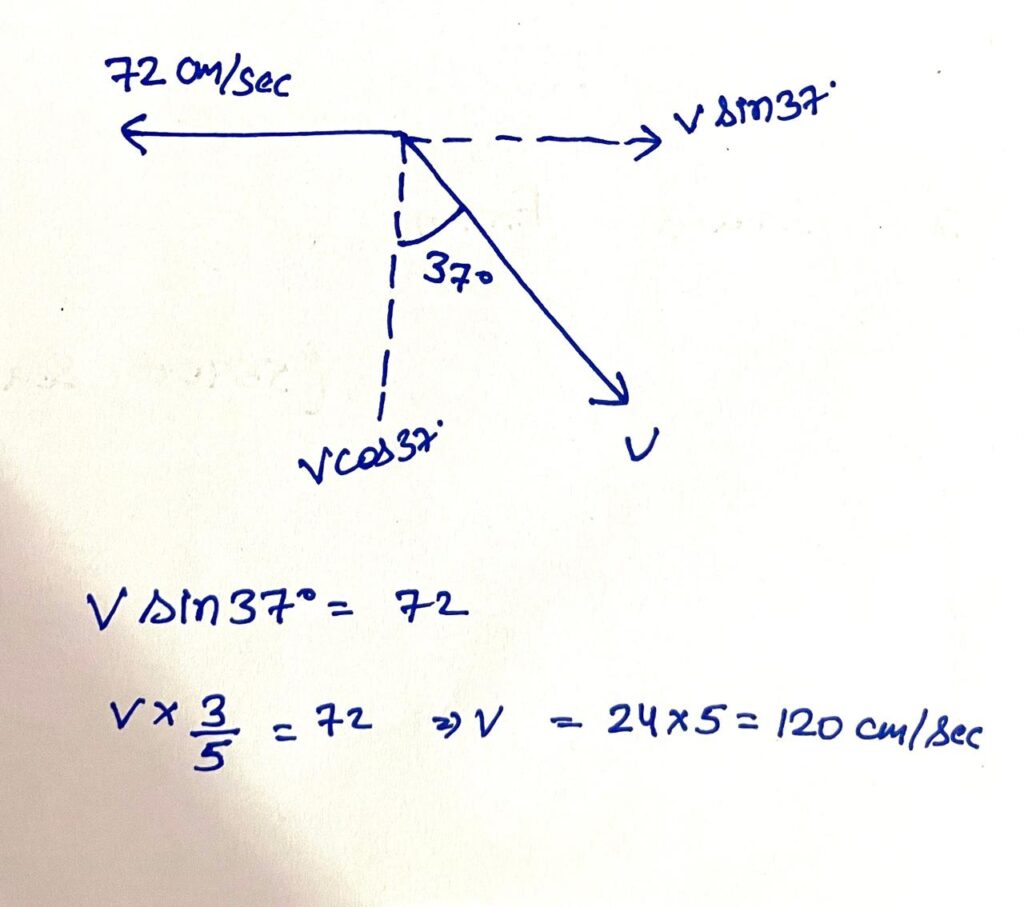
Question 1:
moderateA man walks in rain at 72 cm/s due east and observes the rain falling vertically. When he stops, rain appears to strikes his back at 37º from the vertical. Find velocity of raindrops relative to the ground.
Question 1:
moderateA man walks in rain at 72 cm/s due east and observes the rain falling vertically. When he stops, rain appears to strikes his back at 37º from the vertical. Find velocity of raindrops relative to the ground.
Question 2:
moderateA man wishes to swim across a river 400 m wide flowing with a speed of 3m/s, such that he reaches the point just in front on the other bank in time not greater than 100 sec. The angle made by the direction he swims and river flow direction is :
Distance travelled in y-direction = 400 m
Time to cross = 100 sec
So, Speed in y-direction = 4 m/s
Speed in x-direction = 3m/s
So, angle = 90 +37 =127º
Question 3:
moderateRain drops are falling vertically and a man is running on the ground horizontally with speed equal to the rain with respect to the ground. Rain drops appears to him hitting with velocity 10 km/hr. Find velocity of rain.
Velocity of Rain = - V j
Velocity of Person = V i
Velocity of Rain with respect to the Person = - V i - V j
so, V√2 = 10 ⇒ V = 5√2 km/hr
Question 4:
moderateThe acceleration due to gravity on the planet A is 9 times the acceleration due to gravity on planet B. A man jumps to a height of 2m on the surface of A. What is the height of jump by the same person on the planet B ?
From Equations of motion
The height of a jump is inversely proportional to the acceleration due to gravity. Let \( h_A \) be the height of the jump on planet A, and \( h_B \) be the height of the jump on planet B. Also, let \( g_A \) and \( g_B \) represent the acceleration due to gravity on planets A and B, respectively.
Given:
- \( g_A = 9g_B \)
- \( h_A = 2 \, \text{m} \)
The ratio of heights is:
\[
\frac{h_B}{h_A} = \frac{g_A}{g_B} = 9
\]
Thus, the height on planet B is:
\[
h_B = 9 \times h_A = 9 \times 2 = 18 \, \text{m}
\]
So, the height of the jump on planet B is \( 18 \, \text{m} \).
Question 5:
moderateA small block slides without friction down an inclined plane starting from rest. Let Sn be the distance travelled from time t = n – 1 to t = n. Then Sn/Sn+1 is :
Sn = u + a/2(2n-1) = a/2(2n-1)
Sn+1 = u + a/2(2(n+1)-1) = a/2(2n+1)
Sn / Sn+1 = (2n-1)/(2n+1)
Question 6:
difficultThe given graph shows the variation of velocity with which one of the graph given below correctly represents the variation of acceleration with displacement :
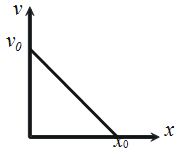
\[ a= v \frac{dv}{ds} \]
Question 7:
moderateThe height y and the distance x along the horizontal plane of a projectile on a certain planet (with no surrounding atmosphere) are given by y = (8t – 5t²) meter and x = 6t meter, where t is in second. The velocity with which the projectile is projected is :
Given:
\[
y = 8t - 5t^2 \quad \text{and} \quad x = 6t
\]
To find the initial velocity, we calculate the horizontal and vertical components of velocity:
1. Horizontal velocity \( v_x = \frac{dx}{dt} = 6 \, \text{m/s} \)
2. Vertical velocity \( v_y = \frac{dy}{dt} = 8 - 10t \)
At \( t = 0 \) (initial velocity):
\[
v_y(0) = 8 \, \text{m/s}
\]
Thus, the magnitude of the initial velocity \( u \) is:
\[
u = \sqrt{v_x^2 + v_y^2} = \sqrt{6^2 + 8^2} = \sqrt{36 + 64} = \sqrt{100} = 10 \, \text{m/s}
\]
The velocity of projection is \( 10 \, \text{m/s} \).
Question 8:
moderateA body moves 6 m north, 8 m east and 10 m vertically upwards, what is its resultant displacement from initial position?
1. Movement 1: 6 m North
\[
\text{Displacement}_1 = 6 \hat{j}
\]
2. Movement 2: 8 m East
\[
\text{Displacement}_2 = 8 \hat{i}
\]
3. Movement 3: 10 m Vertically Upwards
\[
\text{Displacement}_3 = 10 \hat{k}
\]
Total Displacement:
\[
\text{Total Displacement} = 6 \hat{j} + 8 \hat{i} + 10 \hat{k}
\]
Magnitude of Displacement:
\[
|\text{Total Displacement}| = \sqrt{(8^2) + (6^2) + (10^2)} = \sqrt{64 + 36 + 100} = \sqrt{200} = 10\sqrt{2} \, \text{m}
\]
Question 9:
moderateA person moves 30 m north and then 20 m towards east and finally 30√2 min south -west direction. The displacement of the person from the origin will be
1. Movement 1: 30 m North \( \text{Displacement}_1 = 30 \hat{j} \)
2. Movement 2: 20 m East \( \text{Displacement}_2 = 20 \hat{i} \)
3. Movement 3: \( 30\sqrt{2}\) m Southwest \( \text{Displacement}_3 = -30 \hat{i} - 30 \hat{j} \)
Total Displacement: \(
\text{Total Displacement} = (20 \hat{i} + 30 \hat{j}) + (-30 \hat{i} - 30 \hat{j}) = -10 \hat{i} + 0 \hat{j} \)
Displacement = 10 m West
Question 10:
moderateA car moves a distance of 200 m. It covers first half of the distance at speed 60 kmh–¹ and the second half at speed v. If the average speed is 40 kmh–¹, the value of v is
\[ V_{av}= \frac{2V_{1}.V_{2}}{V_{1}+V_{2}}\]
\[ 40= \frac{2\times 60\times V_{2}}{ 60+V_{2}} \]
\[ V_{2}= 30 m/s \]