Ground to Ground Projectile - NEET Physics Chapterwise MCQs & PYQs

NEET Ground to Ground Projectile MCQs & PYQs

Question 1:

moderate

The height y and the distance x along the horizontal plane of a projectile on a certain planet (with no surrounding atmosphere) are given by y = (8t – 5t²) meter and x = 6t meter, where t is in second. The velocity with which the projectile is projected is :

Given:

\[
y = 8t - 5t^2 \quad \text{and} \quad x = 6t
\]

To find the initial velocity, we calculate the horizontal and vertical components of velocity:

1. Horizontal velocity \( v_x = \frac{dx}{dt} = 6 \, \text{m/s} \)
2. Vertical velocity \( v_y = \frac{dy}{dt} = 8 - 10t \)

At \( t = 0 \) (initial velocity):

\[
v_y(0) = 8 \, \text{m/s}
\]

Thus, the magnitude of the initial velocity \( u \) is:

\[
u = \sqrt{v_x^2 + v_y^2} = \sqrt{6^2 + 8^2} = \sqrt{36 + 64} = \sqrt{100} = 10 \, \text{m/s}
\]

The velocity of projection is \( 10 \, \text{m/s} \).

Question 2:

moderate

The maximum height reached by projectile is 4 m. The horizontal range is 12m. The velocity of projection in ms–¹ is : (g is acceleration due to gravity) :

We Know that,

\[ \frac{R}{H}=\frac{4}{tan\theta}\]

\[ tan \theta = 4/3 \]

\[ H = \frac{u^{2}sin^{2}\theta}{2g} \]

Solving we get

\[ u= 5\sqrt{g/2}\]

Question 3:

moderate

The equation of motion of a projectile is \[y=12x-\frac{3}{4}x^{2}\] . What is the range of the projectile?

The equation of motion of the projectile is given as:

\[
y = 12x - \frac{3}{4}x^2
\]

At the range, \( y = 0 \). To find the range, set \( y = 0 \) and solve for \( x \):

\[
0 = 12x - \frac{3}{4}x^2
\]

Multiply the entire equation by 4 to eliminate the fraction:

\[
0 = 48x - 3x^2
\]

Factor the equation:

\[
0 = x(48 - 3x)
\]

This gives two solutions:

\[
x = 0 \quad \text{or} \quad 48 - 3x = 0
\]

Solving for \( x \):

\[
x = \frac{48}{3} = 16
\]

Question 4:

moderate

A particle is projected at 60° to the horizontal with a kinetic energy K. The kinetic energy at the highest point is :

At the highest point of its trajectory, the vertical component of the velocity becomes zero, while the horizontal component remains unchanged.

Initial kinetic energy \( K \) is given by:

\[
K = \frac{1}{2} m u^2
\]

At the highest point, only the horizontal component of the velocity \( u \cos 60^\circ \) remains. Therefore, the kinetic energy at the highest point is due to this horizontal velocity:

\[
K_{\text{highest}} = \frac{1}{2} m (u \cos 60^\circ)^2
\]

Since \( \cos 60^\circ = \frac{1}{2} \):

\[
K_{\text{highest}} = \frac{1}{2} m \left(\frac{u}{2}\right)^2 = \frac{1}{4} \times \frac{1}{2} m u^2 = \frac{K}{2}
\]

Thus, the kinetic energy at the highest point is \( \frac{K}{2} \).

Question 5:

easy

Velocity versus time graph for a body projected vertically upwards is :-

Question 6:

moderate

A particle is thrown with the speed u at an angle α with the horizontal. When the particle makes an angle β with the horizontal, its speed will be :

During Projectile motion horizontal component of velocity remains same so,

\[ u cos\alpha = v cos \beta \]

\[ \frac{u cos\alpha}{cos \beta} = v  \]

\[ {u .cos\alpha}.{sec \beta} = v \]

Question 7:

easy

At what angle to the horizontal should an object be projected so that the maximum height reached is equal to the horizontal range?

\[ \frac{R}{H}=\frac{4}{tan\theta} \]

\[ As, R=H; tan\theta=4 \]

Question 8:

moderate

If a body A of mass M is thrown with velocity v at an angle 30° to the horizontal and another body B of same mass is thrown with same speed at an angle of 60° to the horizontal, the ratio of range of A and B will be :

For Complementary angles ranges are equal

Question 9:

moderate

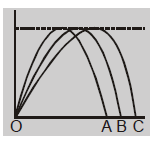
Three projectiles A, B and C are thrown from the same point in the same plane. Their trajectories are shown in the figure. Which of the following statement is true ?

As maximum height is same is all three they will have same vertical speed.

Range of C is maximum so its horizontal speed is maximum.
Question 10:

difficult

At what angle to the horizontal should a ball be thrown so that its range R is related to the time of flight T as R = 5T² ? Take g = 10 ms–² :


Given the relationship \( R = 5T^2 \), and using the formulas for range \( R \) and time of flight \( T \):

1. **Range formula:**
R = u cos(θ) · T

2. **Time of flight formula:**
T = (2u sin(θ)) / g

Substituting T into the range equation:

R = u cos(θ) · (2u sin(θ) / g)

This gives:

R = (2u² sin(θ) cos(θ)) / g

Setting this equal to \( 5T^2 \):

(2u² sin(θ) cos(θ)) / g = 5((2u sin(θ)) / g)²

Simplifying:

(2u² sin(θ) cos(θ)) / g = (20u² sin²(θ)) / g²

Cancelling \( u² / g \):

2 cos(θ) = 20 sin(θ) / g

Given g = 10 m/s²:

2 cos(θ) = 2 sin(θ)

Thus:

cos(θ) = sin(θ)

This implies:

tan(θ) = 1 → θ = 45°

The angle to the horizontal should be  45°