Average Speed and Velocity - NEET Physics Chapterwise MCQs & PYQs

NEET Average Speed and Velocity MCQs & PYQs

Question 1:

moderate

A car moves a distance of 200 m. It covers first half of the distance at speed 60 kmh–¹ and the second half at speed v. If the average speed is 40 kmh–¹, the value of v is

\[ V_{av}= \frac{2V_{1}.V_{2}}{V_{1}+V_{2}}\]

\[ 40= \frac{2\times 60\times V_{2}}{ 60+V_{2}}  \]

\[ V_{2}= 30 m/s \]
Question 2:

moderate

A body of mass m moving along a straight line covers half the distance with a speed of 2 ms–¹. The remaining half of distance is covered in two equal time intervals with a speed of 3 ms–¹ and 5 ms–¹ respectively. The average speed of the particle for the entire journey is

For Second Half of Journey

\[ V_{av}=\frac{3+5}{2}= 4 m/s \]

\[ V_{av}= \frac{2\times 2 \times 4}{2+4}= \frac{8}{6}= \frac{4}{3} \]

Question 3:

difficult

A particle is moving with a constant speed v on a circle of radius R, then find average acceleration of particle during half cycle is :

Change in velocity = 2V

Time taken = πR/V so,

Average acceleration = 2V/(Ï€R/V)

Question 4:

moderate

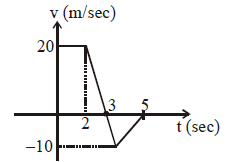
Velocity-time graph of a particle is given as :


then average speed of particle from t = 0 to t = 5 sec is :

Area bounded with Velocity time graph represents displacement. Magnitude of Area bounded  by Velocity time graph represents distance.

Total Area = 60 so, distance = 60 m and time = 5 sec.

Average speed = 12 m/s

Question 5:

easy

A car moves from X to Y with a uniform speed \[v_{u}\] and returns to X with a uniform speed \[v_{d}\]. The average speed for this round trip is


\[ \frac{2}{V_{av}}= \frac{1}{V_{1}}+\frac{1}{V_{2}} \]

Question 6:

difficult

A car is moving along a straight road with a uniform acceleration. It passes through two points P and Q separated by a distance with velocity 30 km/hr and 40 km/hr respectively. The velocity of the car midway between P and Q is :

Speed at mid point is given by

\[ V_{mid}=\sqrt{\frac{V_{1}^{2}+V_{2}^{2}}{2}} \]

Question 7:

difficult

Between two stations, a train accelerates from rest uniformly at first, then moves with constant velocity, and finally retards uniformly to come to rest. If the ratio of the time taken is 1 : 8 : 1 and the maximum speed attained be 60 km h–¹, then what is the average speed over the whole journey?

  1. Time Ratios: The time ratios are given as
    1:8:11:8:1
     

    . So, if the total time is tt 

    , the train spends t10\frac{t}{10} 

    accelerating, 8t10\frac{8t}{10} 

    at constant velocity, and t10\frac{t}{10} 

    decelerating.

  2. Velocity-Time Graph:
    • The graph forms a trapezium.
    • The train accelerates linearly from 0 to 60 km/h, holds constant at 60 km/h, and then decelerates back to 0.

    Key points:

    • The area under this graph represents the total distance traveled.
    • The height (maximum velocity) = 60 km/h.
    • The time intervals are in the ratio
      1:8:11:8:1
       

      .

  3. Average Speed:
    The area of the trapezium is given by: 

    Area=12×(ttotal)×(initial velocity+final velocity)\text{Area} = \frac{1}{2} \times (t_{\text{total}}) \times (\text{initial velocity} + \text{final velocity})For the constant velocity portion:


    Average speed=60×(1+8+1)10=54 km/h\text{Average speed} = \frac{60 \times (1 + 8 + 1)}{10} = 54 \, \text{km/h}

Thus, the average speed is 54 km/h.

Question 8:

moderate

A car is moving along a straight line OP as shown in the figure. It moves from O to P in 18 s and returns from P to Q in 6 s. Which of the following statements is not correct regarding the motion of the car :

Total Distance = OP + PQ = 360 + 120 = 480 m

Displacement = OQ= 240 m

Average Speed = 480/24 = 20 m/s

Average Velocity= 240/24= 10 m/s

Question 9:

easy

A cyclist moving on a circular track of radius 40 m completes half a revolution in 40 s. Its average velocity is :

Displacement = 2R = 80 m

Time = 4o sec

Velocity= 80 m/ 40 sec = 2 m/s

Question 10:

difficult

If velocity of a particle is given by V = (t + 3) m/s, then average velocity in interval

0 ≤ t ≤ 1s is :

\[ V_{av}=\frac{\int_{0}^{1}v.dt}{\int_{0}^{1}dt}= \frac{\int_{0}^{1}(t + 3).dt}{\int_{0}^{1}dt}=\frac{7}{2} m/s \]
