Graphs of Motion: Practice Problem & Solution
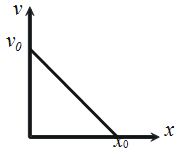
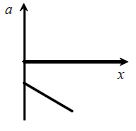
The given graph shows the variation of velocity with which one of the graph given below correctly represents the variation of acceleration with displacement :
Solution Explained:
To solve this problem, we apply the core principles of Graphs of Motion. Understanding the underlying formula is key to arriving at the correct answer below:
\[ a= v \frac{dv}{ds} \]
From the given $v-x$ graph, the equation of the straight line is:
$$v = -\left(\frac{v_0}{x_0}\right)x + v_0$$
Acceleration $a$ as a function of position $x$ is defined as:
$$a = v \frac{dv}{dx}$$
-
Find the velocity gradient $\frac{dv}{dx}$:$$\frac{dv}{dx} = -\frac{v_0}{x_0}$$
-
Substitute $v$ and $\frac{dv}{dx}$ into the acceleration equation:$$a = \left(-\frac{v_0}{x_0}x + v_0\right) \left(-\frac{v_0}{x_0}\right)$$$$a = \left(\frac{v_0}{x_0}\right)^2 x - \frac{v_0^2}{x_0}$$
Conclusion:
-
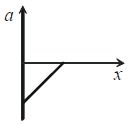
The $a-x$ relation is a straight line with a positive slope $m = \left(\frac{v_0}{x_0}\right)^2 > 0$ and a negative $y$-intercept $c = -\frac{v_0^2}{x_0}$.
-
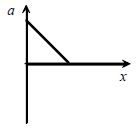
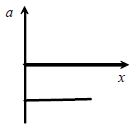
Therefore, the graph starts at a negative value on the acceleration axis ($a = -v_0^2 / x_0$ at $x = 0$) and increases linearly to zero at $x = x_0$ (represented by the first option).
Explain
Have added explanation. Have a look