Question 1:
easy
Velocity of sound in medium is V. If the density of the medium is doubled, what will be the new velocity of sound ?
Velocity of sound in medium is V. If the density of the medium is doubled, what will be the new velocity of sound ?
Speed of sound waves in a fluid depends upon
Two waves of intensity ratio 9 : 1 produce interference then
\[ \frac{I _{max}}{I _{min} } = \]
In a stationary wave all the particles
The particle displacement (in cm) in a stationary wave is given by y(x, t) = 2 sin (0.1 πx) cos (100 πt). The distance between a node and the next antinode is
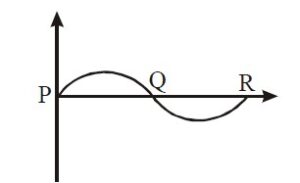
Instantaneous profile of a rope carrying a progressive wave moving from left to right is shown. Find the correct option
The equations of two interferring waves are \(Y_1 = b cos \omega t\) and \(Y_2 = b cos (\omega t+\phi)\) respectively. Destructive interference will take place at the point of observation for the following value of \(\phi\) :–
For destructive interference to occur, the phase difference between the two interfering waves must be an odd multiple of \(pi\) (i.e., \(180^0\), \(540^0 \), etc.). From the options, \(180^0 \) is correct.
Two tuning forks A and B when sounded together produce \(4\text{ beats/s}\). When B is loaded with wax, the beat frequency remains same. If frequency of A is \(212\text{ Hz}\). The frequency of B before loading is:
The frequency of B must be either \(212 + 4 = 216\text{ Hz}\) or \(212 - 4 = 208\text{ Hz}\). Loading B with wax decreases its frequency. For the beat frequency to remain \(4\text{ Hz}\), its frequency must drop from \(216\text{ Hz}\) to \(208\text{ Hz}\). Thus, the initial frequency of B is \(216\text{ Hz}\).
If a string fixed at both ends vibrates in three loops, the wavelength is \(30\text{ cm}\). The length of string is:
For a string fixed at both ends vibrating in \(n\) loops, the length of the string is given by \(L = \frac{n\lambda}{2}\). Here, \(n = 3\) and \(\lambda = 30\text{ cm}\), so \(L = 3 \times \frac{30}{2} = 45\text{ cm}\).
Two waves represented by the following equations are travelling in the same medium: \(y_1 = 5 \sin 2\pi(75t – 0.25x)\) and \(y_2 = 10 \sin 2\pi(150t – 0.50x)\). The intensity ratio \(I_1/I_2\) of the two waves is:
The intensity of a wave is proportional to the square of its amplitude and frequency, \(I \propto A^2 f^2\). Substituting \(A_1=5, f_1=75\) and \(A_2=10, f_2=150\) gives \(\frac{I_1}{I_2} = \left(\frac{5}{10}\right)^2 \left(\frac{75}{150}\right)^2 = \frac{1}{16}\).