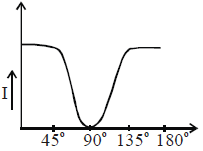
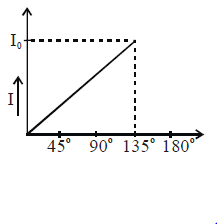
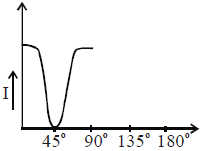
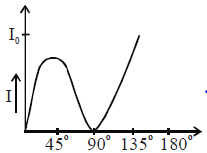
Two polaroids are placed in the path of unpolarized beam of intensity I0 such that no light is emitted from the second polaroid. If a third polaroid whose polarization axis makes an angle θ with the polarization axis of first polaroid, is placed between these polaroids then the intensity of light emerging from the last polaroid will be :
A light has amplitude A and angle between analyser and polariser is 60 degree. Light is transmitted by analyser has amplitude.
Two Nicols are oriented with their principal planes making an angle of 60°. The percentage of incident unpolarized light which passes through the system is :
The graph showing the dependence of intensity of transmitted light on the angle between polariser and analyser, is :
A beam of unpolarised light of intensity \(I_0\) is passed through a polaroid \(A\) and then through analyser \(B\) which is oriented such that its pass-axis makes an angle of \(30^\circ\) relative to that of \(A\). The intensity of emergent light is
Intensity after polaroid \(A\) is \(I_1 = frac{I_0}{2}\). Using Malus's Law, the intensity after analyser \(B\) is \(I_2 = I_1 \cos^2 30^\circ = frac{I_0}{2} \left(\frac{\sqrt{3}}{2}\right)^2 = frac{3I_0}{8}\).