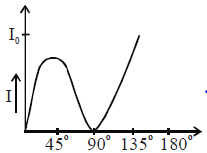
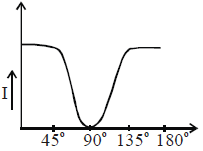
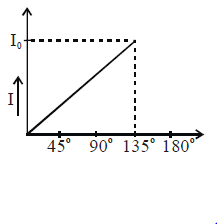
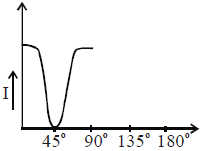
Two polaroids are placed in the path of unpolarised beam of intensity I0 such that no light is emitted from the second polarioid. If a third polaroid whose polarization axis makes an angle θ with the polarization axis of first polaroid, is placed between these polaroids then the intensity of light emerging from the last polaroid will be :
1. \[\frac{I_{0}}{8}sin^{2} 2\theta\]
2. \[\frac{I_{0}}{4}sin^{2} 2\theta\]
3. \[\frac{I_{0}}{2}cos^{4} \theta\]
4. \[I_{0}cos^{4} \theta\]
View Answer
Two polaroids are placed in the path of unpolarized beam of intensity I0 such that no light is emitted from the second polaroid. If a third polaroid whose polarization axis makes an angle θ with the polarization axis of first polaroid, is placed between these polaroids then the intensity of light emerging from the last polaroid will be :
1. \[\left( \frac{I_{0}}{8} \right)sin^{2} 2\theta\]
2. \[\left( \frac{I_{0}}{4} \right)sin^{2} 2\theta\]
3. \[\left( \frac{I_{0}}{2} \right)cos^{2} \theta\]
4. \[I_{0}cos^{4} \theta\]
View Answer
Assertion (A): Resolving power of a microscope is different for different colours of illuminating light.
Reason (R): Resolving power of a microscope is directly proportional to the wavelength of illuminating light.
1. Both (A) & (R) are true and the (R) is the correct explanation of the (A)
2. Both (A) & (R) are true but the (R) is not the correct explanation of the (A)
3. (A) is true but (R) is false
4. Both (A) and (R) are false
View Answer
The resolving power (RP) of a microscope is given by \(RP = \frac{2NA}{1.22\lambda}\), where \(NA\) is the numerical aperture and \(\lambda\) is the wavelength. Since RP is inversely proportional to \(\lambda\), it will be different for different colours (different wavelengths). Reason (R) states direct proportionality, which is false.
Assertion (A): Distance between two coherent sources \(S_1\) and \(S_2\) is \(4\lambda\). A large circle is drawn around these sources with centre of circle lying on centre of \(S_1\) and \(S_2\). there are total 16 maxima on the circle.
Reason (R): Total number of minima on this circle are less compare to total number of maximas.
1. (1) Both (A) & (R) are true and the (R) is the correct explanation of the (A)
2. (2) Both (A) & (R) are true but the (R) is not the correct explanation of the (A)
3. (3) (A) is true but (R) is false
4. (4) Both (A) and (R) are false
View Answer
Given distance \(d=4lambda\). Path difference \(\Delta x = dcos\theta = 4\lambdacos\theta\). The range for \(\Delta x\) is \(-4\lambda \le \Delta x \le 4\lambda\). For maxima, \(\Delta x = n\lambda\), so \(-4 \le n \le 4\). This gives 9 integer values for \(n\). \(n=pm 4\) correspond to \(cos\theta = pm 1\) (2 points). The other 7 values \(n=pm 3, pm 2, pm 1, 0\) correspond to \(|costheta|<1\) (giving \(2times 7 = 14\) points). Total maxima = \(2+14=16\). So (A) is true. For minima, \(\Delta x = (n+1/2)\lambda\), so \(-4.5 \le n \le 3.5\). This gives 8 integer values for \(n\) (from -4 to 3). For all these values, \(|(n+1/2)/4|<1\), so each gives 2 points. Total minima = \(8\times 2 = 16\). Thus, there are 16 maxima and 16 minima. Reason (R) is false.
Assertion (A): If black strips of width \(w\) are separated by white strips of width \(d \left(d < w\right)\) are just distinguishable from a distance \(D\). Then resolving power of eye will be higher for smaller \(d\).
Reason (R): Resolution of eye is \(d/D\) and resolving power inversely proportional to resolution.
1. (1) Both (A) & (R) are true and the (R) is the correct explanation of the (A)
2. (2) Both (A) & (R) are true but the (R) is not the correct explanation of the (A)
3. (3) (A) is true but (R) is false
4. (4) Both (A) and (R) are false
View Answer
Assertion (A) is true. The resolving power of the eye is \(RP = D/d\). Thus, for smaller \(d\), the resolving power \(RP\) will be higher. Reason (R) is false. While \(d/D\) represents the angular separation in this specific scenario when the strips are just distinguishable, it is not the general definition of the 'Resolution of eye'. Resolution of the eye is an intrinsic property (minimum angle it can resolve), not a variable specific to an observation.
Assertion (A): If light incident on surface of two different media. The refracted beam may be partially polarized.
Reason (R): If sum of angle of incidence and angle of refraction is \(\pi/2\) then a reflected light is totally polarised.
1. (1) Both (A) & (R) are true and the (R) is the correct explanation of the (A)
2. (2) Both (A) & (R) are true but the (R) is not the correct explanation of the (A)
3. (3) (A) is true but (R) is false
4. (4) Both (A) and (R) are false
View Answer
Assertion (A) is true. When unpolarized light is incident on the interface of two dielectric media, the refracted light is always partially polarized. Reason (R) is also true by Brewster's law; if the sum of the angle of incidence and refraction is \(90^circ\) (i.e., \(tan i_p = n\)), the reflected light is totally polarized. However, Reason (R) explains the total polarization of reflected light, not the partial polarization of refracted light, so R is not the correct explanation for A.