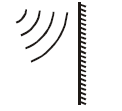
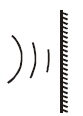
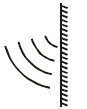
Light waves travel in vaccum along the y-axis. Which of the following may represent the wavefront?
1. \(x =\text{ constant}\)
2. \(y =\text{ constant}\)
3. \(z =\text{ constant}\)
4. \(x + y + z =\text{ constant}\)
View Answer
Wavefronts are surfaces of constant phase which are perpendicular to the direction of propagation. Since propagation is along the y-axis, the wavefront must be parallel to the x-z plane, represented by \(y =\text{ constant}\).
Assertion (A): Huygens’s principle can explain converging nature of convex lens.
Reason (R): Snell’s law can be derived from Huygens’s principle.
1. Both (A) & (R) are true and the (R) is the correct explanation of the (A)
2. Both (A) & (R) are true but the (R) is not the correct explanation of the (A)
3. (A) is true but (R) is false
4. Both (A) and (R) are false
View Answer
Assertion (A) is true. Huygens' principle, through its explanation of wavefront changes, can explain how a convex lens converges light.
Reason (R) is true. Snell's law of refraction, which governs how light behaves at interfaces, can be derived directly from Huygens' principle.
Reason (R) explains a fundamental principle (Snell's Law) that underpins the behavior of lenses, thus it correctly explains (A).
Assertion (A): If incident wavefront is plane, then after reflection or refraction the emerging wave front also must be plane.
Reason (R): Wavefronts are in the direction of energy propagation by light.
1. Both (A) & (R) are true and the (R) is the correct explanation of the (A)
2. Both (A) & (R) are true but the (R) is not the correct explanation of the (A)
3. (A) is true but (R) is false
4. Both (A) and (R) are false
View Answer
Assertion (A) is true: A plane wavefront remains plane after reflection or refraction from plane/spherical surfaces. Reason (R) is false: Wavefronts are surfaces of constant phase and are perpendicular to the direction of energy propagation (rays). Hence, (A) is true, but (R) is false.
Assertion (A): Light is a wave phenomenon.
Reason (R): Light requires a material medium for its propagation.
1. Both (A) & (R) are true and the (R) is the correct explanation of the (A)
2. Both (A) & (R) are true but the (R) is not the correct explanation of the (A)
3. (A) is true but (R) is false
4. Both (A) and (R) are false
View Answer
Light is an electromagnetic wave and can travel through vacuum, so it does not require a material medium for propagation. Thus, Assertion (A) is true but Reason (R) is false.