Fluid Statics - NEET Physics Questions
Question 1: moderate

The density of the atmosphere at sea level is 1.3 kg/m3. Assume it does not change with altitude and g = 10 ms–2, how high would the atmosphere extend ?
1. 8 km
2. 10 km
3. 12 km
4. 16 km
View Answer
Question 2: moderate

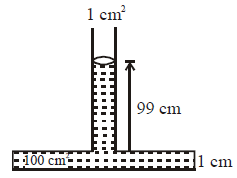
A tube 1 cm2 in cross-section is attached to the top of a vessel 1 cm high and of cross-section 100 cm2. Water is poured into the system filling it to a depth of 100 cm above the bottom of the vessel as shown in figure. Take g = 10 ms–2. Now,

1. Force exerted by the water against the bottom of the vessel is 100 N.
2. Weight of water in the system is 1.99 N.
3. Both (1) and (2) are correct.
4. Neither (1) nor (2) is correct.
View Answer
Question 3: moderate

A body with a volume V neither sinks nor floats in a liquid. If the vessel containing the liquid falls with an acceleration g/3 , then the volume of the solid inside the liquid in the falling condition is:

1. V
2. V/2
3. V/3
4. V/6
View Answer
Question 4: moderate

A sample of metal weights 210 gram in air, 180 gram in water and 120 gram in an unknown liquid. Then:

1. the density of metal is 3 g/cm3
2. the density of metal is 7 g/cm3
3. density of metal is 4 times the density of the unknown liquid
4. the metal will float in water
View Answer
Question 5: moderate

The reading of spring balance when a block is suspended from it in air, is 60 N. This reading is changed to 40 N when the block is immersed in water. The specific gravity of the block is :

1. 3
2. 2
3. 6
4. 3/2
View Answer

Solution:

  • Loss of weight in water = $$\text{Weight in air} - \text{Weight in water} = 60\text{ N} - 40\text{ N} = 20\text{ N}$$

  • Specific gravity = $$\frac{\text{Weight in air}}{\text{Loss of weight in water}} = \frac{60}{20} = 3$$

Therefore, the specific gravity of the block is 3 (Option 1).

Question 6: moderate

An open U-tube contains mercury. When 11.2 cm of water is poured into one of the arms of the tube, how high does the mercury rise in the other arm from its initial level ?

1. 0.82 cm
2. 1.35 cm
3. 0.41 cm
4. 2.32 cm
View Answer

When 11.2 cm of water is poured into one arm, it balances a mercury column of height 2x, where x is the height the mercury rises in the other arm.

Using the pressure balance equation (density of water * height of water = density of mercury * 2x), we get 1 * 11.2 = 13.6 * 2x. Solving for x yields 0.41 cm, making Option 3 the correct answer.