The breakdown in a reverse biased p–n junction diode is more likely to occur due to

(a) large velocity of the minority charge carriers if the doping concentration is small
(b) large velocity of the minority charge carriers if the doping concentration is large
(c) strong electric field in a depletion region if the doping concentration is small
(d) strong electric field in the depletion region if the doping concentration is large.
1. a, d
2. c only
3. b only
4. b, c
View Answer
The breakdown in a reverse biased p–n junction diode is more likely to occur due to
a. Avalanche Breakdown - large velocity of the minority charge carriers if the doping concentration is small
b. Zener Breakdown - strong electric field in the depletion region if the doping concentration is large
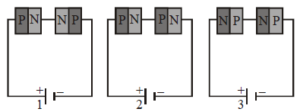
Two PN-junctions can be connected in series by three different methods as shown in the figure. If the potential difference in the junctions is the same, then the correct connections will be :
1. In the circuit (1) and (2)
2. In the circuit (2) and (3)
3. In the circuit (1) and (3)
4. Only in the circuit (1)
View Answer
In circuit 1. First Diode is forward biased and second diode is reverse biased. So, potential across 1st diode is less than 2nd diode.
In circuit 2: Both the diodes are forward biased so potential difference across them is equal
In circuit 3: Both the diodes are reverse biased so potential difference across them is equal to V/2.