Spring Block System - NEET Physics Questions
← Back to Oscillation

Spring Block System

Question 1: easy

In figure S1 and S2 are identical springs. The oscillation frequency of the mass m is f. If one spring is removed, the frequency will become :
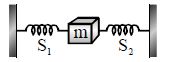
1. f
2. 2f
3. f√2
4. f/√2
View Answer

Given that \( S_1 \) and \( S_2 \) are identical springs, they each have the same spring constant \( k \). When both springs are attached, they are in parallel, so the effective spring constant \( k_{\text{eq}} \) is:

\[
k_{\text{eq}} = k + k = 2k
\]

The frequency \( f \) of oscillation for mass \( m \) with effective spring constant \( k_{\text{eq}} = 2k \) is:

\[
f = \frac{1}{2\pi} \sqrt{\frac{2k}{m}}
\]

If One Spring is Removed

If one spring is removed, only one spring with constant \( k \) is left. The new frequency \( f' \) becomes:

\[
f' = \frac{1}{2\pi} \sqrt{\frac{k}{m}}
\]

Ratio of New Frequency to Original Frequency

\[
\frac{f'}{f} = \frac{\frac{1}{2\pi} \sqrt{\frac{k}{m}}}{\frac{1}{2\pi} \sqrt{\frac{2k}{m}}} = \frac{\sqrt{\frac{k}{m}}}{\sqrt{\frac{2k}{m}}} = \frac{1}{\sqrt{2}}
\]

Thus:

\[
f' = \frac{f}{\sqrt{2}}
\]

Answer: \( f' = \frac{f}{\sqrt{2}} \)

Question 2: easy

When a block is suspended from a spring, time period of its oscillation is \(T\). If this spring is cut into 3 equal parts and this block is suspended from parallel combination of these 3 parts, then new time period of oscillation will be:

1. \(\sqrt{3}T\)
2. \(\frac{T}{\sqrt{3}}\)
3. 3T
4. \(\frac{T}{3}\)
View Answer

Cutting a spring of constant \(k\) into 3 equal parts increases each part's spring constant to \(3k\). In a parallel connection, the equivalent constant is \(k_{\text{eq}} = 3k + 3k + 3k = 9k\). The new time period is \(T' = 2\pi\sqrt{\frac{m}{9k}} = \frac{T}{3}\).

Question 3: easy

A spring is stretched by \(5\text{ cm}\) by a force \(10\text{ N}\). The time period of the oscillations when a mass of \(2\text{ kg}\) is suspended by it is

1. 0.628 s
2. 0.0628 s
3. 6.28 s
4. 3.14 s
View Answer

The spring constant is \(k = \frac{F}{x} = \frac{10}{0.05} = 200\text{ N/m}\). The time period of the spring-mass system is \(T = 2pi \sqrt{\frac{m}{k}} = 2pi \sqrt{\frac{2}{200}} = 0.2pi \approx 0.628\text{ s}\).

Question 4: easy

A vertical spring block system is made to oscillate.


Assertion (A): Its time period on earth is more than that on the moon.


Reason (R): Its extension on moon (in equilibrium) is more than that on the earth.


1. Both (A) & (R) are true and the (R) is the correct explanation of the (A)
2. Both (A) & (R) are true but the (R) is not the correct explanation of the (A)
3. (A) is true but (R) is false
4. Both (A) and (R) are false
View Answer

The time period of a vertical spring-block system is \(T = 2\pi \sqrt{\frac{m}{k}}\), which is independent of gravity (g). So (A) is false. The equilibrium extension is \(x_{eq} = \frac{mg}{k}\). Since \(g_{moon} < g_{earth}\), then \(x_{eq,moon} < x_{eq,earth}\). So (R) is also false.

Question 5: easy

Assertion (A): A spring block watch gives the correct time in orbiting satellite.


Reason (R): Time period of a spring block watch is independent of \(g\) and depends only on spring factor and mass of the block.


1. Both (A) & (R) are true and the (R) is the correct explanation of the (A)
2. Both (A) & (R) are true but the (R) is not the correct explanation of the (A)
3. (A) is true but (R) is false
4. Both (A) and (R) are false
View Answer

The time period of a spring-mass system is \(T = 2\pi \sqrt{m/k}\). This equation shows that the time period is independent of the acceleration due to gravity \(g\). Therefore, a spring block watch would function correctly in an orbiting satellite where effective \(g\) is zero. Both Assertion (A) and Reason (R) are true, and R is the correct explanation of A.

Question 6: easy

Assertion (A): The periodic time of a hard spring is less as compared to that of a soft spring.


Reason (R): The spring constant is large for hard spring.


1. Both (A) & (R) are true and the (R) is the correct explanation of the (A)
2. Both (A) & (R) are true but the (R) is not the correct explanation of the (A)
3. (A) is true but (R) is false
4. Both (A) and (R) are false
View Answer

The periodic time of a spring is given by `\(T = 2\pi\sqrt{\frac{m}{k}}\)`.
A hard spring has a large spring constant `\(k\)`, which means a smaller `\(T\)`. A soft spring has a small `\(k\)`, hence a larger `\(T\)`. Both A and R are true, and R explains A.