Question 1:
difficult
The mass M shown in the figure oscillates in simple harmonic motion with amplitude A. The amplitude of the point P is :
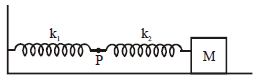
The mass M shown in the figure oscillates in simple harmonic motion with amplitude A. The amplitude of the point P is :
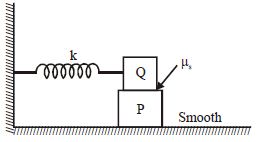
A block P of mass m is placed on a frictionless horizontal surface. Another block Q of same mass is kept on P and connected to the wall with the help of a spring of spring constant k as shown in the figure. μs is the coefficient of friction between P and Q. The blocks move together performing simple harmonic motion with amplitude A. The
maximum value of the friction force between P and Q is :
What is the angular frequency of the system shown in the figure?
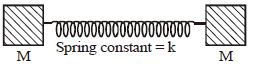
The system shown consists of two masses \( M \) connected by a spring with a spring constant \( k \). Since the masses are identical, the angular frequency \( \omega \) of the system for oscillations is given by:
\[
\omega = \sqrt{\frac{k}{\text{reduced mass}}}
\]
In this case, the reduced mass \( \mu \) of the system is given by:
\[
\mu = \frac{M \cdot M}{M + M} = \frac{M}{2}
\]
Thus, the angular frequency \( \omega \) is:
\[
\omega = \sqrt{\frac{k}{M/2}} = \sqrt{\frac{2k}{M}}
\]
Answer:
\[
\omega = \sqrt{\frac{2k}{M}}
\]