Photoelectric Effects and deBroglie Equation - NEET Physics Questions
← Back to Modern Physics

Photoelectric Effects and deBroglie Equation

Question 11: moderate

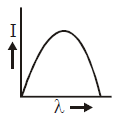
The anode voltage of a photocell is kept fixed. The wavelength λ of the light falling on the cathode is gradually changed. The plate current I of the photocell varies as given below :

1.
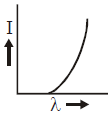
2.
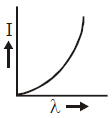
3.
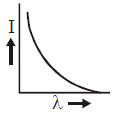
4.
View Answer
Question 12: moderate

If the momentum of an electron is changed by P, then de-Broglie wavelength associated with it
changes by 0.2%. The initial momentum of electron will be about :

1. P/200
2. 100 P
3. 500 P
4. 400 P
View Answer
Question 13: moderate

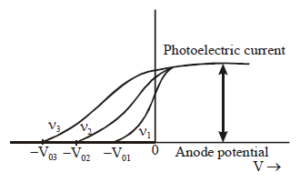
In photoelectric effect, the curve between photoelectric current and anode potential V (for
different frequencies) is shown in figure, then :

1. \[\nu_{1}>\nu_{2}>\nu_{3}\]
2. \[\nu_{1}<\nu_{2}<\nu_{3}\]
3. \[\nu_{1}=\nu_{2}=\nu_{3}\]
4. \[\nu_{1}>\nu_{2}<\nu_{3}\]
View Answer
Question 14: moderate

If the kinetic energy of the particle is increased to 16 times its previous value, the percentage
change in the de-Broglie wavelength of the particle is :

1. 25
2. 75
3. 60
4. 50
View Answer
Question 15: moderate

The de Broglie wavelengths of a proton and an \(\alpha\)-particle are \(3\lambda\) and \(\lambda\) respectively. The ratio of the velocities of proton to \(\alpha\)-particle is

1. \(3 : 1\)
2. \(4 : 3\)
3. \(1 : 9\)
4. \(9 : 2\)
View Answer

Using the de Broglie wavelength formula \(\lambda = \frac{h}{mv}\), the velocity is (v = \frac{h}{m\lambda}\). Therefore, \(\frac{v_p}{v_\alpha} = \frac{m_\alpha \lambda_\alpha}{m_p \lambda_p} = \frac{4 m_p \cdot \lambda}{m_p \cdot 3\lambda} = \frac{4}{3}\).