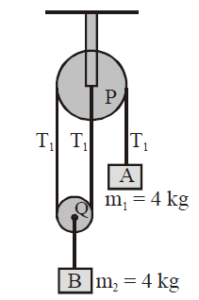
What are the acceleration of the blocks A and B, shown in figure (in m/sec²)
1. 0,0
2. 4 m/s², 4 m/s²
3. 6 m/s², 3 m/s²
4. 4 m/s², 2 m/s²
View Answer
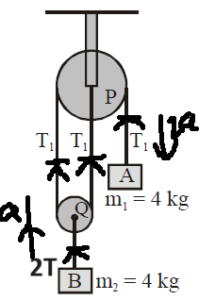
Writing equations of motion for the objects as,
40 - T = 4 × 2a ---(i)
and 2T -40 = 4a -----(ii)
Solving (i) and (ii)
a= 2 m/s²
So, acceleration of object A is 4 m/s² and for object B is 2 m/s²
The masses of the bodies A and B in figure are 20 kg and 10 kg, respectively. They are initially at rest on the floor and are connected by a weightless string passing over a weightless and frictionless pulley. An upward force F is applied to the pulley. Find the acceleration a1 of body A and a2 of body B when F is 340 N :
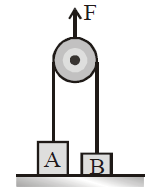
1. a1 = 7 m/sec², a2 = 24 m/sec²
2. a1 = 0, a2 = 0
3. a1 = 1.5 m/sec², a2 = 7 m/sec²
4. a1 = 0 m/sec², a2 = 7 m/sec²
View Answer
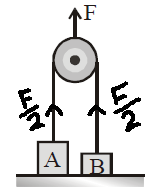
As F= 340 N. Force acting on object A in upward direction is F/2 i.e 170 N. This force is insufficient to pull the object upwards. (weight of A is greater than 170 N)
So, a1= 0 m/s²
Force acting on B in upward direction is 170 N and weight is 10g or 100 N. Net force in upward direction is 70 N. so,
a2= 7 m/s²
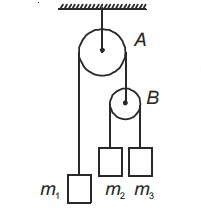
In the arrangement, shown in figure, pulleys A and B are massless and frictionless and threads are ideal. Block of mass m1 will remain at rest if:
1. \[ \frac{1}{m_{3}}=\frac{2}{m_{2}}+\frac{3}{m_{1}} \]
2. \[ m_{1}= m_{2}= m_{3} \]
3. \[ \frac{4}{m_{1}}=\frac{1}{m_{2}}+\frac{1}{m_{3}}\]
4. \[ \frac{1}{m_{1}}=\frac{1}{m_{2}}+\frac{1}{m_{3}}\]
View Answer
In the movable pulley system, tension in the string connecting m2 and m3 is:
Since this tension acts twice to balance
, we equate:
Cancelling
and rearranging gives: