Constrained Motion - NEET Physics Questions
← Back to Laws of Motion

Constrained Motion

Question 1:

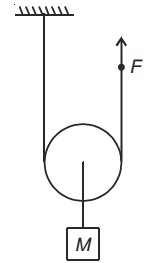
The force F needed to keep the block at equilibrium in given figure is (pulley and string are massless)
neet constrained motion questions

1. Mg/5
2. Mg/4
3. Mg/2
4. Mg/3
View Answer

For Equilibrium,

2F = Mg ⇒ F = Mg/2

Question 2:

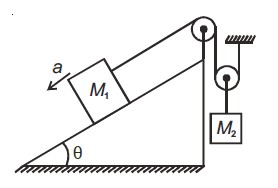
If acceleration of block m1 is a downward then acceleration of block m2 will be:
neet constraint motion questions

1. 2a upward
2. a upward
3. a/2 upward
4. 2a downward
View Answer


For ideal pulleys, the product of tension and acceleration remains constant:


T1a=T2a2T_1 a = T_2 a_2


Since

T2=2T1T_2 = 2T_1

, substitute to get:


T1a=2T1a2a2=a2T_1 a = 2T_1 a_2 \Rightarrow a_2 = \frac{a}{2}


So, M2 accelerates upward with a2\boxed{\text{So, } M_2 \text{ accelerates upward with } \frac{a}{2}}


Question 3:

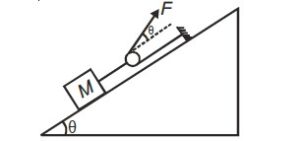
What is the minimum value of F needed so that block begins to move upward on frictionless incline plane as shown?
nlm constrainted motion quesiton 9

1. Mg tan(θ/2)
2. Mg cot(θ/2)
3. Mg.sinθ/(1+sinθ)
4. Mgsin(θ/2)
View Answer

🔹 Step-by-step:

  • Block of mass M is on a frictionless incline of angle
    \theta
     
  • Force
    FF
     

    is applied via a pulley system, split into two components:

    • One acts up along the incline: F
    • One acts horizontally, which when resolved along the incline becomes: F
      cosθF \cos \theta
       

Total upward force along incline =

F+FcosθF + F \cos \theta

Downward component of weight =

MgsinθMg \sin \theta


🔹 For the block to just start moving upward:

F+Fcosθ=Mgsinθ F(1+cosθ)=Mgsinθ F=Mgsinθ1+cosθF = \frac{Mg \sin \theta}{1 + \cos \theta}

Now use the identity:

sinθ1+cosθ=cot(θ2)\frac{\sin \theta}{1 + \cos \theta} = \cot\left(\frac{\theta}{2}\right)

 Final Answer:

F=Mgcot(θ2)\boxed{F = Mg \cot\left(\frac{\theta}{2}\right)}