Relative Motion in Two Dimension - NEET Physics Questions
← Back to Kinematics

Relative Motion in Two Dimension

Question 1:

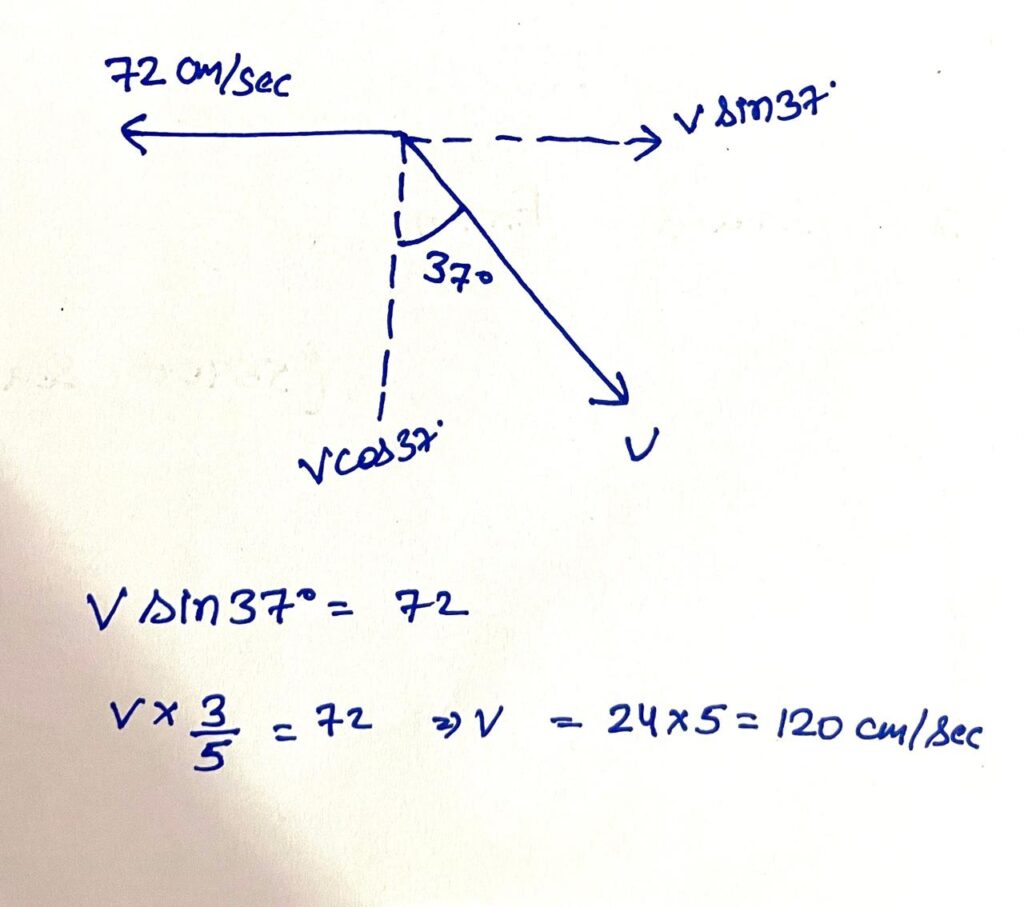
A man walks in rain at 72 cm/s due east and observes the rain falling vertically. When he stops, rain appears to strikes his back at 37º from the vertical. Find velocity of raindrops relative to the ground.

1. 100 cm/s
2. 26 cm/s
3. 120 cm/s
4. 54 cm/s
View Answer

Question 2:

A man wishes to swim across a river 400 m wide flowing with a speed of 3m/s, such that he reaches the point just in front on the other bank in time not greater than 100 sec. The angle made by the direction he swims and river flow direction is :

1. 90º
2. 127º
3. 150º
4. 143º
View Answer

Distance travelled in y-direction = 400 m

Time to cross = 100 sec

So, Speed in y-direction = 4 m/s

Speed in x-direction = 3m/s

So, angle = 90 +37 =127º

Question 3:

Rain drops are falling vertically and a man is running on the ground horizontally with speed equal to the rain with respect to the ground. Rain drops appears to him hitting with velocity 10 km/hr. Find velocity of rain.

1. 5 km/hr
2. 10 km/hr
3. 5√2 km/hr
4. 10√2 km/hr
View Answer

Velocity of Rain = - V j

Velocity of Person = V i

Velocity of Rain with respect to the Person = - V i - V j

so, V√2 = 10 ⇒ V = 5√2 km/hr

Question 4:

A river flows from east to west with a speed of 5 m/min. A man on south bank of river, capable of swimming at the rate of 10 m/min in still water, wants to swim across the river in shortest time; he should swim :

1. due north
2. due north-east
3. due north-east with double the speed of river
4. none of these
View Answer

To cross the river in the shortest time, the man should swim directly perpendicular to the riverbank, regardless of the river's flow. This way, his entire swimming speed is used to cross the river.

 Given:
- Speed of the river (east to west) = 5 m/min
- Speed of the swimmer in still water = 10 m/min

The swimmer should aim **directly north** to minimize the crossing time. The river's current will cause him to drift downstream, but this direction ensures the shortest crossing time.

Thus, the man should swim:

\[
{\text{directly north}}
\]

Question 5:

A man wishes to swim across a river 0.5 km wide. If he can swim at the rate of 2 km/h in still water and the river flows at the rate of 1 km/h. The angle made by the directon (w.r.t. the flow of the river) along which he should swim so as to reach a point exactly opposite his starting point, should be :

1. 60°
2. 120°
3. 145°
4. 90°
View Answer

To swim across the river and reach a point directly opposite his starting point, the man must swim at an angle against the flow of the river to counteract the river's current.

### Given:
- Speed of the man in still water = 2 km/h
- Speed of the river flow = 1 km/h

Let \(\theta\) be the angle between the man's swimming direction and the river flow. To counteract the river's flow, the horizontal component of the man's velocity must equal the river's velocity.

\[
\text{Horizontal component} = 2 \sin \theta = 1
\]

Solving for \(\theta\):

\[
\sin \theta = \frac{1}{2}
\]
\[
\theta = \sin^{-1} \left( \frac{1}{2} \right) = 30^\circ
\]

Thus, the man should swim at an angle of:

\[
{120^\circ} \text{ upstream from the river flow.}
\]
Question 6:

A bird is flying towards south with a velocity 40km/h and a train is moving with a velocity 40 km/h towards east. What is the velocity of the bird w.r.t. an observer in the train ?

1. 40 √2 km/h. N-E
2. 40 √2 km/h. S-E
3. 40 √2 km/h. S-W
4. 40 √2 km/h. N-W
View Answer

The relative velocity of the bird with respect to the observer in the train is found by combining the bird's velocity (south) and the train's velocity (east) using the Pythagorean theorem.

\[
v_{\text{relative}} = \sqrt{(40^2 + 40^2)} = \sqrt{3200} = 40\sqrt{2} \, \text{km/h}
\]

The direction is \( 45^\circ \) south of west.

Thus, the relative velocity is:

\[ {40\sqrt{2} \, \text{km/h} \text{ at } 45^\circ \text{ south of west}}
\]

Question 7:

A boy is running on a levelled road with velocity (v) with a long hollow tube in his hand. Water is falling vertically downwards with velocity (u). At what angle to the vertical, should he incline the tube so that the water drops enters without touching its side :

1. \[tan^{-1}\left( \frac{v}{u} \right)\]
2. \[sin^{-1}\left( \frac{v}{u} \right)\]
3. \[tan^{-1}\left( \frac{u}{v} \right)\]
4. \[cos^{-1}\left( \frac{v}{u} \right)\]
View Answer

The tube should be inclined at an angle \(\theta\) such that the water's relative velocity to the boy is along the axis of the tube.

The horizontal velocity of the boy is \(v\), and the vertical velocity of the falling water is \(u\). The angle \(\theta\) between the tube and the vertical satisfies:

\[
\tan \theta = \frac{v}{u}
\]

Thus, the required angle is:

\[
\theta = \tan^{-1} \left( \frac{v}{u} \right)
\]