Newton's Law of Gravitation - NEET Physics Questions
← Back to Gravitation

Newton's Law of Gravitation

Question 1: moderate

Earth exerts a gravitational force on the Moon, keeping it in its orbit. The reaction to this force, in the sense of Newton’s third law, is:

1. the centripetal force on the Moon
2. the nearly circular orbit of the Moon
3. the gravitational force on Earth by the Moon
4. the tides due to the Moon
View Answer

According to Newton’s third law, for every action, there is an equal and opposite reaction.

The Earth exerts a gravitational force on the Moon, and the Moon exerts an equal and opposite gravitational force on the Earth. This reaction force is the gravitational force on Earth by the Moon.

Question 2: moderate

Two bodies having same mass m each are placed at a distance r, gravitation force between them is F.  If 25 % mass of the body is transfer to the second body and separation become half then gravitational force between them is :

1. 15/4F
2. F
3. 4F/15
4. 15F/16
View Answer

The initial gravitational force between two bodies is:

\[
F = G \frac{m \cdot m}{r^2}
\]

After transferring 25% of mass from one body to the other, the new masses become \( 0.75m \) and \( 1.25m \), and the separation becomes \( \frac{r}{2} \). The new gravitational force is:

\[
F' = G \frac{(0.75m)(1.25m)}{\left(\frac{r}{2}\right)^2}
\]

Simplifying:

\[
F' = G \frac{0.9375 m^2}{\frac{r^2}{4}} = 4 \times 0.9375 \times \frac{G m^2}{r^2} = 15F/4
\]

So, the new gravitational force is:

\[
F' = 3.75F= 15F/4
\]

Question 3: moderate

If the universal constant of gravitation were decreasing uniformly with time, then a satellite in orbit would still maintain its :

1. Radius
2. Tangential speed
3. Angular momentum
4. Period of revolution
View Answer

If the universal constant of gravitation \( G \) were decreasing uniformly with time, the gravitational force between the satellite and the Earth would weaken. However, the satellite's angular momentum would remain conserved because angular momentum depends on the mass, velocity, and radius of orbit, and not directly on \( G \).

According to the law of conservation of angular momentum:

\[
L = m v r
\]

where \( L \) is angular momentum, \( m \) is the satellite's mass, \( v \) is its velocity, and \( r \) is the orbital radius. Since no external torque acts on the system, angular momentum is conserved even if \( G \) changes.

However, the satellite’s orbital parameters like its velocity and orbital radius might change over time due to the weakening gravitational force, but the total angular momentum will remain constant.

Question 4: moderate

Weight of 1 kg becomes 1/6th on moon. If the radius of moon is \( 1.768 × 10^{6} m \), then the mass of moon will be :

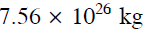
1.
2.
3.
4.
View Answer

The weight of an object on the Moon is given by:

\[
W_{\text{moon}} = \frac{1}{6} W_{\text{earth}}
\]

Weight is related to the gravitational acceleration \( g \) by:

\[
W = mg
\]

Thus,

\[
g_{\text{moon}} = \frac{1}{6} g_{\text{earth}}
\]

The formula for gravitational acceleration is:

\[
g = \frac{GM}{R^2}
\]

Where:
- \( G \) is the gravitational constant,
- \( M \) is the mass of the Moon,
- \( R \) is the radius of the Moon.

Given:
- \( g_{\text{earth}} = 9.8 \, \text{m/s}^2 \),
- \( g_{\text{moon}} = \frac{1}{6} \times 9.8 = 1.633 \, \text{m/s}^2 \),
- \( R_{\text{moon}} = 1.768 \times 10^6 \, \text{m} \).

Now, solve for \( M_{\text{moon}} \) using:

\[
g_{\text{moon}} = \frac{G M_{\text{moon}}}{R_{\text{moon}}^2}
\]

Rearranging for \( M_{\text{moon}} \):

\[
M_{\text{moon}} = \frac{g_{\text{moon}} R_{\text{moon}}^2}{G}
\]

Substitute values:

\[
M_{\text{moon}} = \frac{1.633 \times (1.768 \times 10^6)^2}{6.674 \times 10^{-11}}
\]

Calculating this gives:

\[
M_{\text{moon}} \approx 7.35 \times 10^{22} \, \text{kg}
\]

Thus, the mass of the Moon is approximately \( 7.35 \times 10^{22} \, \text{kg} \).

Question 5: moderate

The diameter of two planets are in the ratio 4:1 and their mean densities in the ratio 1:2 the amocceleration due to gravity on the planets will be in ratio :

1. 1 : 2
2. 2 : 3
3. 2 : 1
4. 4 : 1
View Answer

The formula for acceleration due to gravity \( g \) on a planet is:

\[
g = \frac{GM}{R^2}
\]

Where:
- \( G \) is the gravitational constant,
- \( M \) is the mass of the planet,
- \( R \) is the radius of the planet.

Mass \( M \) is related to density \( \rho \) and volume \( V \):

\[
M = \rho V = \rho \frac{4}{3} \pi R^3
\]

Substituting into the equation for \( g \):

\[
g = \frac{G \rho \frac{4}{3} \pi R^3}{R^2} = \frac{4}{3} \pi G \rho R
\]

Thus, \( g \propto \rho R \).

Given:
- Diameter ratio \( R_1 : R_2 = 4:1 \), so \( R_1 : R_2 = 4:1 \),
- Density ratio \( \rho_1 : \rho_2 = 1:2 \).

Now,

\[
g_1 : g_2 = (\rho_1 R_1) : (\rho_2 R_2) = (1 \times 4) : (2 \times 1) = 4:2 = 2:1
\]

Thus, the ratio of acceleration due to gravity on the planets is \( 2:1 \).