Newton's Law of Gravitation - NEET Physics Questions
← Back to Gravitation

Newton's Law of Gravitation

Question 1: easy

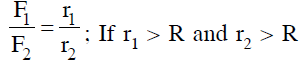
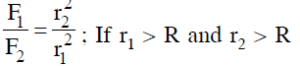
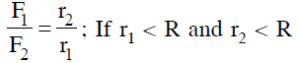
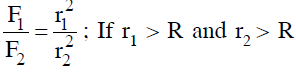
The magnitude of the gravitational force at distance r1 and r2 from the centre of a uniform sphere of radius R and mass M are F1 and F2 respectively then :
1.
2.
3.
4.
View Answer

When both \( r_1 \) and \( r_2 \) are greater than \( R \) (i.e., both are outside the sphere), the gravitational force at a distance \( r \) from the center of a uniform sphere is given by:

\[
F = \frac{G M}{r^2}
\]

So, the forces \( F_1 \) and \( F_2 \) at distances \( r_1 \) and \( r_2 \) from the center are:

\[
F_1 = \frac{G M}{r_1^2}
\]
\[
F_2 = \frac{G M}{r_2^2}
\]

Now, taking the ratio \( \frac{F_1}{F_2} \):

\[
\frac{F_1}{F_2} = \frac{\frac{G M}{r_1^2}}{\frac{G M}{r_2^2}} = \frac{r_2^2}{r_1^2}
\]

Thus, the ratio of the gravitational forces is:

\[
\frac{F_1}{F_2} = \left( \frac{r_2}{r_1} \right)^2
\]

Question 2: easy

Dimensions of gravitational constant are :

1. [ML²T²]
2. [M¹L³T–²]
3. [M°L³T²]
4. [M–¹L³T–²]
View Answer

To find the dimensions of the gravitational constant \( G \), use Newton's law of gravitation:

\[
F = \frac{G M_1 M_2}{r^2}
\]

Where:
- \( F \) is force (with dimensions \( [M L T^{-2}] \)),
- \( M_1 \) and \( M_2 \) are masses (with dimensions \( [M] \)),
- \( r \) is distance (with dimensions \( [L] \)).

Rearranging for \( G \):

\[
G = \frac{F r^2}{M_1 M_2}
\]

Substitute the dimensions:

\[
G = \frac{[M L T^{-2}] [L^2]}{[M][M]}
\]

Simplify:

\[
G = [M^{-1} L^3 T^{-2}]
\]

Thus, the dimensions of \( G \) are \( [M^{-1} L^3 T^{-2}] \).

Question 3: easy

If three uniform spheres, each having mass \(M\) and radius \(r\), are kept in such a way that each touches the other two, the magnitude of the gravitational force on any sphere due to the other two is

1. \(\frac{GM^2}{4r^2}\)
2. \(\frac{2GM^2}{r^2}\)
3. \(\frac{2GM^2}{4r^2}\)
4. \(\frac{\sqrt{3} GM^2}{4r^2}\)
View Answer

The distance between centers is \(2r\). Force between any two is \(F = \frac{GM^2}{4r^2}\). Since the angle between the forces is \(60^\circ\), the resultant force is \(F_{\text{net}} = \sqrt{3}F = \frac{\sqrt{3} GM^2}{4r^2}\).

Question 4: easy

The acceleration due to gravity (on earth) depends upon

1. size of the body
2. gravitational mass of the body
3. gravitational mass of the earth
4. none of the above factors
View Answer

The acceleration due to gravity is \(g = \frac{GM_e}{R_e^2}\). This depends on the mass of the Earth, not on the properties of the body itself.

Question 5: easy

A thin rod of length \(L\) is bent to form a circle. Its mass is \(M\). What force will act on the mass \(m\) placed at the centre of the circle?

1. \(\frac{4\pi^2 GMm}{L^2}\)
2. \(\frac{GMm}{4\pi^2 L^2}\)
3. \(\frac{2\pi GMm}{L^2}\)
4. zero
View Answer

Due to the symmetrical distribution of mass in a circular ring, the gravitational field at the center is zero. Therefore, the force on any mass placed at the center is zero.

Question 6: easy

The gravitational force of attraction between two bodies is \(F\) newtons. If the mass of each body and the distance between them are doubled, then the gravitational force between them in newton is

1. \(16 F\)
2. \(F/16\)
3. \(F/4\)
4. \(F\)
View Answer

Formula of gravitational force is \(F = \frac{G m_1 m_2}{r^2}\). If masses and distance are doubled: \(F' = \frac{G(2m_1)(2m_2)}{(2r)^2} = \frac{4 G m_1 m_2}{4 r^2} = F\). Thus, the force remains unchanged.

Question 7: easy

If three uniform spheres, each having mass \(M\) and radius \(R\), are kept in such a way that each touches the other two, the magnitude of the gravitational force on any sphere due to the other two is

1. \(\frac{GM^2}{4r^2}\)
2. \(\frac{2GM^2}{r^2}\)
3. \(\frac{2GM^2}{4r^2}\)
4. \(\frac{\sqrt{3}GM^2}{4r^2}\)
View Answer

The distance between the centers of any two touching spheres is \(2R\). The gravitational force between any two is \(F = \frac{GM^2}{(2R)^2} = \frac{GM^2}{4R^2}\). The angle between the two forces acting on one sphere is \(60^\circ\). Net force is \(F_{\text{net}} = \sqrt{3}F = \frac{\sqrt{3}GM^2}{4R^2}\).

Question 8: easy

A thin rod of length \(L\) is bent to form a circle. Its mass is \(M\). What force will act on the mass \(m\) placed at the centre of the circle ?

1. \(\frac{4 \pi^2 GMm}{L^2}\)
2. \(\frac{GMm}{4 \pi^2 L^2}\)
3. \(\frac{2 \pi GMm}{L^2}\)
4. zero
View Answer

Due to symmetry, the gravitational forces exerted by all symmetric parts of the ring at the center cancel each other out, resulting in a net force of zero.

Question 9: easy

A spherical shell has mass \(M\) and radius \(R\). A point mass \(m/2\) kept inside the shell at a distance \(R/2\) from centre. Then force of attraction on the mass is:

1. \(\frac{2Gm^2}{R^2}\)
2. \(\frac{Gm^2}{R^2}\)
3. \(\frac{Gm^2}{2R}\)
4. zero
View Answer

The gravitational field inside a uniform spherical shell is zero everywhere. Therefore, the gravitational force on any mass kept inside the shell is zero.

Question 10: easy

Imagine a light planet revolving around a very massive star in a circular orbit of radius \(r\) with a period of revolution T. If the gravitational force of attraction between the planet and the star is proportional to \(r^{-5/2}\), then the square of the time period will be proportional to

1. \(r^3\)
2. \(r^2\)
3. \(r^{2.5}\)
4. \(r^{3.5}\)
View Answer

The centripetal force is \(F = m\omega^2 r = m\frac{4\pi^2}{T^2} r \propto \frac{r}{T^2}\). Given \(F \propto r^{-5/2}\), we get \(\frac{r}{T^2} \propto r^{-5/2} \Rightarrow T^2 \propto r^{3.5}\).