Acceleration Due to Gravity and its variation - NEET Physics Questions
← Back to Gravitation

Acceleration Due to Gravity and its variation

Question 1: moderate

The acceleration due to gravity on the planet A is 9 times the acceleration due to gravity on planet B. A man jumps to a height of 2m on the surface of A. What is the height of jump by the same person on the planet B ?

1. 18 m
2. 6 m
3. 2/3 m
4. 2/9 m
View Answer

From Equations of motion

The height of a jump is inversely proportional to the acceleration due to gravity. Let \( h_A \) be the height of the jump on planet A, and \( h_B \) be the height of the jump on planet B. Also, let \( g_A \) and \( g_B \) represent the acceleration due to gravity on planets A and B, respectively.

Given:
- \( g_A = 9g_B \)
- \( h_A = 2 \, \text{m} \)

The ratio of heights is:

\[
\frac{h_B}{h_A} = \frac{g_A}{g_B} = 9
\]

Thus, the height on planet B is:

\[
h_B = 9 \times h_A = 9 \times 2 = 18 \, \text{m}
\]

So, the height of the jump on planet B is \( 18 \, \text{m} \).
 

Question 2: moderate

The diameter of two planets are in the ratio 4:1 and their mean densities in the ratio 1:2 the acceleration due to gravity on the planets will be in ratio :

1. 1 : 2
2. 2 : 3
3. 2 : 1
4. 4 : 1
View Answer

\[ g=\frac{GM}{R^{2}}= \frac{G\times \rho\frac{4}{3}\pi R^{3}}{R^{2}}=\frac{4G\rho\pi R}{3} \]

\[ \frac{g_{1}}{g_{2}}= \frac{R_{1}.\rho_{1}}{R_{2}.\rho_{2}}= \frac{4\times 1}{1\times 2}= \frac{2}{1} \]


Question 3: moderate

Imagine a new planet having the same density as that of earth but it is 3 times bigger than the earth in size. If the acceleration due to gravity on the surface of earth is g and that on the surface of the new planet is g’, then :

1. g' = 3g
2. g' = g/9
3. g' = 9g
4. g'=27 g
View Answer

The acceleration due to gravity \( g' \) on the new planet can be calculated using the formula:

\[
g' = \frac{GM}{R^2}.
\]

For the new planet:

- Its radius \( R' = 3R \) (3 times the radius of Earth).
- Its mass \( M' \) is given by \( M' = \text{density} \times \text{volume} = \rho \times \frac{4}{3} \pi (R')^3 = \rho \times \frac{4}{3} \pi (3R)^3 = 27 \times \rho \times \frac{4}{3} \pi R^3 = 27M \) (mass is 27 times that of Earth).

Substituting into the formula:

\[
g' = \frac{G(27M)}{(3R)^2} = \frac{27GM}{9R^2} = 3g.
\]

Thus, \( g' = 3g \).

Question 4: moderate

A spherical planet has a mass Mp and diameter Dp. A particle of mass m falling freely near the surface of this planet will experience an acceleration due to gravity, equal to :

1. GMp/Dp²
2. 4GMpm/Dp²
3. 4GMp/Dp²
4. GMpm/ Dp²
View Answer

The acceleration due to gravity \( g \) on the surface of a spherical planet can be calculated using the formula:

\[
g = \frac{GM_p}{R_p^2},
\]

where:
- \( G \) is the gravitational constant,
- \( M_p \) is the mass of the planet,
- \( R_p \) is the radius of the planet.

Given that the diameter \( D_p = 2R_p \), we can express the radius as \( R_p = \frac{D_p}{2} \).

Substituting this into the formula gives:

\[
g = \frac{GM_p}{\left(\frac{D_p}{2}\right)^2} = \frac{GM_p}{\frac{D_p^2}{4}} = \frac{4GM_p}{D_p^2}.
\]

Thus, the acceleration due to gravity experienced by the particle near the surface of the planet is:

\[
g = \frac{4GM_p}{D_p^2}.
\]

Question 5: moderate

The change in the value of g at a height h above the surface of the earth is the same as at a depth d below the earth when both d and h are much smaller than the radius of the earth, which one of the following is correct ?

1. d = h/2
2. d = 3h/2
3. d = 2h
4. d = h
View Answer

The change in the value of \( g \) at height \( h \) above the surface of the Earth and at depth \( d \) below the surface can be expressed using the following formulas:

1. **At height \( h \)**:
\[
g_h = g \left(1 - \frac{2h}{R}\right) \quad \text{(for small } h\text{)}
\]

The change in \( g \) is:
\[
\Delta g_h = g - g_h = g \frac{2h}{R} = \frac{2gh}{R}.
\]

2. **At depth \( d \)**:
\[
g_d = g \left(1 - \frac{d}{R}\right) \quad \text{(for small } d\text{)}
\]

The change in \( g \) is:
\[
\Delta g_d = g - g_d = g \frac{d}{R}.
\]

Setting the changes equal gives:

\[
\frac{2gh}{R} = \frac{g d}{R}.
\]

Cancelling \( g \) and \( R \) (assuming they are non-zero):

\[
2h = d.
\]

Thus, the relation between depth \( d \) and height \( h \) is:

\[
d = 2h.
\]

Question 6: moderate

Two types of balances, the beam balance and the spring balance are commonly used for measuring weight at shops. If we are at the moon, we can continue to use :

1. Only the beam type balance without any change
2. Only the spring balance without any change
3. both the balances without any change
4. Neither of the two balances without making any change
View Answer

On the Moon, the acceleration due to gravity is weaker (about \( \frac{1}{6} \) of that on Earth), affecting how a spring balance measures weight.

A spring balance relies on the gravitational force to measure weight based on the stretch of the spring, so it would give a lower reading on the Moon.

In contrast, a beam balance compares masses based on equilibrium, unaffected by gravity. Thus, it can be used without any change to measure weight accurately on the Moon.

Question 7: moderate

The depth at which the effective value of acceleration due to gravity is g/4 is (R is radius of the earth) :

1. R
2. 3R/4
3. R/2
4. R/4
View Answer

To find the depth \( d \) at which the effective acceleration due to gravity is \( \frac{g}{4} \), we use the formula for gravity at depth:

\[
g_d = g \left(1 - \frac{d}{R}\right).
\]

Setting \( g_d = \frac{g}{4} \):

\[
\frac{g}{4} = g \left(1 - \frac{d}{R}\right).
\]

Dividing both sides by \( g \):

\[
\frac{1}{4} = 1 - \frac{d}{R}.
\]

Rearranging gives:

\[
\frac{d}{R} = 1 - \frac{1}{4} = \frac{3}{4}.
\]

Thus:

\[
d = \frac{3R}{4}.
\]

So, the depth at which the effective value of acceleration due to gravity is \( \frac{g}{4} \) is \( \frac{3R}{4} \).

Question 8: moderate

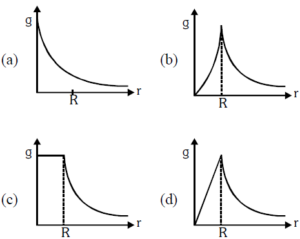
The dependence of acceleration due to gravity ‘g’ on the distance ‘r’ from the centre of the earth, assumed to be a sphere of radius R of uniform density, is as shown in figure below:-

The correct figure is :

1. (a)
2. (b)
3. (c)
4. (d)
View Answer

\[ g= \frac{GMr}{R^{3}}  \] for internal point

\[ g= \frac{GM}{r^{2}}  \] for external point