Question 21:
easy
In series LCR circuit voltage across L, C & R is 20V each. If capacitor is short-circuited then
voltage across inductor is :
In series LCR circuit voltage across L, C & R is 20V each. If capacitor is short-circuited then
voltage across inductor is :
Which of the following plot correctly depicts the variation of phase difference between voltage and current in a series L-C AC circuit ?
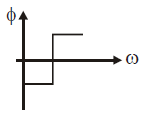
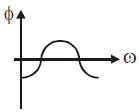
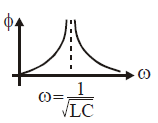
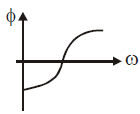
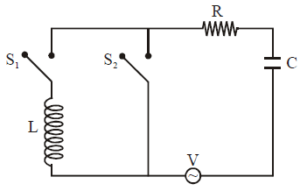
When S1 is closed and S2 is open, \[V_{L}=V_{R}=V_{C}=10V\]. What will be the value of
\[V_{C}\] if S1 opened and S2 is closed ?
A coil has power factor of 0.707 at 60 Hz. Then its power factor at 180 Hz will be :-
A variable inductor is connected to an ac source. What effect does increasing the inductance have on the reactance and current in this circuit ?
A variable capacitor is connected to an ac source. What effect does decreasing the capacitance have on the reactance and current in this circuit ?
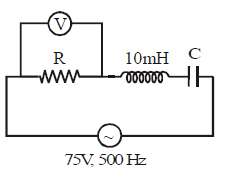
In the circuit of Figure, the volmeter reads 75 V.Value of C is :
A square wave current switching rapidly between \(+0.5\) ampere and \(-0.5\) ampere is passed through an A.C ammeter. Then the reading shown by it, is
An AC ammeter measures the RMS value of the current. For a symmetric square wave of amplitude \(I_0\), the RMS value is equal to its peak value, \(I_{rms} = I_0 = 0.5\text{ A}\).
Given below are two statements :
Statement I : In an LCR series circuit, current is maximum at resonance.
Statement II : Current in a purely resistive circuit can never be less than that in a series LCR circuit (using same resistance) when connected to same voltage source.
In the light of the above statements, choose the correct from the options given below :
At resonance, impedance of an LCR circuit is minimum and equal to \(R\), so current is maximum. In general, impedance \(Z ge R\), hence the current \(I = V/Z\) is less than or equal to the purely resistive current \(V/R\). Thus, both statements are true.
The maximum power is dissipated for an ac in a/an
The average power dissipated is \(P = V_{\text{rms}} I_{\text{rms}} cos \phi\). For a purely resistive circuit, the phase angle \(\phi = 0\), which gives the maximum power factor \(cos \phi = 1\).