Question 11:
moderate
In an a.c. circuit V and I are given by
V = 100 sin (100 t) volts
I = 100 sin (100t + π/3) mA
The power dissipated in the circuit is
In an a.c. circuit V and I are given by
V = 100 sin (100 t) volts
I = 100 sin (100t + π/3) mA
The power dissipated in the circuit is
A condenser of capacity C is charged to a potential difference of V1. The plates of the condenser are then connected to an ideal inductor of inductance L. The current through the indictors when the potential difference across the condenser reduces to V2 is ?
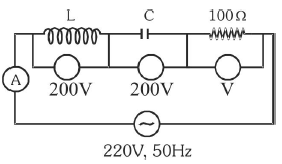
The readings of ammeter and voltmeter in the following circuit are respectively :-
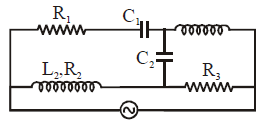
For given circuit, find effective impedance for frequencies much higher than resonating
frequency.
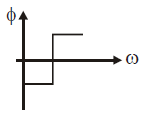
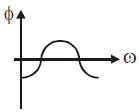
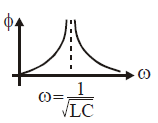
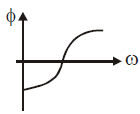
Which of the following plot correctly depicts the variation of phase difference between voltage and current in a series L-C AC circuit ?
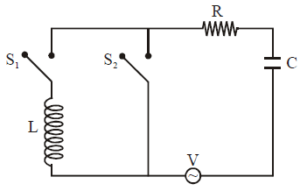
When S1 is closed and S2 is open, \[V_{L}=V_{R}=V_{C}=10V\]. What will be the value of
\[V_{C}\] if S1 opened and S2 is closed ?
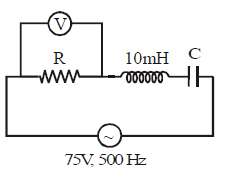
In the circuit of Figure, the volmeter reads 75 V.Value of C is :
A square wave current switching rapidly between \(+0.5\) ampere and \(-0.5\) ampere is passed through an A.C ammeter. Then the reading shown by it, is
An AC ammeter measures the RMS value of the current. For a symmetric square wave of amplitude \(I_0\), the RMS value is equal to its peak value, \(I_{rms} = I_0 = 0.5\text{ A}\).
In an LCR series circuit the potential differences across the resistance, capacitance and inductance are \(80\text{ V}\), \(40\text{ V}\) and \(100\text{ V}\) respectively. The power factor of this circuit is:
Total voltage in series LCR is \(V = \sqrt{V_R^2 + (V_L - V_C)^2} = \sqrt{80^2 + (100 - 40)^2} = 100\text{ V}\). Power factor is \(\cos\phi = \frac{V_R}{V} = \frac{80}{100} = 0.8\).
The maximum power is dissipated for an ac in a/an
The average power dissipated in an AC circuit is \(P_{\text{avg}} = V_{\text{rms}} I_{\text{rms}} cos\phi\). For a purely resistive circuit, the phase difference \(\phi = 0\), hence \(cos\phi = 1\) (maximum), resulting in maximum power dissipation.