Oscillation - NEET Physics Chapterwise MCQs & PYQs

NEET Oscillation MCQs & PYQs

Question 1:

easy

If the maximum velocity and acceleration of a particle executing SHM are equal in magnitude, the time period will be

In simple harmonic motion (SHM), the maximum velocity \( v_{\text{max}} \) and maximum acceleration \( a_{\text{max}} \) are given by:

\[
v_{\text{max}} = \omega A \quad \text{and} \quad a_{\text{max}} = \omega^2 A
\]

where:
- \( \omega \) is the angular frequency,
- \( A \) is the amplitude.

 Solution:

1. Given that \( v_{\text{max}} = a_{\text{max}} \), we have:
\[
\omega A = \omega^2 A
\]

2. Dividing both sides by \( A \) (assuming \( A \neq 0 \)):
\[
\omega = \omega^2
\]

3. Solving for \( \omega \):
\[
\omega = 1 \, \text{rad/s}
\]

4. Time Period \( T \):
\[
T = \frac{2\pi}{\omega} = \frac{2\pi}{1} = 2\pi \approx 6.28 \, \text{s}
\]

Answer:
The time period of the particle is **6.28 seconds**.
Question 2:

easy

The equation of SHM of a particle is given as 2d²x/dt² + 32x = 0, where x is the displacement from the mean position. then time period of its oscillation (in seconds) is

Given the SHM equation:

\[
2 \frac{d^2x}{dt^2} + 32x = 0
\]

We can rewrite it as:

\[
\frac{d^2x}{dt^2} + 16x = 0
\]

This equation is of the form:

\[
\frac{d^2x}{dt^2} + \omega^2 x = 0
\]

where \( \omega^2 = 16 \).

Solution:

1. Angular Frequency \( \omega \):
\[
\omega = \sqrt{16} = 4 \, \text{rad/s}
\]

2. Time Period \( T \):
\[
T = \frac{2\pi}{\omega} = \frac{2\pi}{4} = \frac{\pi}{2} \, \text{s}
\]

 Answer:
The time period of the oscillation is \( \frac{\pi}{2} \) seconds.

Question 3:

easy

Two simple harmonic motions of angular frequency 10rad/sec and 100 rad s–¹ have the same displacement amplitude. The ratio of their maximum acceleration is

Solution:

1. Maximum Acceleration in SHM is given by:
\[
a_{\text{max}} = \omega^2 A
\]

2. Ratio of Maximum Accelerations:
\[
\frac{a_{\text{max}_2}}{a_{\text{max}_1}} = \frac{\omega_2^2 A}{\omega_1^2 A} = \frac{\omega_2^2}{\omega_1^2} = \frac{(100)^2}{(10)^2} = \frac{10000}{100} = 100
\]

Answer:
The ratio of their maximum accelerations is \( 1 : 100 \) or \( 1 : 10^2 \).

Question 4:

easy

A particle executing SHM has amplitude 0.01 m and frequency 60 Hz. The maximum acceleration of the particle is

Given:
- Amplitude, \( A = 0.01 \, \text{m} \)
- Frequency, \( f = 60 \, \text{Hz} \)

Solution:

1. Angular Frequency \( \omega \):
\[
\omega = 2 \pi f = 2 \pi \times 60 = 120 \pi \, \text{rad/s}
\]

2. Maximum Acceleration \( a_{\text{max}} \):
Maximum acceleration in SHM is given by:
\[
a_{\text{max}} = \omega^2 A
\]

Substitute values of \( \omega \) and \( A \):
\[
a_{\text{max}} = (120 \pi)^2 \times 0.01 = 14400 \pi^2 \times 0.01 = 144 \pi^2 \, \text{m/s}^2
\]

Answer:
The maximum acceleration of the particle is \( 144 \pi^2 \, \text{m/s}^2 \).

Question 5:

easy

Average velocity of a particle performing SHM in one time period is:

As displacement in one time interval is zero. Average velocity is zero.

Question 6:

easy

The equation of SHM of a particle is a + 4π²x = 0 where a is instantaneous linear acceleration at displacement x. The frequency of motion is :

Question 7:

easy

The equation of motion of a particle of mass 1 gm is d²x/dt² + π²x = 0 where x is displacement (in m) from mean position. The frequency of oscillation is (in Hz) :

a =- ω²x

comparing 

ω² = π² ⇒ ω =π ⇒ 2πυ= π ⇒ υ = 1/2 Hz

Question 8:

easy

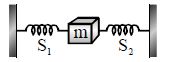
In figure S1 and S2 are identical springs. The oscillation frequency of the mass m is f. If one spring is removed, the frequency will become :

Given that \( S_1 \) and \( S_2 \) are identical springs, they each have the same spring constant \( k \). When both springs are attached, they are in parallel, so the effective spring constant \( k_{\text{eq}} \) is:

\[
k_{\text{eq}} = k + k = 2k
\]

The frequency \( f \) of oscillation for mass \( m \) with effective spring constant \( k_{\text{eq}} = 2k \) is:

\[
f = \frac{1}{2\pi} \sqrt{\frac{2k}{m}}
\]

If One Spring is Removed

If one spring is removed, only one spring with constant \( k \) is left. The new frequency \( f' \) becomes:

\[
f' = \frac{1}{2\pi} \sqrt{\frac{k}{m}}
\]

Ratio of New Frequency to Original Frequency

\[
\frac{f'}{f} = \frac{\frac{1}{2\pi} \sqrt{\frac{k}{m}}}{\frac{1}{2\pi} \sqrt{\frac{2k}{m}}} = \frac{\sqrt{\frac{k}{m}}}{\sqrt{\frac{2k}{m}}} = \frac{1}{\sqrt{2}}
\]

Thus:

\[
f' = \frac{f}{\sqrt{2}}
\]

Answer: \( f' = \frac{f}{\sqrt{2}} \)

Question 9:

easy

What should be the displacement of a simple pendulum whose amplitude is A, at which potential energy is 1/4 th of the total energy ?

\[ \frac{1}{2} k x^{2}=\frac{1}{4}\left( \frac{1}{2}kA^{2} \right) \]

\[ \frac{1}{2}k x^{2}=\frac{1}{4}\left(kA^{2} \right)  x= \frac{A}{2} \]

Question 10:

easy

For a particle executing simple harmonic motion, the amplitude is \(A\) and time period is \(T\). The maximum speed will be:

The maximum speed of a particle in simple harmonic motion is given by \(v_{\text{max}} = A\omega\). Since \(\omega = \frac{2\pi}{T}\), we get \(v_{\text{max}} = \frac{2\pi A}{T}\).