Energy in SHM - NEET Physics Chapterwise MCQs & PYQs

NEET Energy in SHM MCQs & PYQs

Question 1:

difficult

For a particle executing simple harmonic motion, the displacement x is given by x = A cosωt. Identify the graph which represents the variation of potential energy (PE) as function of time t and displacement x
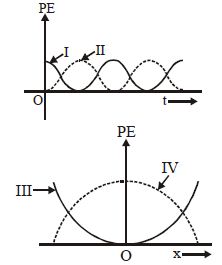
\[ P.E = \frac{1}{2}Kx^{2} = \frac{1}{2}KA^{2}cos^{2}\left( \omega t \right) \]

Graph I represents graph of cos²ωt.

\[ P.E = \frac{1}{2}Kx^{2} \]

Graph III represents a parabolic function


Question 2:

moderate

A body is executing simple harmonic motion. At a displacement x, its potential energy is E1 and at a displacement y, its potential energy is E2. The potential energy E at a displacement (x + y) is :

\[ E_{1}= \frac{1}{2}Kx^{2} \]

\[ E_{2}= \frac{1}{2}Ky^{2} \]

\[  E= \frac{1}{2}K(x+y)^{2}= \frac{1}{2}Kx^{2} + \frac{1}{2}Ky^{2} + Kxy \]

Question 3:

moderate

A block whose mass is 1 kg is fastened to a spring. The spring has a spring constant of 50 Nm–¹. The block is pulled to a distance of x = 10 cm from its equilibrium position at x = 0 cm on a frictionless surface from rest at t = 0. The kinetic energy of the block when it is 5 cm away from the mean position is 

\[ K.E= \frac{1}{2}K\left( A^{2}-x^{2} \right)\]

\[ K.E= \frac{1}{2}\times 50\left( 10^{2}-5^{2} \right)/10^{4}= 0.19 J \]

Question 4:

moderate

The total mechanical energy of a spring-mass system in simple harmonic motion is E=1/2mω²A².  Suppose the oscillating particle is replaced by another particle of double the mass while the amplitude A remains the same. The new mechanical energy will :

Question 5:

moderate

The total mechanical energy of a particle executing simple harmonic motion is E. When the displacement is half the amplitude its kinetic energy will be :

\[ K.E= \frac{1}{2}K\left(A^{2}-\left( \frac{A}{2}\right)^{2} \right)= \frac{3}{8} K A^{2} \]

K.E= 3E/4

Question 6:

moderate

A particle is executing S.H.M., If its P.E. & K.E. is equal then the ratio of displacement & amplitude will be :

\[ K.E= \frac{1}{2}K\left(A^{2}-x^{2} \right) \]

\[ P.E= \frac{1}{2}Kx^{2} \]

\[ \frac{1}{2}K\left(A^{2}-x^{2} \right)= \frac{1}{2}Kx^{2} \]

\[ x= A/\sqrt{2} \]


Question 7:

moderate

A particle is executing linear simple harmonic motion of amplitude A. What fraction of the total energy is kinetic when the displacement is half the amplitude 

\[ K.E= \frac{1}{2}K\left(A^{2}-x^{2} \right) \]

\[ K.E= \frac{1}{2}K\left(A^{2}-\left( \frac{A}{2}\right)^{2} \right)= \frac{3}{8} K A^{2} \]

K.E/T.E =3/4

Question 8:

moderate

A particle of mass 0.1 kg executes SHM under a force F = (–10x) Newton. Speed of particle at mean position is 6 m/s. Then amplitude of oscillations is :

Spring Constant K = m ω² ⇒ 10 = 0.1 ω² ⇒ ω²= 100 ⇒ ω = 10 rad/sec

Speed is maximum at mean position 

Vmax= Aω

6= A × 10

A = 0.6 m

Question 9:

moderate

The potential energy of a particle executing simple harmonic motion at a distance x from the equilibrium position is proportional to :

\[ U = \frac{1}{2}kx^{2} \]

Question 10:

easy

What should be the displacement of a simple pendulum whose amplitude is A, at which potential energy is 1/4 th of the total energy ?

\[ \frac{1}{2} k x^{2}=\frac{1}{4}\left( \frac{1}{2}kA^{2} \right) \]

\[ \frac{1}{2}k x^{2}=\frac{1}{4}\left(kA^{2} \right)  x= \frac{A}{2} \]