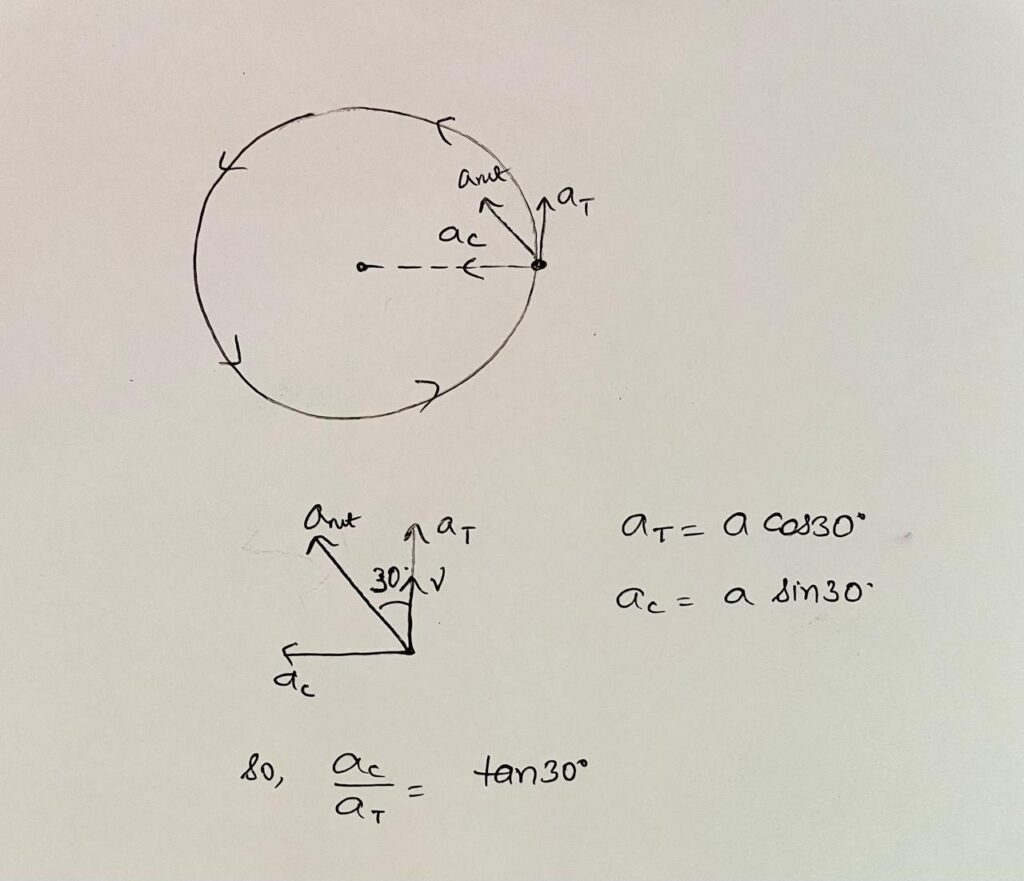
Question 1:
moderateA point on the periphery of rotating disc has its acceleration vector making on angle 30° with velocity vector then the ratio of magnitude of centripetal acceleration to tangential acceleration is :
Kinematics of circular motion is important for preparation of NEET, JEE Mains, JEE Advance , CUET and other exams in which Physics is asked
Question 1:
moderateA point on the periphery of rotating disc has its acceleration vector making on angle 30° with velocity vector then the ratio of magnitude of centripetal acceleration to tangential acceleration is :
Question 2:
moderateA block on a stationary horizontal table with increasing speed in a circle is seen from an inertial frame of reference. The angle between net force on the block and velocity vector is :
When net acceleration makes acute angle with velocity, speed of the particle will increase. As tangential accleration is positive, speed will increase.
Question 3:
moderateA wheel is subjected to uniform angular acceleration about its axis. Initially its angular velocity is zero. In the first 2 sec, it rotates through an angle θ1; in the next 4 sec, it rotates through an additional angle θ2. The ratio of θ2/θ1 is :
For Circular motion angle traversed is θ = ω t + ½ α t²
so, θ1 =½α(2)² = 2α
and θ1 + θ2 = ½α(6)² = 18 α ⇒ θ2= 16 α
so θ2 /θ1= 8
Question 4:
moderateAt t = 0 a wheel is rotating at 50 rad/sec. A motor gives it a constant angular acceleration of 5 rad/sec2 until it reaches 100 rad/sec the motor is disconnected how many revolutions are completed at t = 20 sec
ω = ω 0 + α.t
⇒ 100 =50 + 5 × t
⇒ 50 = 5.t
⇒ t = 10 sec.
Angle traversed during acceleration= ½.α.t²= ½×5×(10)²= 250 rad
Angle traversed with constant angular speed = ω.t= 100 × 10 = 1000 rad
Total angle traversed = 1250 rad
Number of Revolutions = 1250 /2π= 625 /π
Question 5:
moderateThe kinetic energy \((K)\) of particle moving along a circle of radius \(R\) depends upon the distance covered \(S\) and is given by \(K = aS\) where \(a\) is a constant. Then the centripetal force acting on the particle is:
Kinetic energy is \(K = \frac{1}{2}mv^2 = aS\). Centripetal force is \(F_c = \frac{mv^2}{R}\) ( Since \(mv^2 = 2aS\), we get \(F_c = \frac{2aS}{R}\).
Question 6:
moderateA rigid body rotates about a stationary axis according to the equation, \(\theta = 6t^2 – 2t^3\). Its angular velocity, when its angular acceleration becomes 6 \(\text{rad/s}^2\), will be (Where \(\theta\) denotes angular displacement in radian, t denotes time in second)
Angular velocity is \(omega = 12t - 6t^2\) and angular acceleration is \(alpha = 12 - 12t\). Setting \(alpha = 6\text{ rad/s}^2\) gives \(t = 0.5\text{ s}\). Thus, \(omega = 12(0.5) - 6(0.5)^2 = 4.5\text{ rad/s}\).
Question 7:
moderateA particle of mass $10 \text{ g}$ moves along a circle of radius $6.4 text{ cm}$ with a constant tangential acceleration. What is the magnitude of this acceleration if the kinetic energy of the particle becomes equal to $8 \times 10^{-4} \text{ J}$ by the end of the second revolution after the beginning of the motion?
(2016-I)
Work done by tangential force $W = (ma_t)s = \Delta K$, where distance $s = 4\pi r = 4 \times \pi \times 0.064 \text{ m}$. Substituting values gives $a_t = 0.1 \text{ m/s}^2$.
Question 8:
moderateFor a body angular velocity $\vec{\omega} = \hat{i} – 2\hat{j} + 3\hat{k}$ and radius vector is $\vec{r} = \hat{i} + \hat{j} + \hat{k}$ then its velocity is:
(1999)
Velocity is given by $\vec{v} = \vec{\omega} \times \vec{r}$. Evaluating the cross-product determinant yields $-5\hat{i} + 2\hat{j} + 3\hat{k}$.