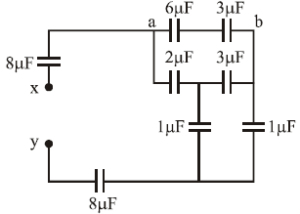
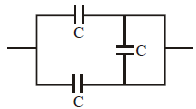
In the circuit shown, the effective capacitance between points X and Y is:
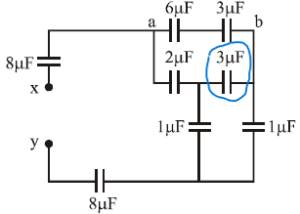
In the Upper arm 6 μF and 3 μF capacitors are in series , so equivalent capacitance is 2μF. The 3μF capacitor ( circled one) can be removed as it is part of balanced wheat stone bridge.
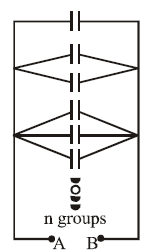
The equivalent capacitance of the combination shown in figure is :
Reason for the Short Circuit:
The middle capacitor is bypassed by a conducting wire (short circuit). Hence, no voltage difference exists across the middle capacitor, and it can be ignored in the calculation.
Simplified Circuit:
The circuit reduces to two capacitors
at the top and bottom in parallel.
For capacitors in parallel, the equivalent capacitance is simply the sum of their capacitances:
Final Answer:
The equivalent capacitance of the given combination is 2C.
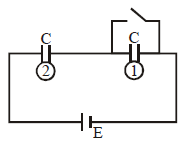
Two capacitors \( C_1 \) and \( C_2 \) are charged to \( 120\text{V} \) and \( 200\text{V} \) respectively. It is found that by connecting them together the potential on each one can be made zero. Then :
For the common potential to be zero, the initial charges on the capacitors must be equal in magnitude and connected with opposite polarities: \( q_1 = q_2 \Rightarrow 120 C_1 = 200 C_2 \Rightarrow 3 C_1 = 5 C_2 \).
A capacitor of capacitance \( 1\ \mu\text{F} \) can withstand a potential difference of \( 6\text{V} \) and another capacitor of \( 1\ \mu\text{F} \) can withstand a potential difference of \( 4\text{V} \). If they are connected in series, the combination can withstand a potential difference of
Since both capacitors are in series and have equal capacitance, the total potential difference divides equally between them. The maximum potential is limited by the weaker capacitor: \( V_{\text{max}} = 2 \times 4\text{V} = 8\text{V} \).
Two conduction spheres of radii \(R_1\) and \(R_2\) are kept widely separated from each other. If the spheres are connected by a metal wire, what will be the capacitance of the combination? Think in terms of series-parallel connections.
When widely separated conductors are connected, they are effectively in parallel as they share a common potential. The equivalent capacitance is the sum of individual capacitances: \(C_{eq} = C_1 + C_2 = 4 \pi \epsilon_0 R_1 + 4 \pi \epsilon_0 R_2 = 4 \pi \epsilon_0 (R_1 + R_2)\).
Three capacitors \(2 \mutext{F}\), \(3 \mutext{F}\, \text{and }5 \mutext{F}\), can withstand voltages to \(3text{V}\), \(2text{V}\), \text{and }1text{V}\), respectively. Their series combination can withstand a maximum voltage equal to :
For each capacitor, calculate the maximum charge it can hold: \(Q_1 = C_1 V_1 = (2 \mu\text{F})(3\text{V}) = 6 \mu\text{C}\), \(Q_2 = C_2 V_2 = (3 \mu\text{F})(2\text{V}) = 6 \mu\text{C}\), \(Q_3 = C_3 V_3 = (5 \mu\text{F})(1text{V}) = 5 \mu\text{C}\). In a series combination, the charge must be the same on each capacitor, so the maximum charge is the minimum of these, \(Q_{max} = 5 \mu\text{C}\). The equivalent capacitance in series is \(\frac{1}{C_{eq}} = \frac{1}{2} + \frac{1}{3} + \frac{1}{5} = \frac{15+10+6}{30} = \frac{31}{30} \text{F}^{-1}\), so \(C_{eq} = \frac{30}{31} \mu\text{F}\). The maximum voltage is \(V_{max} = \frac{Q_{max}}{C_{eq}} = \frac{5 \mu\text{C}}{(30/31) \mu\text{F}} = \frac{5 \times 31}{30} = \frac{31}{6} \text{ Volts}\).
Capacitors A and B are identical. Capacitor A is charged so it stores \(4\text{J}\), of energy and capacitor B is uncharged. The capacitor are then connected in parallel. The total stored energy in the capacitors is now:
Let \(C\) be the capacitance of each capacitor. For capacitor A, initial energy \(U_A = \frac{Q_A^2}{2C} = 4\text{J}\), so \(Q_A = \sqrt{8C}\). Capacitor B is uncharged, so \(Q_B = 0\). When connected in parallel, total charge is conserved: \(Q_{total} = Q_A + Q_B = \sqrt{8C}\). The equivalent capacitance is \(C_{eq} = C + C = 2C\). The final total energy is \(U_{total} = \frac{Q_{total}^2}{2C_{eq}} = \frac{(\sqrt{8C})^2}{2(2C)} = \frac{8C}{4C} = 2\text{J}\).