Combination of Capacitors - NEET Physics Chapterwise MCQs & PYQs

NEET Combination of Capacitors MCQs & PYQs

Question 1:

difficult

Three capacitors 2 μF, 3 μF and 5 μF can withstand voltages to 3V, 2V and 1V respectively. Their series combination can withstand a maximum voltage equal to

Let's verify and calculate the correct answer step-by-step:

Given Data:

  • Capacitances:
    C1=2 μF,C2=3 μF,C3=5 μFC_1 = 2 \, \mu\text{F}, C_2 = 3 \, \mu\text{F}, C_3 = 5 \, \mu\text{F}
     
  • Maximum voltages:
    V1=3 V,V2=2 V,V3=1 VV_1 = 3 \, \text{V}, V_2 = 2 \, \text{V}, V_3 = 1 \, \text{V}
     

Step 1: Maximum charge each capacitor can store:


Q1=C1⋅V1=2⋅3=6 μCQ_1 = C_1 \cdot V_1 = 2 \cdot 3 = 6 \, \mu\text{C}


Q2=C2⋅V2=3⋅2=6 μCQ_2 = C_2 \cdot V_2 = 3 \cdot 2 = 6 \, \mu\text{C}


Q3=C3⋅V3=5⋅1=5 μCQ_3 = C_3 \cdot V_3 = 5 \cdot 1 = 5 \, \mu\text{C}


The capacitor with the minimum charge capacity limits the system. Here,

Qmax=5 μCQ_{\text{max}} = 5 \, \mu\text{C}

, dictated by

C3C_3

.


Step 2: Voltage distribution across each capacitor:

In series, charge

QQ

is the same on all capacitors, and the voltage across each capacitor is:


V1=QC1,V2=QC2,V3=QC3V_1 = \frac{Q}{C_1}, \quad V_2 = \frac{Q}{C_2}, \quad V_3 = \frac{Q}{C_3}


Total voltage across the series combination:


Vtotal=V1+V2+V3V_{\text{total}} = V_1 + V_2 + V_3


Substitute

Q=5 μCQ = 5 \, \mu\text{C}

:


V1=52=2.5 V,V2=53≈1.67 V,V3=55=1 VV_1 = \frac{5}{2} = 2.5 \, \text{V}, \quad V_2 = \frac{5}{3} \approx 1.67 \, \text{V}, \quad V_3 = \frac{5}{5} = 1 \, \text{V}


Step 3: Total voltage:


Vtotal=V1+V2+V3=2.5+1.67+1=156+106+66=316 V.V_{\text{total}} = V_1 + V_2 + V_3 = 2.5 + 1.67 + 1 = \frac{15}{6} + \frac{10}{6} + \frac{6}{6} = \frac{31}{6} \, \text{V}.


Final Answer:

The maximum voltage the series combination can withstand is:
 

316 V≈5.17 V.\boxed{\frac{31}{6} \, \text{V}} \approx 5.17 \, \text{V}.


Question 2:

difficult

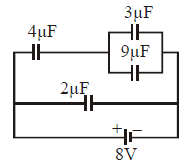
A combination of capacitors is set up as shown in the figure. The magnitude of the electric field, due to a point charge Q (having a charge equal to the sum of the charges on the 4μF and 9μF capacitors), at a point distant 30 m from it, would equal :

Question 3:

difficult

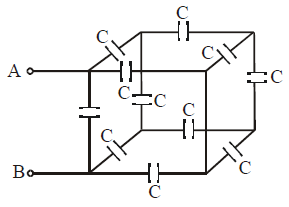
The equivalent capacitance between A and B is :

To find the equivalent capacitance for this cubical capacitor network, where each edge of the cube has a capacitance

CC

, here’s the shortest solution:

Step-by-Step:

  1. Symmetry analysis:
    • By symmetry, all corners of the cube can be grouped into equivalent potential nodes.
    • The cube's symmetry allows reduction to a simpler circuit.
  2. Key nodes:
    • Node
      AA
       

      is connected to one corner of the cube.

    • Node
      BB
       

      is connected to the diagonally opposite corner.

  3. Effective connections:
    • Due to symmetry, three capacitors are effectively in parallel between
      AA
       

      and an intermediate point.

    • Similarly, three capacitors are effectively in parallel between
      BB
       

      and the same intermediate point.

    • Two capacitors remain directly between
      AA
       

      and BB 

      .

  4. Simplification:
    • The three parallel capacitors at each node result in:
      Cparallel=3CC_{\text{parallel}} = 3C
       
    • The equivalent circuit becomes two
      3C3C
       

      capacitors in series with a 2C2C 

      capacitor: Series combination:1Ceq=13C+13C+12C\text{Series combination:} \quad \frac{1}{C_{\text{eq}}} = \frac{1}{3C} + \frac{1}{3C} + \frac{1}{2C} 

  5. Calculation:
    • Combine series:
      1Ceq=23C+12C=46C+36C=76C\frac{1}{C_{\text{eq}}} = \frac{2}{3C} + \frac{1}{2C} = \frac{4}{6C} + \frac{3}{6C} = \frac{7}{6C}
       
    • Invert to find
      CeqC_{\text{eq}}
       

      : Ceq=6C7×2=12C7C_{\text{eq}} = \frac{6C}{7} \times 2 = \frac{12C}{7} 

Thus, the equivalent capacitance is:


Ceq=12C7C_{\text{eq}} = \frac{12C}{7}


Question 4:

difficult

Three capacitors \(2 \mutext{F}\), \(3 \mutext{F}\, \text{and }5 \mutext{F}\), can withstand voltages to \(3text{V}\), \(2text{V}\), \text{and }1text{V}\), respectively. Their series combination can withstand a maximum voltage equal to :

For each capacitor, calculate the maximum charge it can hold: \(Q_1 = C_1 V_1 = (2 \mu\text{F})(3\text{V}) = 6 \mu\text{C}\), \(Q_2 = C_2 V_2 = (3 \mu\text{F})(2\text{V}) = 6 \mu\text{C}\), \(Q_3 = C_3 V_3 = (5 \mu\text{F})(1text{V}) = 5 \mu\text{C}\). In a series combination, the charge must be the same on each capacitor, so the maximum charge is the minimum of these, \(Q_{max} = 5 \mu\text{C}\). The equivalent capacitance in series is \(\frac{1}{C_{eq}} = \frac{1}{2} + \frac{1}{3} + \frac{1}{5} = \frac{15+10+6}{30} = \frac{31}{30} \text{F}^{-1}\), so \(C_{eq} = \frac{30}{31} \mu\text{F}\). The maximum voltage is \(V_{max} = \frac{Q_{max}}{C_{eq}} = \frac{5 \mu\text{C}}{(30/31) \mu\text{F}} = \frac{5 \times 31}{30} = \frac{31}{6} \text{ Volts}\).