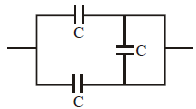
The equivalent capacitance of the combination shown in figure is :
Reason for the Short Circuit:
The middle capacitor is bypassed by a conducting wire (short circuit). Hence, no voltage difference exists across the middle capacitor, and it can be ignored in the calculation.
Simplified Circuit:
The circuit reduces to two capacitors
at the top and bottom in parallel.
For capacitors in parallel, the equivalent capacitance is simply the sum of their capacitances:
Final Answer:
The equivalent capacitance of the given combination is 2C.
Two capacitors \( C_1 \) and \( C_2 \) are charged to \( 120\text{V} \) and \( 200\text{V} \) respectively. It is found that by connecting them together the potential on each one can be made zero. Then :
For the common potential to be zero, the initial charges on the capacitors must be equal in magnitude and connected with opposite polarities: \( q_1 = q_2 \Rightarrow 120 C_1 = 200 C_2 \Rightarrow 3 C_1 = 5 C_2 \).
A capacitor of capacitance \( 1\ \mu\text{F} \) can withstand a potential difference of \( 6\text{V} \) and another capacitor of \( 1\ \mu\text{F} \) can withstand a potential difference of \( 4\text{V} \). If they are connected in series, the combination can withstand a potential difference of
Since both capacitors are in series and have equal capacitance, the total potential difference divides equally between them. The maximum potential is limited by the weaker capacitor: \( V_{\text{max}} = 2 \times 4\text{V} = 8\text{V} \).
Two conduction spheres of radii \(R_1\) and \(R_2\) are kept widely separated from each other. If the spheres are connected by a metal wire, what will be the capacitance of the combination? Think in terms of series-parallel connections.
When widely separated conductors are connected, they are effectively in parallel as they share a common potential. The equivalent capacitance is the sum of individual capacitances: \(C_{eq} = C_1 + C_2 = 4 \pi \epsilon_0 R_1 + 4 \pi \epsilon_0 R_2 = 4 \pi \epsilon_0 (R_1 + R_2)\).
Capacitors A and B are identical. Capacitor A is charged so it stores \(4\text{J}\), of energy and capacitor B is uncharged. The capacitor are then connected in parallel. The total stored energy in the capacitors is now:
Let \(C\) be the capacitance of each capacitor. For capacitor A, initial energy \(U_A = \frac{Q_A^2}{2C} = 4\text{J}\), so \(Q_A = \sqrt{8C}\). Capacitor B is uncharged, so \(Q_B = 0\). When connected in parallel, total charge is conserved: \(Q_{total} = Q_A + Q_B = \sqrt{8C}\). The equivalent capacitance is \(C_{eq} = C + C = 2C\). The final total energy is \(U_{total} = \frac{Q_{total}^2}{2C_{eq}} = \frac{(\sqrt{8C})^2}{2(2C)} = \frac{8C}{4C} = 2\text{J}\).
Two identical capacitors, have the same capacitance (C). One of them is charged to potential \(V_1\) and the other to \(V_2\). The negative ends of the capacitors are connected together. When the positive ends are also connected, the decrease in energy of the combined system is :
Initial energy \(U_i = \frac{1}{2}CV_1^2 + \frac{1}{2}CV_2^2\). Common potential after connection \(V = \frac{CV_1 + CV_2}{C + C} = \frac{V_1 + V_2}{2}\) for like-polarity connection. Final energy \(U_f = \frac{1}{2}(2C)V^2 = C \left(\frac{V_1 + V_2}{2}\right)^2 = \frac{C}{4}(V_1^2 + V_2^2 + 2V_1V_2)\) . Decrease in energy \(Delta U = U_i - U_f = \frac{1}{4}C(V_1^2 + V_2^2 - 2V_1V_2) = \frac{1}{4}C(V_1 - V_2)^2\).
The capacitance of a a parallel plate capacitor is (C) when the region between the plate has air. This region is now filled with a dielectric slab of dielectric constant (k). The capacitor is connected to a cell of emf (E), and the slab is taken out
Concept: Work done by external agent in removing dielectric from capacitor connected to battery. Formula: (W_{\text{ext}} = \Delta U - W_{\text{cell}}\), where (W_{\text{cell}} = E\Delta Q\). Solution: Initial stored energy (U_1 = \frac{1}{2} kCE^2\) and charge (Q_1 = kCE\). Final stored energy (U_2 = \frac{1}{2} CE^2\) and charge (Q_2 = CE\). Change in stored energy (Delta U = U_2 - U_1 = -\frac{1}{2} CE^2(k-1)\). Charge returned to cell (Delta Q = Q_1 - Q_2 = CE(k-1)\). Work done by cell (W_{\text{cell}} = E (Q_2 - Q_1) = -E^2C(k-1)\). Work done by external agent (W_{\text{ext}} = \Delta U - W_{\text{cell}} = -\frac{1}{2} CE^2(k-1) - (-E^2C(k-1)) = \frac{1}{2} E^2C(k-1)\).
Two identical capacitors each of capacitance \(C\) and breakdown voltage \(V\) are connected in series. The respective values of capacitance and the breakdown voltage of the combination will be
In series, the equivalent capacitance is \(C_{text{eq}} = \frac{C}{2}\). Since the voltage is shared equally between the two identical capacitors, the maximum safe voltage across the combination is \(2V\).