Question 31:
moderate
A light has amplitude A and angle between analyser and polariser is 60 degree. Light is transmitted by analyser has amplitude.
A light has amplitude A and angle between analyser and polariser is 60 degree. Light is transmitted by analyser has amplitude.
Two Nicols are oriented with their principal planes making an angle of 60°. The percentage of incident unpolarized light which passes through the system is :
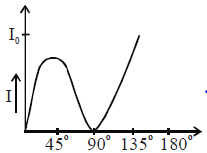
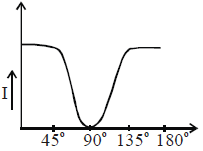
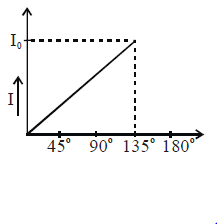
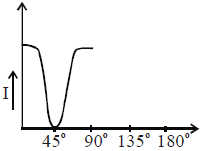
The graph showing the dependence of intensity of transmitted light on the angle between polariser and analyser, is :
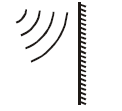
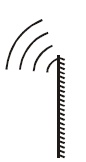
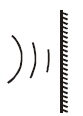
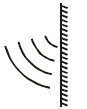
Spherical wavefronts shown in fig, strike a plane mirror. Reflected wavefronts will be as shown in:
White light is used to illuminate the two silts in a Young’s double slit experiment. The separation between the slits is b and the screen is at a distance d (> > b) from the slits. At a point on the screen directly in front of one of the slits, certain wavelengths are missing. Some of these missing wavelengths are :
The first diffraction minimum due to a single slit diffraction is at θ = 30° for a light of wavelength 5000Å. The width of the slit is :
Light waves travel in vaccum along the y-axis. Which of the following may represent the wavefront?
Wavefronts are surfaces of constant phase which are perpendicular to the direction of propagation. Since propagation is along the y-axis, the wavefront must be parallel to the x-z plane, represented by \(y =\text{ constant}\).
The equations of two interferring waves are \(Y_1 = b cos \omega t\) and \(Y_2 = b cos (\omega t+\phi)\) respectively. Destructive interference will take place at the point of observation for the following value of \(\phi\) :–
For destructive interference to occur, the phase difference between the two interfering waves must be an odd multiple of \(pi\) (i.e., \(180^0\), \(540^0 \), etc.). From the options, \(180^0 \) is correct.
Two polarizers are oriented with transmission planes making an angle of \(45^\circ\) with each other. The percentage of incident unpolarised light that passes through the system is
An unpolarized light of intensity \(I_0\) becomes \(I_1 = \frac{I_0}{2}\) after passing through the first polarizer. According to Malus's Law, the final intensity is \(I_2 = I_1 cos^2(45^\circ) = \frac{I_0}{2} \left(\frac{1}{\sqrt{2}}\right)^2 = \frac{I_0}{4}\), which corresponds to \(25%\) of the incident intensity.
In a diffraction pattern due to a single slit of width \(a\), the first minimum is observed at an angle \(30^\circ\) when light of wavelength \(\lambda\) is incident on the slit. The first secondary maximum is observed at an angle
For first minimum, \(a sin(30^\circ) = \lambda \Rightarrow a = 2\lambda\). For first secondary maximum, \[a sin\theta = \frac{3}{2}\lambda \Rightarrow sin\theta = \frac{3\lambda}{2(2\lambda)} = \frac{3}{4}\].