Properties of Semiconductors - NEET Physics Questions
← Back to Semiconductor Physics

Properties of Semiconductors

Question 1: easy

In case of a semiconductor, which of the following statement is wrong :

1. Doping increases conductivity
2. Temperature coefficient of resistance is negative
3. Resisitivity is in between that of a conductor and insulator
4. At absolute zero temperature, it behaves like a conductor
View Answer

The statement "At absolute zero temperature, it behaves like a conductor" is wrong for a semiconductor.

Explanation:

  • At absolute zero (0 K), intrinsic semiconductors (like silicon and germanium) do not have free charge carriers (electrons and holes) because all the electrons occupy the valence band, and there is no thermal energy available to promote them to the conduction band.
  • Therefore, intrinsic semiconductors behave like insulators at absolute zero, not conductors.
Question 2: easy

A conducting wire of Copper and Germanium are cooled from room temperature to temperature 80K, then their resistance will :

1. increase
2. decrease
3. copper's increase and Germanium's decrease
4. copper's decrease and Germanium's increase
View Answer

When a conducting wire of Copper and Germanium is cooled from room temperature to 80K:

  • Copper (metal): Its resistance will decrease because metals have lower resistance at lower temperatures due to reduced electron scattering.
  • Germanium (semiconductor): Its resistance will increase because the number of charge carriers (electrons and holes) decreases at lower temperatures, leading to higher resistance.

Thus, Copper's resistance decreases, while Germanium's resistance increases when cooled to 80K

Question 3: easy

Which statement is correct ?

1. N-type germanium is negatively charged and P-type germanium is positively charged
2. Both N-type and P-type germanium are neutral
3. N-type germanium is positively charged and P-type germanium is negatively charged
4. Both N-type and P-type germanium are negatively charged
View Answer

Both N-type and P-type germanium are electrically neutral because, while they have an imbalance of charge carriers (electrons or holes), the overall number of positive and negative charges remains equal.

- **N-type**: Donor atoms add extra electrons (negatively charged carriers), but the atoms themselves become positively charged ions. This ensures charge neutrality.

- **P-type**: Acceptor atoms create holes (positively charged carriers) by accepting electrons, but the atoms become negatively charged ions. This balances the charge.

In both cases, the total positive and negative charges cancel each other out, keeping the material electrically neutral.

Question 4: easy

Wires P and Q have the same resistance at ordinary (room) temperature. When heated, resistance of P increases and that of Q decreases. We conclude that :

1. P and Q are conductors of different materials
2. P is N-type semiconductor and Q is P-type semiconductor
3. P is semiconductor and Q is conductor
4. P is conductor and Q is semiconductor
View Answer

Resistance of conductor increases with increasing temperature and resistance of semiconductor decreases with increasing temperature.

Question 5: easy

The resistivity of a pure semiconductor is 0.5 Ωm. If the electron and hole mobility be
0.39 m²/V-s and 0.19 m²/V-s respectively then calculate the intrinsic carrier concentration.

1. \[2.16\times 10^{19}/m^{3}\]
2. \[4.32\times 10^{19}/m^{3}\]
3. \[10^{20}/m^{3}\]
4. \[10^{30}/m^{3}\]
View Answer

The resistivity () of a pure (intrinsic) semiconductor is given by the formula:


ρ=1q(ni)(μn+μp)\rho = \frac{1}{q (n_i) (\mu_n + \mu_p)}

Where:


  • ρ=0.5Ωm\rho = 0.5 \, \Omega\text{m}
     

    (resistivity),


  • q=1.6×10¹⁹Cq = 1.6 \times 10^{-19} \, \text{C}
     

    (charge of an electron),


  • nin_i
     

    = intrinsic carrier concentration (to be calculated),


  • μn=0.39m2/V-s\mu_n = 0.39 \, \text{m}^2/\text{V-s}
     

    (electron mobility),


  • μp=0.19m2/V-s\mu_p = 0.19 \, \text{m}^2/\text{V-s}
     

    (hole mobility).

Rearranging the formula to solve for

nin_i

:


ni=1qρ(μn+μp)n_i = \frac{1}{q \rho (\mu_n + \mu_p)}

Substitute the values:


ni=1(1.6×10¹⁹)(0.5)(0.39+0.19)n_i = \frac{1}{(1.6 \times 10^{-19})(0.5)(0.39 + 0.19)}

ni=1(1.6×10¹⁹)(0.5)(0.58)n_i = \frac{1}{(1.6 \times 10^{-19})(0.5)(0.58)}


ni=14.64×1020=2.16×10¹⁹m3


Thus, the intrinsic carrier concentration

nin_i

is

2.16×10¹⁹m32.16 \times 10^{19} \, \text{m}^{-3}


Question 6: easy

Which one of the following statement is FALSE :

1. The resistance of intrinisic semiconductor decreases with increase of temperature.
2. Pure Si doped with trivalent impurities gives a p-type semiconductor.
3. Majority carriers in a n-type semiconductor are holes.
4. Minority carriers in a p-type semiconductor are electrons.
View Answer

Majority charge carrier in N-type semiconductor is electrons and in P-type semiconductor is holes

Question 7: easy

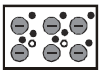
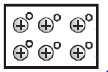
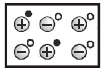
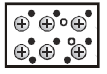
Representation of N-type semiconductor is :

1.
2.
3.
4.
View Answer

In N type semiconductor number of electrons is more than number of holes

Question 8: easy

Intrinsic semiconductor is electrically neutral. Extrinsic semiconductor having large number of current carriers would be :

1. Positively charged
2. Negatively charged
3. Positively charged or negatively charged depending upon the type of impurity that has been added
4. Electrically neutral
View Answer

An extrinsic semiconductor with a large number of current carriers is still electrically neutral overall because the total number of positive and negative charges remains balanced.

Question 9: easy

A p-type extrinsic semiconductor is obtained when Germanium is doped with

1. Arsenic
2. Boron
3. Antimony
4. Phosphorous
View Answer

A p-type semiconductor is created by doping a tetravalent semiconductor (like Ge) with a trivalent impurity such as Boron.

Question 10: easy

The electron concentration in an \(n\)-type semiconductor is the same as hole concentration in a \(p\)-type semiconductor. An external field (electric) is applied across each of them. Compare the currents in them.

1. No current will flow in \(p\)-type, current will only flow in \(n\)-type
2. Current in \(n\)-type = current in \(p\)-type
3. Current in \(p\)-type > current in \(n\)-type
4. Current in \(n\)-type > current in \(p\)-type.
View Answer

The mobility of electrons (\(mu_e\)) is greater than the mobility of holes (\(mu_h\)). Since current is proportional to mobility for the same carrier concentration and electric field, the current in the \(n\)-type semiconductor is greater than that in the \(p\)-type.