Oscillation - NEET Physics Questions
← All Chapters

Oscillation

Question 41: easy

What should be the displacement of a simple pendulum whose amplitude is A, at which potential energy is 1/4 th of the total energy ?

1. A/√2
2. A/2
3. A/4
4. A/2√2
View Answer

\[ \frac{1}{2} k x^{2}=\frac{1}{4}\left( \frac{1}{2}kA^{2} \right) \]

\[ \frac{1}{2}k x^{2}=\frac{1}{4}\left(kA^{2} \right)  x= \frac{A}{2} \]
Question 42: difficult

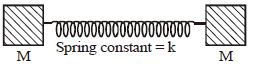
What is the angular frequency of the system shown in the figure?

1. \[ \sqrt[]{\frac{k}{m}} \]
2. \[ \sqrt[]{\frac{k}{2m}} \]
3. \[ \sqrt[]{\frac{k}{3m}} \]
4. \[ \sqrt[]{\frac{2k}{m}}\]
View Answer

The system shown consists of two masses \( M \) connected by a spring with a spring constant \( k \). Since the masses are identical, the angular frequency \( \omega \) of the system for oscillations is given by:

\[
\omega = \sqrt{\frac{k}{\text{reduced mass}}}
\]

In this case, the reduced mass \( \mu \) of the system is given by:

\[
\mu = \frac{M \cdot M}{M + M} = \frac{M}{2}
\]

Thus, the angular frequency \( \omega \) is:

\[
\omega = \sqrt{\frac{k}{M/2}} = \sqrt{\frac{2k}{M}}
\]

Answer:

\[
\omega = \sqrt{\frac{2k}{M}}
\]

Question 43: easy

For a particle executing simple harmonic motion, the amplitude is \(A\) and time period is \(T\). The maximum speed will be:

1. \(4AT\)
2. \(\frac{2A}{T}\)
3. \(2\pi\sqrt{\frac{A}{T}}\)
4. \(\frac{2\pi A}{T}\)
View Answer

The maximum speed of a particle in simple harmonic motion is given by \(v_{\text{max}} = A\omega\). Since \(\omega = \frac{2\pi}{T}\), we get \(v_{\text{max}} = \frac{2\pi A}{T}\).

Question 44: easy

A particle is performing SHM along x-axis such that its velocity and displacement are related as \(27v^2 = 10 – 3x^2\), then time period of oscillation of particle is:

1. \(2\pi\text{ s}\)
2. \(3\pi\text{ s}\)
3. \(6\pi\text{ s}\)
4. \(9\pi\text{ s}\)
View Answer

The given equation can be rewritten as \(v^2 = \frac{10}{27} - \frac{1}{9}x^2\). Comparing this with the standard SHM equation \(v^2 = \omega^2(A^2 - x^2)\), we get \(\omega^2 = \frac{1}{9}\) which gives \(omega = \frac{1}{3}\text{ rad/s}\). Thus, the time period is \(T = \frac{2\pi}{\omega} = 6\pi\text{ s}\).

Question 45: easy

The potential energy of a harmonic oscillator of mass \(2\text{ kg}\) in its mean position is \(5\text{ J}\). If its total energy is \(9\text{ J}\) and its amplitude is \(0.01\text{ m}\), its time period will be:

1. \(\frac{\pi}{100}\text{ s}\)
2. \(\frac{\pi}{50}\text{ s}\)
3. \(\frac{\pi}{20}\text{ s}\)
4. \(\frac{\pi}{10}\text{ s}\)
View Answer

The total energy is given by \(E = U_0 + \frac{1}{2}m\omega^2 A^2\). Substituting the values: \(9 = 5 + \frac{1}{2}(2)\omega^2 (0.01)^2\), which gives \(\omega = 200\text{ rad/s}\). Therefore, the time period is \(T = \frac{2\pi}{\omega} = \frac{\pi}{100}\text{ s}\).

Question 46: easy

When a block is suspended from a spring, time period of its oscillation is \(T\). If this spring is cut into 3 equal parts and this block is suspended from parallel combination of these 3 parts, then new time period of oscillation will be:

1. \(\sqrt{3}T\)
2. \(\frac{T}{\sqrt{3}}\)
3. 3T
4. \(\frac{T}{3}\)
View Answer

Cutting a spring of constant \(k\) into 3 equal parts increases each part's spring constant to \(3k\). In a parallel connection, the equivalent constant is \(k_{\text{eq}} = 3k + 3k + 3k = 9k\). The new time period is \(T' = 2\pi\sqrt{\frac{m}{9k}} = \frac{T}{3}\).

Question 47: easy

A particle is performing simple harmonic motion of amplitude \(A\) about origin. Then position at which kinetic energy of particle is 8 times of its potential energy at that instant is:

1. \(x = \frac{A}{2\sqrt{2}}\)
2. \(x = \frac{A}{8}\)
3. \(x = \frac{A}{3}\)
4. \(x = \frac{A}{9}\)
View Answer

The given condition is \(\text{KE} = 8\text{PE}\). Substituting the expressions: \(\frac{1}{2}m\omega^2(A^2 - x^2) = 8\left(\frac{1}{2}m\omega^2 x^2\right)\), which simplifies to \(A^2 - x^2 = 8x^2\) or \(9x^2 = A^2\). Thus, \(x = \frac{A}{3}\).

Question 48: easy

A particle is executing SHM. Then, the graph of velocity as a function of displacement is a/an:

1. straight line
2. circle
3. ellipse
4. hyperbola
View Answer

For a particle in SHM, velocity \(v = \omega \sqrt{A^2 - x^2}\). Squaring and rearranging gives \(\frac{v^2}{\omega^2 A^2} + \frac{x^2}{A^2} = 1\), which represents an ellipse.

Question 49: easy

Two pendulums have time periods T and \(\frac{5T}{4}\). They start SHM at the same time from the mean position. What will be the phase difference between them, when the smaller pendulum has completed one oscillation?

1. \(60^\circ\)
2. \(72^\circ\)
3. \(90^\circ\)
4. \(120^\circ\)
View Answer

For the smaller pendulum, time elapsed for one oscillation is \(t = T\), so its phase is \(2\pi\). The phase of the second pendulum is \(\phi_2 = \frac{2\pi}{5T/4}T = \frac{8\pi}{5}\). The phase difference is \(2\pi - \frac{8\pi}{5} = \frac{2\pi}{5} = 72^\circ\).

Question 50: easy

A particle is performing simple harmonic motion of amplitude A and time period 12 seconds. If at t = 0 particle is at mean position, then distance travelled by particle in first 5 seconds will be:

1. \(\frac{7A}{3}\)
2. \(\frac{4A}{3}\)
3. \(\frac{3A}{2}\)
4. \(\frac{5A}{2}\)
View Answer

The equation of motion is \(x = A \sin\left(\frac{\pi t}{6}\right)\). At \(t = 3\text{ s}\), \(x = A\). At \(t = 5\text{ s}\), \(x = A \sin(5\pi/6) = 0.5A\). Total distance is \(A\) (from 0 to \(A\)) plus \(0.5A\) (returning from \(A\) to \(0.5A\)), which is \(1.5A = \frac{3A}{2}\).