Oscillation - NEET Physics Questions
← All Chapters

Oscillation

Question 31: easy

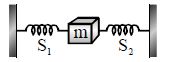
In figure S1 and S2 are identical springs. The oscillation frequency of the mass m is f. If one spring is removed, the frequency will become :
1. f
2. 2f
3. f√2
4. f/√2
View Answer

Given that \( S_1 \) and \( S_2 \) are identical springs, they each have the same spring constant \( k \). When both springs are attached, they are in parallel, so the effective spring constant \( k_{\text{eq}} \) is:

\[
k_{\text{eq}} = k + k = 2k
\]

The frequency \( f \) of oscillation for mass \( m \) with effective spring constant \( k_{\text{eq}} = 2k \) is:

\[
f = \frac{1}{2\pi} \sqrt{\frac{2k}{m}}
\]

If One Spring is Removed

If one spring is removed, only one spring with constant \( k \) is left. The new frequency \( f' \) becomes:

\[
f' = \frac{1}{2\pi} \sqrt{\frac{k}{m}}
\]

Ratio of New Frequency to Original Frequency

\[
\frac{f'}{f} = \frac{\frac{1}{2\pi} \sqrt{\frac{k}{m}}}{\frac{1}{2\pi} \sqrt{\frac{2k}{m}}} = \frac{\sqrt{\frac{k}{m}}}{\sqrt{\frac{2k}{m}}} = \frac{1}{\sqrt{2}}
\]

Thus:

\[
f' = \frac{f}{\sqrt{2}}
\]

Answer: \( f' = \frac{f}{\sqrt{2}} \)
Question 32: moderate

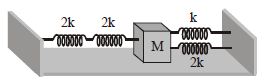
Four massless springs whose force constants are 2k, 2k, k and 2k respectively are attached to a mass M kept on a frictionless plane (as shown in figure). If the mass M is displaced in the horizontal direction, then the frequency of oscillation of the system is :

1. \[ \frac{1}{2\pi} \sqrt{\frac{k}{4M}}\]
2. \[ \frac{1}{2\pi} \sqrt{\frac{4k}{M}}\]
3. \[ \frac{1}{2\pi} \sqrt{\frac{k}{7M}}\]
4. \[ \frac{1}{2\pi} \sqrt{\frac{7k}{M}}\]
View Answer

1. Left Side:
- Two springs with spring constants \( 2k \) and \( 2k \) are in series.
- The combined spring constant \( k_{\text{left}} \) for these two springs in series is:
\[
\frac{1}{k_{\text{left}}} = \frac{1}{2k} + \frac{1}{2k} = \frac{1}{k}
\]
\[
k_{\text{left}} = k
\]

2. Right Side:
- Two springs with spring constants \( k \) and \( 2k \) are in parallel.
- The combined spring constant \( k_{\text{right}} \) for these two springs in parallel is:
\[
k_{\text{right}} = k + 2k = 3k
\]

3. Combine Left and Right Sides:
- Since \( k_{\text{left}} \) and \( k_{\text{right}} \) are in parallel, the equivalent spring constant \( k_{\text{eq}} \) is:
\[
k_{\text{eq}} = k_{\text{left}} + k_{\text{right}} = k + 3k = 4k
\]

Step 2: Calculate the Frequency of Oscillation

The frequency \( f \) is given by:

\[
f = \frac{1}{2\pi} \sqrt{\frac{k_{\text{eq}}}{M}}
\]

Substitute \( k_{\text{eq}} = 4k \):

\[
f = \frac{1}{2\pi} \sqrt{\frac{4k}{M}}
\]

Final Answer

\[
f = \frac{1}{2\pi} \sqrt{\frac{4k}{M}}
\]

Question 33: moderate

A force of 6.4 N stretches a vertical spring by 0.1 m. The mass that must be suspended from the spring so that it oscillates with a time period of π/4 second :

1. π/4 kg
2. 4/π kg
3. 1 kg
4. 10 kg
View Answer

Given:

- Force \( F = 6.4 \, \text{N} \)
- Extension \( x = 0.1 \, \text{m} \)
- Time period \( T = \frac{\pi}{4} \, \text{s} \)

1. Find the spring constant \( k \):

\[
k = \frac{F}{x} = \frac{6.4}{0.1} = 64 \, \text{N/m}
\]

2. Use the formula for the time period of a mass-spring system:

\[
T = 2\pi \sqrt{\frac{m}{k}}
\]

Substitute \( T = \frac{\pi}{4} \) and \( k = 64 \):

\[
\frac{\pi}{4} = 2\pi \sqrt{\frac{m}{64}}
\]

3. Solve for \( m \):

\[
\frac{1}{8} = \sqrt{\frac{m}{64}}
\]

\[
\frac{1}{64} = \frac{m}{64}
\]

\[
m = 1 \, \text{kg}
\]

Answer: \( m = 1 \, \text{kg} \)

Question 34: moderate

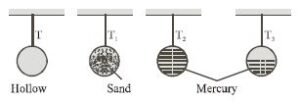
The period of a simple pendulum, whose bob is a hollow metallic sphere, is T. The period is T1 when the bob is filled with sand, T2 when it is filled with mercury and T3 when it is half filled with mercury. Which of the following is true:

1. T = T1 = T2 > T3
2. T = T1 = T3 > T
3. T > T3 > T1 = T2
4. T = T1 = T2 < T3
View Answer

In Hollow Sphere (T) , Solid Spheres ( T1 and T2) Center of mass lie at center. Where as in Half filled sphere center of mass lie below center(T3).

 As length of pendulum will increase in T3. Time period is highest for it.

Question 35: difficult

Two simple pendulums of length 1 m and 16m respectively are both given small displacement in the same direction at the same instant. They will be again in phase after the shorter pendulum has completed n oscillations. The value of n is :

1. 1/3
2. 2/3
3. 1
4. 4/3
View Answer

\[ T = 2\pi\sqrt{\frac{l}{g}} \]

\[ T_{1}= 2\pi\sqrt{\frac{1}{g}}= 2 sec \]

\[ T_{2}= 2\pi\sqrt{\frac{16}{g}}= 8 sec \]

Question 36: difficult

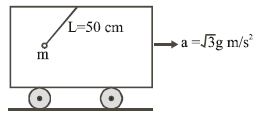
A simple pendulum 50 cm long is suspended from the roof of a cart accelerating in the horizontal direction with constant acceleration √3g m / s² .The period of small oscillations of the pendulum about its equilibrium position is (g = π² m/s²):

1. 1.0 sec
2. 1.25 sec
3. 1.53 sec
4. 1.68 sec
View Answer

\[ T = 2\pi\sqrt{\frac{l}{\sqrt{a^{2}+g^{2}}}} \]

\[ T = 2\pi\sqrt{\frac{0.5}{\sqrt{\left( \sqrt{3}g \right)^{2}+g^{2}}}} \]

\[ T = 2\pi\sqrt{\frac{0.5}{2g}} \]

\[ T = 2\pi\frac{1}{2\sqrt{g}} = 2\pi\frac{1}{2\pi}= 1 sec \]

Question 37: moderate

A particle is executing S.H.M., If its P.E. & K.E. is equal then the ratio of displacement & amplitude will be :

1. 1/√2
2. √2
3. 1/2
4. 3/2
View Answer

\[ K.E= \frac{1}{2}K\left(A^{2}-x^{2} \right) \]

\[ P.E= \frac{1}{2}Kx^{2} \]

\[ \frac{1}{2}K\left(A^{2}-x^{2} \right)= \frac{1}{2}Kx^{2} \]

\[ x= A/\sqrt{2} \]


Question 38: moderate

A particle is executing linear simple harmonic motion of amplitude A. What fraction of the total energy is kinetic when the displacement is half the amplitude 

1. 1/4
2. 1/2√2
3. 1/2
4. 3/4
View Answer

\[ K.E= \frac{1}{2}K\left(A^{2}-x^{2} \right) \]

\[ K.E= \frac{1}{2}K\left(A^{2}-\left( \frac{A}{2}\right)^{2} \right)= \frac{3}{8} K A^{2} \]

K.E/T.E =3/4

Question 39: moderate

A particle of mass 0.1 kg executes SHM under a force F = (–10x) Newton. Speed of particle at mean position is 6 m/s. Then amplitude of oscillations is :

1. 0.6 m
2. 0.2 m
3. 0.4 m
4. 0.1 m
View Answer

Spring Constant K = m ω² ⇒ 10 = 0.1 ω² ⇒ ω²= 100 ⇒ ω = 10 rad/sec

Speed is maximum at mean position 

Vmax= Aω

6= A × 10

A = 0.6 m

Question 40: moderate

The potential energy of a particle executing simple harmonic motion at a distance x from the equilibrium position is proportional to :

1. √x
2. x
3.
4.
View Answer

\[ U = \frac{1}{2}kx^{2} \]