Friction - NEET Physics Questions
Question 1:

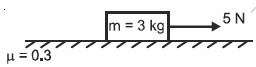
The value of frictional force on block in the given diagram is (Take g = 10 m/s²)

1. 4 N
2. 5 N
3. 6 N
4. 9 N
View Answer

Maximum friction force acting on the object will be uN= 0.3 * 30 = 9 N

But applied force is 5N so friction force acting on the object will be 5N

Question 2:

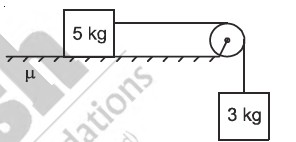
The minimum value of coefficient of friction (μ) such that block of mass ‘5 kg’ remains at rest is

1. 0.3
2. 0.4
3. 0.5
4. 0.6
View Answer

Given

m1=5m_1 = 5

kg,

m2=3m_2 = 3

kg, and

g=10g = 10

m/s²:

  • Tension:
    T=m2g=3×10=30T = m_2 g = 3 \times 10 = 30
     

    N

  • Friction force:
    f=μN=μ×50f = \mu N = \mu \times 50
     
  • At equilibrium:
    μ×50=30\mu \times 50 = 30
     

Solving,

μ=3050=0.6\mu = \frac{30}{50} = 0.6

.

Question 3:

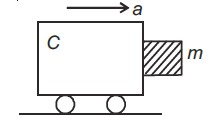
A block of mass m is in contact with the cart. The coefficient of static friction between the block and the cart is ü. The acceleration a of the cart that prevent the block from falling will be


neet pseudo force questions

1. a> (mg/ü)
2. a> (g/ü.m)
3. a ≥ (g/ü)
4. a ≤ (g/ü)
View Answer

The condition to prevent the block from falling is that the friction force must be at least equal to the weight of the block:

fsmgf_s \geq mg

Since static friction is given by fs=μNf_s = \mu N and the normal force is due to pseudo force N=maN = ma, we get:

μmamg\mu ma \geq mg

Dividing both sides by μm\mu m:

agμa \geq \frac{g}{\mu}

Thus, the required acceleration of the cart is agμa \geq \frac{g}{\mu}.

Question 4:

A body of mass m is kept on a rough horizontal surface (coefficient of friction = μ). A horizontal force is applied on the body, but it does not move. The resultant of normal reaction and the frictional force acting on the object is given by F, where F is:

1. F = mg
2. F = μmg
3. F = mg + μmg
4. F ≤ mg(1 + μ2) 1/2
View Answer

The forces acting on the body are: Normal reaction (N=mg) (upward) and Friction force fμmg (opposing applied force)

The resultant force is:

F=N2+f2=mg2+(μmg)2=mg1+μ2F = \sqrt{N^2 + f^2} = \sqrt{mg^2 + (\mu mg)^2} = mg \sqrt{1 + \mu^2}

F \leq mg(1 + \mu^2)^{1/2}