A uniform chain of mass m and length l is lying on a horizontal table with one third of its length hanging over the edge of the table. If the chain is in limiting equilibrium what is the coefficient of friction for the contact between the table and chain?
1. 1/3
2. 2/3
3. 3/4
4. 1/2
View Answer
The hanging part of the chain has weight
, and the part on the table has normal force
. In limiting equilibrium, friction
balances
, so
Solving,
.
In the arrangement shown, the normal reaction between the block A and ground is:
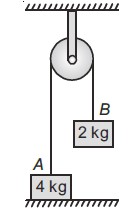
1. 10 N
2. 20 N
3. 30 N
4. 40 N
View Answer
Weight of block = N.
Weight of block = N.
Tension in the string = Weight of = 20 N.
Normal reaction on , Weight of – Tension = N.
In translatory equilibrium
1. The net external force acting on particle is zero
2. The net external force acting on particle is constant (non-zero)
3. Particle is always at rest
4. Velocity of particle changes linearly with time
View Answer
In translational equilibrium the net force acting on the object is zero. so the object moves with constant velocity.
A 1 kg object strikes a wall with velocity \(1\text{ ms}^{-1}\) at an angle of \(60^\circ\) with the wall and reflects at the same angle. If it remains in contact with wall for 0.1 s, then the force exerted on the wall is
1. \(10\sqrt{3}\text{ N}\)
2. \(20\sqrt{3}\text{ N}\)
3. \(30\sqrt{3}\text{ N}\)
4. Zero
View Answer
The angle with the normal is \(90^\circ - 60^\circ = 30^\circ\). The change in momentum perpendicular to the wall is \(\Delta p = 2mv\cos(30^\circ) = 2(1)(1)\left(\frac{\sqrt{3}}{2}\right) = \sqrt{3}\text{ kg m s}^{-1}\). Average force \(F = \frac{\Delta p}{\Delta t} = \frac{\sqrt{3}}{0.1} = 10\sqrt{3}\text{ N}\).
A body is said to be in mechanical equilibrium if
1. The net force on the body is zero
2. The net torque on the body is zero
3. Both net force and net torque on the body is zero
4. The centre of mass of the body is at rest
View Answer
For complete mechanical equilibrium, a body must be in both translational equilibrium (net external force is zero) and rotational equilibrium (net external torque is zero).
Assertion (A): A bird sits on a stretched wire depressing it slightly. The increase in tension of the wire is more than the weight of the bird.
Reason (R): The tension must be more than the weight as it is required to balance weight.
1. (1) Both (A) & (R) are true and the (R) is the correct explanation of the (A)
2. (2) Both (A) & (R) are true but the (R) is not the correct explanation of the (A)
3. (3) (A) is true but (R) is false
4. (4) Both (A) and (R) are false
View Answer
Assertion (A) is true: When a bird sits on a wire, causing it to sag slightly, the vertical components of tension in the two halves of the wire balance the bird's weight. Since the sag is slight, the angle the wire makes with the horizontal is small. To have vertical components sum up to the bird's weight \(W\), the tension \(T\) in each part of the wire must be much larger than \(W/2\) (specifically, if \(theta\) is the angle, \(2Tsin(theta) = W\)). Given \(sin(theta)\) is small, \(T\) must be large, often significantly more than \(W\).nReason (R) is true: As explained, for the small vertical components of tension to balance the bird's weight, the overall tension in the wire must be considerably larger than the weight itself. Reason (R) correctly explains why this phenomenon occurs. Therefore, (A) and (R) are true, and (R) is the correct explanation of (A).