Relative Motion in One Dimension - NEET Physics Questions
← Back to Kinematics

Relative Motion in One Dimension

Question 1: easy

A 100 m long train at 15 m/s overtakes a man running on the platform in the same direction in 10s. How long the train will take to cross the man if he was running in the opposite direction ?

1. 7 s
2. 5 s
3. 3 s
4. 1 s
View Answer

1. Relative Speed (Same Direction):
\[
\text{Speed of Train} = 15 \, \text{m/s}
\]
\[
\text{Time to Overtake} = 10 \, \text{s}
\]
\[
\text{Distance} = \text{Length of Train} = 100 \, \text{m}
\]
\[
\text{Relative Speed} = \frac{\text{Distance}}{\text{Time}} = \frac{100}{10} = 10 \, \text{m/s}
\]
\[
\text{Speed of Man} = 15 - 10 = 5 \, \text{m/s}
\]

2. Relative Speed (Opposite Direction):
\[
\text{Relative Speed} = 15 + 5 = 20 \, \text{m/s}
\]

3. Time to Cross Man (Opposite Direction):
\[
\text{Time} = \frac{\text{Distance}}{\text{Relative Speed}} = \frac{100}{20} = 5 \, \text{s}
\]

Thus, the train will take 5 seconds to cross the man if he is running in the opposite direction.
Question 2: easy

Two cars are moving along a straight line in opposite direction with the same speed 10 m/s. The relative velocity of two cars w.r.t. each other is:

1. 20 m/s
2. 30 m/s
3. zero
4. none of these
View Answer

When objects move in opposite directions relative velocity= v1+ v2= 20 m/s

Question 3: easy

Two objects A and B are moving with speeds 10 m/sĀ  and 20 m/s respectively in the same direction. The relative velocity of A w.r.t. B is

1. 30 m/s
2. 10 m/s
3. - 10 m/s
4. 50 m/s
View Answer

When moving in same direction relative velocity = V 1 -V 2= 10-20 = -10 m/s

Question 4: easy

Two objects A and B are moving with speeds 10 m/s and 20 m/s respectively in the same direction. The relative velocity of B w.r.t. A is

1. 30 m/s
2. 10 m/s
3. - 10 m/s
4. 50 m/s
View Answer

Velocity of A w.r.t B = V A - V B
Velocity of B w.r.t A = V B - V A

Question 5: easy

The relative velocity of two objects A and B is 10 m/s. If the velocity of object A is 40 m/s then the velocity with which B is moving is (assume both objects are moving in same direction)

1. 10 m/s
2. 20 m/s
3. 30 m/s
4. 40 m/s
View Answer

Relative Velocity = V A - V B
10= 40 - V B
V B = 30 m/s

* Is 50 m/s a possible answer ?

Question 6: easy

Two trains A and B are moving in a straight line in the same direction with speeds of 54 km/h and 15 m/s respectively. The relative velocity of one train w.r.t. other is

1. 69 km/hr
2. 69 m/s
3. 39 m/s
4. Zero
View Answer

As, 54 km/hr = 15 m/s both have same velocity in same direction their relative speed/velocity is zero

Question 7: easy

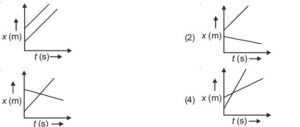
Two objects A and B are moving in same direction with same speed of 20 m/s each then, which of the following position-time graphs correctly represents two moving objects A and B

neet question in 1-d motion

1. 1
2. 2
3. 3
4. 4
View Answer

As both A and B have same velocity their relative speed is zero. so both have same slope in position time graph.

Question 8: easy

A person walks up a stalled escalator in 45 sec. He is carried in 60s, when standing on the same escalator which is now moving. The time he would take to walk up the moving escalator will be :

1. 27 s
2. 72 s
3. 18 s
4. 25.71 s
View Answer

Let the length of the escalator be \(L\). Speed of person is \(v_p = L/45\). Speed of escalator is \(v_e = L/60\). When both move, their effective speed is \(v_{eff} = v_p + v_e = L/45 + L/60 = (4L+3L)/180 = 7L/180\). The time taken \(T = L/v_{eff} = L / (7L/180) = 180/7 \approx 25.71\) s.

Question 9: easy

A body A is thrown up vertically from the ground with velocity \(v_0\) and another body B is simultaneously dropped from a height H. They meet at a height \(H/2\) if \(v_0^2\) is equal to

1. \(2gH\)
2. \(gH\)
3. \((1/4)gH\)
4. \((2g)/H\)
View Answer

Position of B: \(y_B(t) = H - (1/2)gt^2\). Meeting at \(H/2\): \(H/2 = H - (1/2)gt^2 \Rightarrow (1/2)gt^2 = H/2 \Rightarrow t = \sqrt{H/g}\). Position of A: \(y_A(t) = v_0t - (1/2)gt^2\). At meeting: \(H/2 = v_0t - H/2 \Rightarrow H = v_0t\). Substitute \(t\): \(H = v_0 \sqrt{H/g}\). Squaring both sides gives \(H^2 = v_0^2 (H/g) \Rightarrow v_0^2 = gH\).

Question 10: easy

Two trains each of length \(100\text{ m}\) are running on parallel tracks. One overtakes the other in \(20\text{ s}\) when they are moving in the same direction and crosses the other in \(10\text{ s}\) when they move in the opposite directions. The velocities of the two trains are:

1. \(15\text{ m/s}\) & \(5\text{ m/s}\)
2. \(25\text{ m/s}\) & \(15\text{ m/s}\)
3. \(10\text{ m/s}\) & \(10\text{ m/s}\)
4. \(30\text{ m/s}\) & \(10\text{ m/s}\)
View Answer

Let the velocities be \(v_1\) and \(v_2\). Distance to cross is \(100 + 100 = 200\text{ m}\). For same direction: \(v_1 - v_2 = 200/20 = 10\text{ m/s}\). For opposite direction: \(v_1 + v_2 = 200/10 = 20\text{ m/s}\). Solving these gives \(v_1 = 15\text{ m/s}\) and \(v_2 = 5\text{ m/s}\).